Peter Kempthorne's research advisor helped build a volatility formula 6.2 times more efficient than the one most of Wall Street still runs on.
Standard volatility just compares yesterday's close to today's close. It throws out everything else the market showed you that day - the open, the high, the low all get discarded for one number.
Kempthorne's advisor, Michael Klass, and his classroom instructor, Mark Garman, co-authored the fix while Kempthorne was still a grad student at Berkeley - before he was teaching it, he was sitting a few feet from the people building it. Their estimator hit 6.2x efficiency by their own math. A later version pushed that to 8.4.
The Yang-Zhang model used today goes further still.
Here's the part that actually matters for anyone using this stuff: a 6x more efficient estimator means you can replace 20 days of price history with about 7 and land on the same precision.
That's not a rounding improvement - that's a third of the data doing the same job, which matters enormously if you're trying to react to a regime change before your competitors' slower estimators catch up.
But the more interesting failure isn't in the formula - it's in how people misuse it. When Kempthorne's own class ran a modern version through diagnostics, they found a spike in the residual noise sitting at exactly lag 21.
It looked like a signal.
It wasn't.
It was the 21-day window they'd chosen for the estimator, leaking back into their own results.
That's the trap efficiency doesn't fix: a better formula still can't tell you when you're reading the market versus reading your own assumptions back at yourself.
Every volatility model has a window size baked into it somewhere, and that window will eventually show up in your output pretending to be information.
Fold nine-six offsuit heads-up with 2.5 big blinds and you just lost 253 chips. Not by playing the hand badly. By folding it.
An MIT professor graphed the expected value of shoving all-in with that exact hand against every calling range a human opponent could realistically construct. The line never dipped negative. Not against tight players. Not against loose ones. Not even against someone calling with the mathematically optimal range.
Here's the part that breaks people's brains.
Folding nine-six offsuit in that spot loses you the exact same number of chips as voluntarily calling all-in with three-four against pocket aces. One of those decisions feels like patience. The other feels like a death wish. The math says they're identical.
Will Ma teaches this in MIT's Poker Theory course, Lecture 4. He breaks the expected value of a semi-bluff into two pieces: pot size times your probability of getting a fold, plus your probability of getting called times your equity when that happens. Simple enough to write on one line.
Then he maps real hand rankings onto a logarithmic curve — and gets an R-squared of 98%. That's a cleaner regression than most Wall Street quant models ever produce on real market data.
His students sat in that room and learned, with total mathematical certainty, that shoving garbage hands was a guaranteed long-run profit. Most of them still couldn't pull the trigger later that evening when a real tournament put real chips on the line.
Knowing the expected value was never the hard part. Acting on it while every instinct in your body is screaming "this hand is trash" — that's where almost everyone breaks, in poker and in every market that ever existed.
Markowitz won the Nobel in the early 1990s for a machine that most desks quietly refuse to run.
Jake Xia said this at MIT with the optimizer still on the board.
The machine wants three things you do not have: next year’s returns, a true volatility, and a correlation matrix that stays still.
Nudge any input and the “optimal” weights lurch.
The math produces too many answers, so people invent constraints until the software looks decisive.
Then he killed the sacred word.
Volatility is not risk.
A long out-of-the-money call wants the world to shake.
A short call wants silence.
Standard deviation calls both events the same crime.
Sharpe inherits the lie. Sortino splits the tails and still will not tell you the bet size.
Xia’s replacement is uglier and usable.
Expected gain G.
Expected loss L.
Skill is (G − L) / (G + L).
That fraction is a Kelly-style position, not a vanity score.
After that the lecture leaves finance and walks onto the Millennium Bridge.
Pedestrians fall into step.
The bridge begins to sway.
Markets do the same trick: crowding, feedback, power laws, a few super-agents that can turn the whole crowd.
You can print an efficient frontier in color.
The market does not grade the printout.
It grades the size of the next ticket.
@Svenchipo That’s the whole indictment.
If a six-month window can rearrange the book, you weren’t allocating. You were fitting yesterday’s noise and calling it a frontier)
80% of Europe's banks priced systemic risk on a 256-column spreadsheet.
Kenneth Abbott ran Firm Risk Management at Morgan Stanley before he ever stood in front of MIT students. In 1996, spreadsheets meant Lotus 1-2-3, capped at 256 columns, no tabs to split work across. When a bank's book ran too long, Abbott summed the tail across 2 separate spreadsheets, by hand.
His name for it: an abacus but on the screen.
The formula underneath never grows past one line. One position vector, one covariance matrix, multiply x transpose, sigma, x, and an entire portfolio's variance comes out as a single number.
The sign is the part that trips people up. Quote dollar-yen in yen per dollar, hold the yen side of that trade, and a $100 position gets entered as negative 100, because a weakening yen costs that position money, whatever the size says. A bond works the same way: rising yields hit the owner, so that exposure goes in negative too.
Every entry in the vector tracks which way you bleed, not what you hold.
One extra rule cuts Ray Dalio's odds of losing money in a year from 40% to 11%.
Start with one bet. 10% expected return. 10% risk.
Add a second. A third. A fourth. If each new one runs at 60% correlation with the rest, the math barely moves. Stack 1,000 of them at that correlation and total risk falls by roughly 15%, then goes flat.
Drop the correlation to 10%, and the same math turns violent. By the 7th or 8th uncorrelated bet, risk is cut in half. Same return. Half the risk. The return-to-risk ratio just doubled.
Dalio's answer: stop hunting for one great investment. Hunt for 15 to 20 decent ones that refuse to move together.
No single investment beats another by 5x. Nobody is skilled enough to pick one that far ahead of the market. Structure gets you there instead.
Run 15 to 20 genuinely uncorrelated bets and the return-to-risk ratio reaches 1.25. The odds of losing money in any year drop from 40% for one bet to 11% for the portfolio.
You don't need a better bet. You need bets that don't agree.
Stan Druckenmiller didn't know how to spell Nvidia 3 months before he bought it.
He ran Duquesne Capital for 29 years, 1981 to 2010, without a single down year. Near 30% annualized.
His edge was never the technology. It was noticing where smart people were already going.
In 2008, he bought Palantir for one reason: it was the company every ambitious kid at Stanford wanted to join. He watched where the talent flowed, then bought the destination.
Early 2022, his young analysts noticed a shift on campus. Stanford students were leaving crypto for AI.
He didn't understand the technology behind it. He trusted the signal anyway.
His partner brought in his own AI contacts from Palo Alto to explain it. Most of it went over Druckenmiller's head. He asked one question: what do I buy.
The answer was Nvidia. He bought enough to feel it - enough to hurt if he was wrong.
2 weeks later, ChatGPT launched. Nobody at the table had mentioned it. He doubled the position.
At a Morgan Stanley macro roundtable, the strategists gave their calls on rates and currencies. A tech analyst cut in: you're all missing something bigger than anything on this table.
Druckenmiller doubled again.
The stock ran from 150 to 390 in 5 months. He told an interviewer he couldn't picture selling for another 2 or 3 years.
The person who understood the technology best, the one who knew 50 times more about AI than he did, sold his own Nvidia within weeks.
Druckenmiller held.
The stock hit 800. He broke his own promise and sold.
5 weeks later, it hit 1,400. He called the feeling sick.
To this day, he says, he couldn't tell you what the company earned that year.
He never learned to spell it. He still made 6 times his money.
Edward Thorp turned $1.4 million into $273 million after learning the same lesson at a blackjack table.
He was a mathematician first. In the 1960s he used an early computer to prove the casino could be beaten if you counted cards, sized bets, and never broke discipline. Las Vegas answered with heat and ban lists.
He took the lesson to New York.
Wall Street, he told Kitco in 2017, is the greatest casino on earth. The tables are prettier. The rake is hidden in 401(k) menus, fund expenses, trading costs, and taxes. The house still wins if you play without an edge.
He opened a hedge fund in the late 1960s with $1.4 million. Eighteen years later it held $273 million. Over three decades the operation threw off about $800 million in profits. The method was not a hot tip. It was models, costs, and the refusal to bet when the math was thin.
For everyone else he offered a smaller, colder edge.
Buy the whole market.
Pay about 0.2% in fees and another sliver in trading drag.
Do not trade for entertainment.
Do not let a salesman clip another 1–2% a year from an IRA that is supposed to compound.
Gold, he said, has tracked inflation for 800 years. That is not a disaster. It is also not a growth engine. Stocks and bonds beat it over long stretches.
Gambling is investing simplified. If you have a winning system, the casino is training. If you do not, you are the system.
The clip is five minutes. Almost nobody finishes it.
@the_no_mind The public speaking example is what makes this land a week of writing one sentence for 10 minutes a day, and a genuine fear was gone. That's a pretty testable claim, not just vague self-help talk
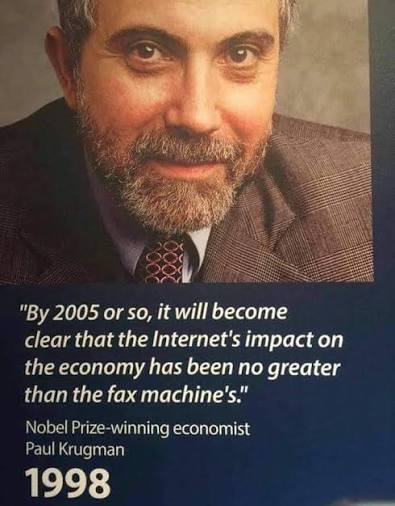
Paul Krugman wrote in 1998 that the internet's economic impact would be no greater than the fax machine's. You read that correctly. The man who won a Nobel Prize in 2008 and spent the following decade lecturing you about stimulus spending predicted that a technology reshaping every sector of human commerce was basically a novelty.
This matters beyond the embarrassment.
Krugman's error flowed directly from his methodology. Central planners and their academic allies consistently underestimate decentralized, emergent systems because those systems don't fit their models. Prices aggregate dispersed knowledge that no single mind holds. The internet turbo-charged exactly that process. By 2026, e-commerce alone exceeds $6 trillion annually in global sales. Amazon, founded in 1994, turned Krugman's fax-machine comparison into a punchline worth roughly $2 trillion in market capitalization.
Voluntary exchange, entrepreneurial discovery, and the profit-loss system direct resources toward genuine human needs.
Krugman kept writing columns. He championed the 2009 stimulus, called for even more spending, and watched inflation hit 9.1% in June 2022 while insisting it was transitory, while it very clearly wasn't. The internet prediction wasn't a one-off stumble. It revealed a man who trusts institutions over markets, models over reality, and his own prestige over the evidence.
"The machines are doing shitty this year. I'm kicking their ass."
David Tepper, founder of Appaloosa Management.
David Tepper explains:
"The machines are doing shitty this year. Really bad. I'm kicking their ass."
"When I went to Goldman, they had a trading model on the desk, and it was just wrong. I knew the option part was wrong."
"The machines are only as good as the people programming the machines."
"When times are changing — higher rates, out of the QE environment — people are continuously programming the same damn thing."
"They'll be less emotional than people, but when the times change, they don't change unless somebody reprograms them."
"When times change fast, that doesn't work."
"When you have a guy like Trump, you better know how to deal with people and how different emotions work."