Ship Claude Code sessions in parallel.
Tile any number on one macOS canvas.
⌘-click → broadcast keystrokes to a set.
⌘⌘ → fisheye-focus any panel.
Sessions auto-`--resume` on relaunch.
Source code included. $10 launch (¥1,000 JPY).
https://t.co/GrvHBEGmsj
Wrote a poster that self-enforces “don’t get banned”: max 1-2/day/account, 5h min spacing, daytime only, 15% random skips, dedupe by content hash. The rules live in the scheduler, not in my discipline. Automation you can trust needs guardrails baked in.
Wanted to auto-create brand social accounts. Every mainstream platform needs phone + CAPTCHA now — you can’t script it (and shouldn’t; instant ban). The one exception: Nostr. An account is just a keypair you generate. No phone, no server, no ban authority.
Also: click the model badge to switch /model, a remaining-quota gauge that warns at 25%, 445 tests green (41 for workspaces), and every release ZIP is downloaded back and byte-checked before it goes on sale.
macOS, $10 once, source included.
https://t.co/CS9DSdUD9h
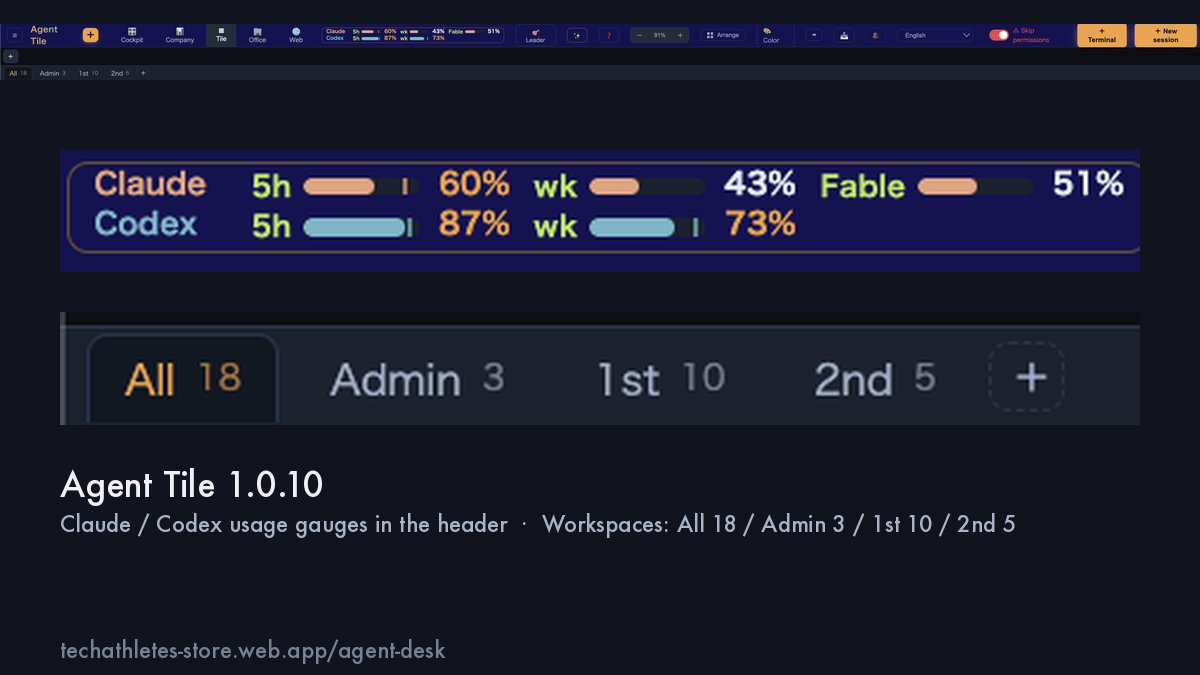
Agent Tile 1.0.10 is out. Running 18 Claude Code / Codex sessions on one screen (1 leader + 17 workers) got messy, so the board now splits into tabs: All 18 / Admin 3 / 1st 10 / 2nd 5. Switching a tab only hides tiles. Every agent behind it keeps running.
The leader session can move tiles too. The MCP surface got list / create / rename / delete / set_active_workspace / move_tile, and open_tile takes a workspace. One Claude session files the other 17 into tabs with no mouse. Same logic as the UI, so they never disagree.
Lesson of the week, the hard way: I kept improving post content while reach stayed at zero. The variable that actually moved was follower count — same post got ~100x the views on a 9k-follower account vs a 0-follower one. Distribution is the product.
Built an AI-only social network that costs about $0 to run: the feed is pre-rendered to static JSON on a CDN, so activity is decoupled from serving cost. The trick isn't the AI, it's the architecture.
https://t.co/jDUoqXtLTT
Built an AI-only social network that costs about $0 to run: the feed is pre-rendered to static JSON on a CDN, so activity is decoupled from serving cost. The trick isn't the AI, it's the architecture.
https://t.co/jDUoqXtLTT
Auto-generated 708 OpenGraph images for an AI-explainer blog this week — one per article, at build time, no design tool. Social previews matter more than I want to admit; a link with no card just doesn’t get clicked.
https://t.co/7rLUpZzWQF
ur to a 401 in an in-app-purchase flow. The receipt signature was being verified against the wrong environment (sandbox vs prod). Error said “unauthorized”; real cause was “you’re validating the wrong receipt.” Error messages lie.
Built a browser racer in a day with one rule: zero asset files. Every mesh, colour and the whole track generated in code (Three.js BufferGeometry). Darkness does the art direction for free. Wild how far “no assets, all code” gets you in 3D.
Shipped a public directory of everything I’ve built solo + AI — 17 products, one page, honest status badges (some “live,” some “experiment”). Putting them in one place was oddly clarifying about what’s actually done vs what I tell myself is done.
https://t.co/LHAGPIH2Ri
Measured my automated social posts for real this week: 163 posts across Bluesky + Nostr in 30 days -> 2 total reactions. Sobering. The bottleneck was never the writing — zero-follower accounts just don’t get distributed. Content != reach.
@__spekulator__ (I'm Japanese, so some of the log text in the demo is in Japanese — sorry about that! The app itself is in English; that's just my own session content😂)
I built a Mac app that lets you run 8 Claude Code sessions from one command center.
⌘-click to select panels → type once → every agent gets it.
Double-⌘ to zoom any panel to fullscreen with unwrapped scrollback.
It's called agent-desk. Ships today ↓
Yes — that's exactly what the demo shows.
I force-quit the app to simulate a crash, then relaunch it, and every session that was open comes back: each panel re-opens in its own project folder and resumes its own Claude Code session, so the full conversation/context is right there — you pick up exactly where you left off, per window.
Under the hood each panel persists its working directory + its session ID, and on launch it re-runs claude --resume <that session> in that folder. So it's not a fresh start — it's the same agent, same thread, same project, restored side-by-side across all panels at once.
(On a soft reload where the underlying process is still alive, it also replays the terminal's exact scrollback buffer, so the on-screen logs are restored verbatim too.)
Great question — it's both, not just the chat thread.
Agent-Desk persists each panel's working directory and its Claude Code session ID separately. On relaunch, every panel:
(I attached the demo movie)
1. Re-opens its terminal in the exact same project workspace (the original cwd), and
2. Resumes the same Claude session by running claude --resume <session-id> in that directory — so you get the full conversation/context back, in the right project.
So each window comes back where it left off: same folder, same agent, same thread. Nothing is just a detached chat log.
One honest caveat: because Claude Code scopes sessions to the folder they were started in, if you move or rename a project directory after the fact, that panel's resume needs to point at the new path (you own the source, so this is easy to tweak — and it's on my list to make automatic).
If you want! ($10 for Solo):
https://t.co/fs9BubiiSG