China continues to cushion the global oil market, with imports May-to-date plunging significantly below even the depressed levels seen in April.
At the current pace, Chinese crude oil imports are set to hit a 10-year low in May. On a four-week average, Chinese crude/condesate imports are running >4 million b/d BELOW pre-war levels.
The UAE tried to persuade Saudi Arabia and Qatar to take part in a coordinated military response to Iran’s airstrikes and was left frustrated when they refused, sources say https://t.co/qzcVTrf2Ly
Israail government wants to ensure that UAE president MbZ, gets so damaged by his intimate Israeli engagement that he can’t cut a deal with Iran or play any role in GCC, independent of Israel. Having known MbZ I find this depressing.
Financial Times has reported that Saudi Arabia has offered Iran a Middle Eastern non aggression pact.
Israel wanted to use the Gulf, led by Saudi Arabia, to fight Iran. But Saudi Arabia has instead used the war to ward off pressure to sign the Abraham Accords and is now trying to strike a deal with a weakened Iran.
If this materializes, not only would Saudi defense procurement from US would plummet rapidly, but it is hard to see how US military presence in the Kingdom, whose stated aim is to defend KSA against Iran and its proxies, would remain in place.
Moreover, this would be a death knell to the surging UAE Israel defense partnership against Iran. If KSA strikes a deal with Iran, the GCC will bandwagon. And if UAE-Israel ties spoil that deal, we could see a blockade of the UAE similar to the Qatar blockade in 2017.
The question is how and how hard the US and Israel will try to spoil it. This clearly does not suit the US military industrial complex, but it is even more antithetical to Israeli strategy of fragmentation in the Middle East, some call it the Yinon Plan. The Israelis will most certainly go berserk.
BREAKING: Following the controversy surrounding Prime Minister Netanyahu’s confirmed secret visit to the UAE, it can now be revealed that not only the PM, the Mossad chief and the Shin Bet director visited the Gulf state during the war — but also IDF Chief of Staff Lt. Gen. Eyal Zamir. @YehoshuaYosi
BREAKING: UAE discloses it’s building an additional second pipeline bypassing the Strait of Hormuz.
The new pipeline will be finished in 2027 and will double the country’s export capacity in Fujairah (the current pipeline has a capacity of 1.5-1.8m b/d)
Si el debate público acaba teniendo un coste personal, solo incentiva dos cosas:
1. El anonimato en la red (que siempre me ha parecido un problema).
2. La bunkerización y el ojo por ojo.
Quienes han buscado esto me temo que han conseguido una victoria pírrica.
The German media are reporting that €10bn of the recovery fund money earmarked for Spain ended up in the country’s pension system. This is how the good idea of a eurobond gets killed. Mistrust is not only present. It is justified. This example also goes to show that a eurobond can only work as a sovereign debt instrument of a unified state. If you really care about a eurobond to fortify a capital markets union and the euro as a global currency, you should talk about political union first. Don’t make this a technical discussion.
https://t.co/xhrTyJS1Hq
My "theory of everything" paper is out with Harvard @BelferCenter@MiddleEast_HKS
Don’t split the Mideast into resource-rich Gulf & population-rich states elsewhere: they all run on rents
The real divide: the form of rent & whether it's enough
1/5
https://t.co/ACvrrIRslq
Oil Majors Hit the Brakes on Clean Spend
Oil supermajors led the retrenchment in transition-related investment in 2025. Their combined low-carbon spend fell 65% to $8.3 billion, the lowest since 2019. All seven firms reduced spending, marking the first such occurrence in BNEF’s tracking as far back as 2015.
Los marroquíes son ya la primera comunidad extranjera en #Israel, con 190.607 residentes, por delante de ucranianos (151.855) y rusos (126.688), según la Orgnización Internacional de Migraciones. Este dato ilustra la relación cada vez más estrecha entre Marruecos y el Estado hebreo.
https://t.co/zIhD6tqQle
Gulf states plunking down $17bn to buy ~4,200 Patriots, which is equal to America's entire annual production of the missiles for the next seven years, does not suggest a high degree of confidence that the war is going to end with lasting calm in the region https://t.co/xzkz70nl9x
The real story of UAE–Israel normalisation is no longer trade, tech or optics. It is war. Iran’s attacks pushed a quieter security relationship into the open — and revealed both the promise and peril of a new regional alignment. My latest for @RUSI_org
But can a visible Israel–UAE axis become a regional model — or is it already the limit of it?
For the UAE, Israel offers advanced capabilities, intelligence value and a stronger deterrent posture against Iran. Yet neither side can escape the political costs of making that relationship more visible. The more public the alignment becomes, the harder it will be to present it as merely pragmatic, technical or defensive. It will increasingly be judged for what it represents: not just cooperation, but a particular vision of regional order. Link below 👇
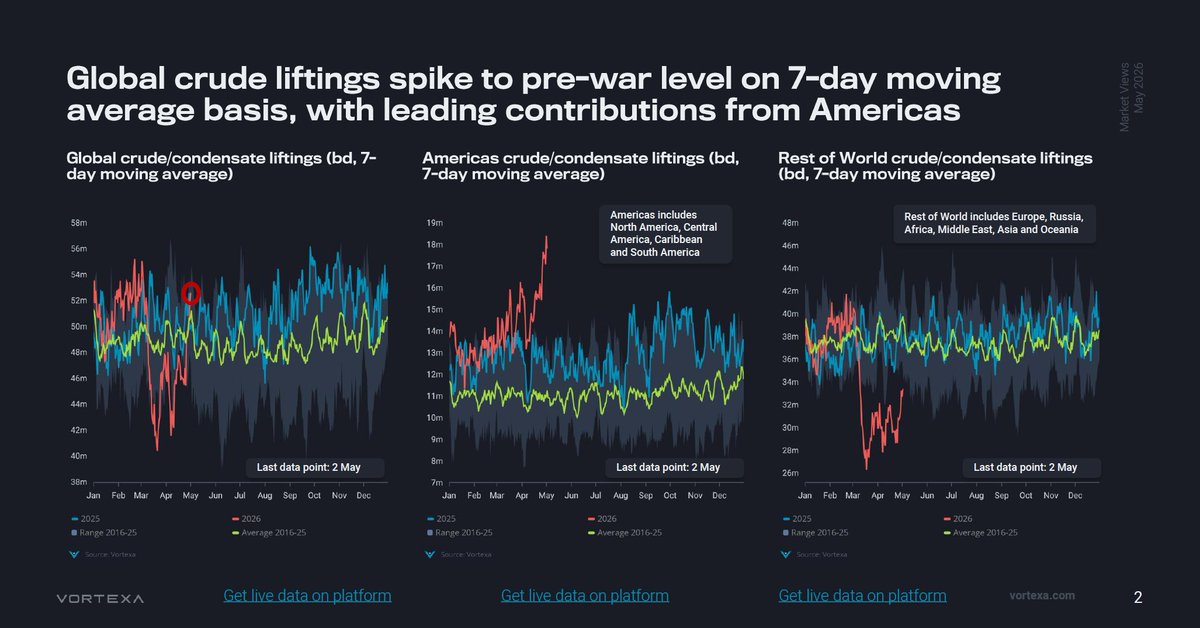
CHART OF THE DAY: Impressive chart via @Vortexa.
On a 7-day moving average, global oil liftings (into tankers) have **recovered to their pre-war level** due to a surge in liftings in the Americas.
(Of course, that's helped by massive stock drawdonws / SPR use, but still...)
In our fourth paper, @g_escribano, Ana Fontoura Gouveia @IUrbasos & João Fachada examined the policy response to the energy crisis in the Iberian Peninsula, where renewables and few interconnections with the rest of Europe mitigated the worst impacts. (10) https://t.co/38gn9bRmMb
Great graph. Loadings at Yanbu are a lot lower than expected (and advertised). Despite the Saudi’s efforts, this is probably due to a mix of reasons like:
>2-2.05m bpd of nameplate refinery capacity (Jizan, Rabigh, YASREF, SAMREF, & the Yanbu refinery)
>downstream slippage of exports from attacks which reduced 700kbpd temporarily
>Terminal export inefficiency (port congestion, berthing delays)
>Lower than reported pipeline utilization.
It’s also worth remembering the East-West crude pipeline only has a capacity for 5 million bpd. The extra 2 million bpd comes from the parallel NGL pipeline.
The Saudi’s transferred it over to crude very quickly so there could be lingering logistical constraints, delays, and inefficiencies there that haven’t been widely reported yet.
Loadings in Fujairah have also decreased significantly, so who knows what going on behind the scenes and what isn’t be told or released out to the public. #tankers #oott