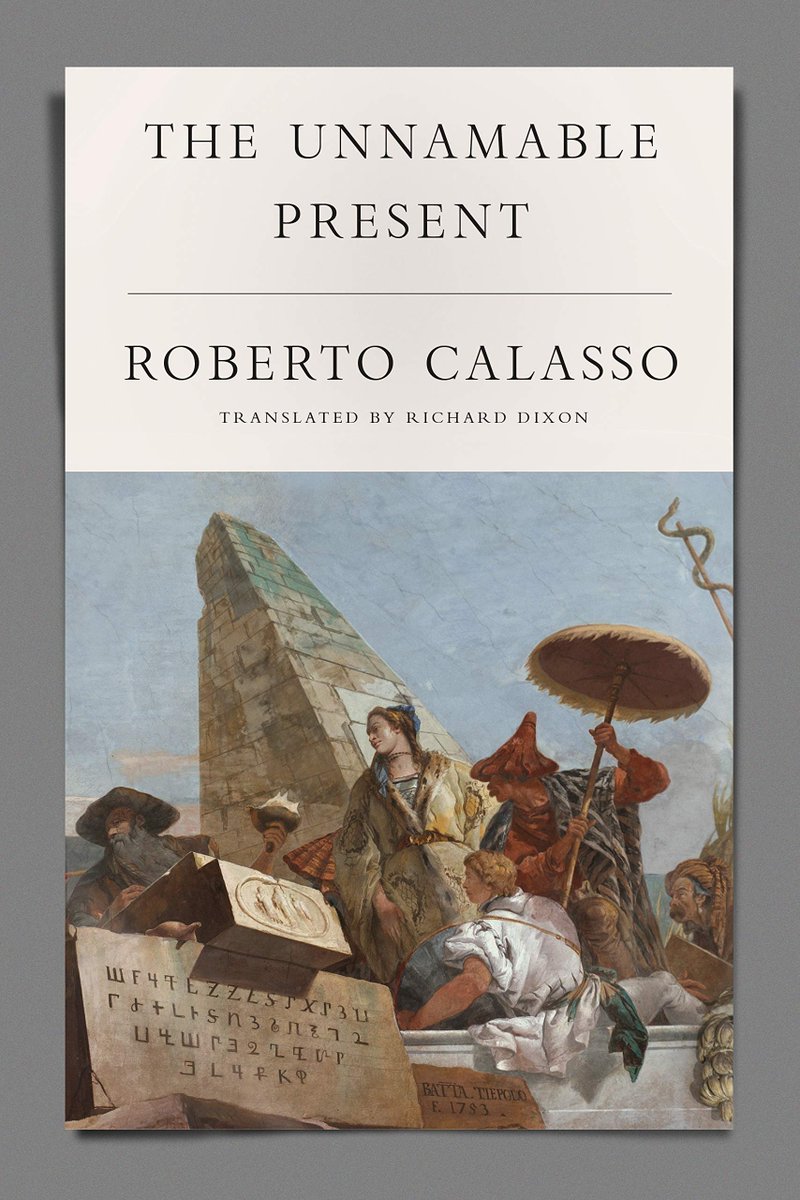
The Unnamable Present
2017 book by Roberto Calasso
The Unnamable Present is a meditation by Roberto Calasso on the re-emergence of nationalism and totalitarianism in global politics and culture in the context of an artificially intelligent contemporary world-system. @grok
In a talk at the Zurich Project, investor Chris Bloomstran highlighted hyperscalers like Amazon, Microsoft, Alphabet, and Meta spending $400 billion last year on AI data centers and chips, with projections hitting $750 billion this year and up to $7 trillion by 2030. He pointed
to off-balance-sheet debt through SPVs totaling $650 billion, circular financing loops like Nvidia's investments in OpenAI, and fast GPU depreciation that could understated expenses by $176 billion through 2028. While defenders cite high demand and strong returns on rented
And this concern wages out a persistent battle against our being so that we do not have the chance to build strong bonds of kinship with the deeper essence of our existence. Each one of us begins with the name N o b o d y.
(2)
#philosophy Gemma
by Dimitris Liantinis (Author)
We start off our lives insubstantial, untested, non-existent, anonymous. Our starting points lie within the ontological oblivion, and inside the opaque fog of concern.
(1)
"AI will form a new paradigm of warfare. It's already actively doing so," Danylo Tsvok, the head of the defence ministry's AI centre, told Reuters.
He predicted AI systems would eventually be unified into a single network overseeing the battlefield,
https://t.co/5IZRb6sWCI
Today's AI has read everything humans have ever written, including the theory of relativity. So when it explains relativity back to you, it's repeating an answer that already exists.
That's not intelligence.
The smartest man in AI just exposed the whole AGI narrative as a LIE.
And he used a physics problem from 1905 to prove it.
His name is Demis Hassabis. He runs Google DeepMind, and won the Nobel Prize for using AI to crack a problem in biology that had stumped scientists for 50 years.
Almost nobody in this industry has a track record like his.
He went on the NothingButTech podcast and called out the biggest lie in AI right now:
Right now the loudest voices in AI are telling you that AGI is basically here. OpenAI has literally defined AGI as a system that can outperform humans at most "economically valuable work." In other words, if it replaces enough jobs, we have arrived.
Hassabis thinks that bar is a joke.
He said real general intelligence has to do what the human brain can do, because the brain is the only proof we have that this kind of intelligence is even possible. He called that "a higher bar than just being able to do some useful economic work," which is about as close as a polite British Nobel laureate gets to calling his rivals out.
Then he gave the actual test:
Today's AI has read everything humans have ever written, including the theory of relativity. So when it explains relativity back to you, it's repeating an answer that already exists.
That's not intelligence.
So Hassabis proposed a test that makes memorization impossible. Train an AI on only what humanity knew in 1901, four years BEFORE Einstein published relativity. Then ask it to come up with relativity on its own.
It can't look up the answer, because in 1901 the answer doesn't exist yet. The only way to pass is to do what Einstein actually did: Take the same physics everyone else had and reason its way to an idea no human had ever had.
Hassabis says not a single AI today can, no matter how much it has memorized. Which means what we keep calling "almost AGI" is really just the best librarian in history.
It can find any answer that already exists but it cannot create one that doesn't.
His second version is even sharper:
AlphaGo, the system his own team built, famously invented a brand new move that no human had played in 2,000 years of the game.
Everyone called it genius but Hassabis says that still is not the bar.
The real test is not whether an AI can invent a new move inside Go, it is whether an AI could INVENT a game as deep and as beautiful as Go in the first place.
No model that exists today can do it.
The people telling you AGI has already arrived are the same people raising hundreds of billions of dollars on that exact promise.
The valuations only work if the finish line is right in front of us. So the finish line keeps getting dragged closer, and AGI keeps getting quietly redefined down to "does useful work," until the products they already sell happen to qualify.
Hassabis has nothing to prove and nothing to sell you. He already won the Nobel, and he is telling you the machines still cannot do the one thing that would make them genuinely intelligent, which is have a truly original idea.
To be fair to him, he is not a pessimist about it. He believes real AGI IS coming, and he is spending his life building it. He just refuses to pretend it is already sitting in your phone.
So the next time a founder tells you AGI is months away, remember that the one man in the room with a Nobel Prize built his test around Einstein, and admitted that nothing we have made can pass it.
What do you think?
»As for athletics in general, I do not know what its fate will be, but I wish to draw your attention to the important fact that it presents two new features (…). It is democratic and international...
-- Pierre de Coubertin #sports
https://t.co/pm0os3EJfP
Now, 25 politicians from Labour, the Lib Dems, Green Party and Plaid Cymru have signed a motion, external in parliament, calling on international sporting bodies to consider expelling the US from major international competitions including the World Cup #WorldCup2025 BBC #sports
The practical application of this distinction is called domination.”
(Sloterdijk: “Not Saved. Essays after Heidegger”, German edition 2001, English 2017, translated by Ian Alexander Moore and Christopher Turner.)
New Philosophical Schools of Thought
What is crucial is that with the idea of really existing memories and self-organizing systems the metaphysical distinction between nature and culture becomes untenable, because both sides of the difference only present regional states of
As we have seen, they divide beings into subjective and objective and set that which pertains to the soul, the ego, and the human off to one side and that which pertains to things, that which is mechanical, and that which is non-human off to the other.