Here’s is my full quote on Rwanda’s nuclear energy agenda, it was unfortunately chopped up to fit the writer’s storyline:
“Rwanda is working with a variety of global partners to develop our civil nuclear capabilities. In addition to Russian company Rosatom, a world leader in construction of nuclear power plants, last week at the Nuclear Energy Innovation Summit in Kigali, Rwanda signed an MoUs with the US Government, to advance civil nuclear cooperation between the two countries, as well as other agreements between Rwanda’s Atomic Energy Board and companies from the United States, South Africa and Austria.
In Rwanda, feasibility studies for both the construction of a facility using SMR technology and establishing the Centre for Nuclear Science and Technology are ongoing. Historically, these kinds of projects have been financed by governments, but more recently multilateral development banks have started discussions around financing frameworks to expand access for emerging economies embarking on nuclear energy development.”
Speaking at the @NEISAfrica Ministerial Compact Roundtable on financing Africa’s nuclear future, here are a few takeaways from the remarks by our Deputy CEO, Louise Kanyonga:
----------
1. Africa’s energy ambitions cannot rely solely on concessional financing and external funding. Sustainable energy transformation will require strong participation from African institutional investors.
2. Local institutional capital must play a central role in financing Africa’s energy future. Pension funds, insurance companies, and other long-term capital institutions have a responsibility to step into this space.
3. RSSB sees itself as a catalytic investor capable of:
- De-risking emerging sectors
- Validating investment opportunities
4. African institutional investors must move beyond traditional comfort zones and develop the capacity to understand and invest in emerging energy asset classes.
5. Building technical and regulatory capacity across African markets will be essential to unlock institutional investment into innovative energy sectors.
6. The future of scalable and sustainable energy financing in Africa depends on African institutions taking a central role in capital deployment rather than relying primarily on external actors.
The Holtec SMR-300 deployment in Rwanda is the more important detail than the MOU itself. SMR-300 is a 300 MW pressurized water reactor being licensed in the US right now. Putting one in Rwanda lets Holtec accelerate manufacturing scale and gives African industrial buildout dispatchable baseload that beats diesel and intermittent solar on cost. This is how SMR exports actually start.
Key discussions are being put forward on financing, energy security, and Africa’s pathway from nuclear ambition to implementation, highlighting the critical role of regional cooperation, alongside diplomatic and investment engagement.
#NEISA2026
Happening Now:
The NEISA Diplomatic & International Organisations Briefing is underway — bringing together partners shaping the future of nuclear energy in Africa.
As preparations build toward NEISA 2026 (18–21 May), discussions are focused on one priority:
“Powering Africa’s Future: Turning Nuclear Energy Ambition into Investable Reality.”
#NEISA2026
We are honored to welcome William D. Magwood, IV, Director General of the OECD Nuclear Energy Agency, to the Nuclear Energy Innovation Summit for Africa.
His work leading international collaboration on nuclear energy policy and innovation will add valuable perspective to discussions on Africa’s sustainable energy future.
Learn more: https://t.co/rcX4F3HGxn
We are honored to welcome Dr. Sama Bilbao y León, Director General of the World Nuclear Association, to the summit.
Her leadership in advancing nuclear energy as a cornerstone of secure and investable clean energy systems brings an important perspective to conversations on Africa’s energy future.
Learn more: https://t.co/rcX4F3HGxn
We are honored to welcome Rafael Mariano Grossi, Director General of the International Atomic Energy Agency, to the summit.
His leadership at the forefront of global nuclear governance brings a critical perspective to conversations on energy and international cooperation.
Learn more: https://t.co/rcX4F3HGxn
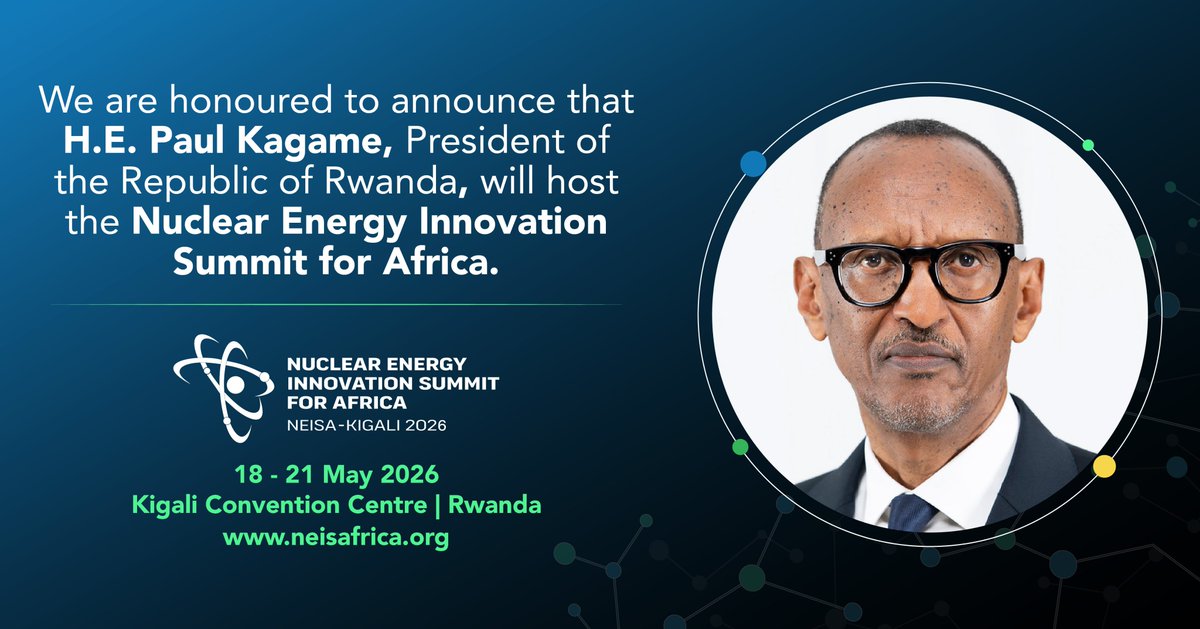
We are pleased to announce that H.E. Paul Kagame, President of the Republic of Rwanda, will host the Nuclear Energy Innovation Summit for Africa in Kigali.
The Summit will be held from 18–21 May 2026 at the Kigali Convention Centre, Rwanda, under the theme:
“Powering Africa’s Future: Turning Nuclear Energy Ambition into Investable Reality.”
Learn more: https://t.co/e5dLHOT8hk
Africa’s leading Nuclear Energy Innovation Summit returns to Kigali this May, shifting the continent’s nuclear energy conversation from policy debate to real project delivery.
#NEISA2026 will spotlight practical implementation pathways, innovative investment models, and the institutional readiness required to translate ambition into action.
📆 18–21 May 2026
📍 Kigali, Rwanda
🌐 https://t.co/OJOkERXWLu
📩 By invitation and application
#NEISA2026
#CleanEnergy
We thank Chairman Smith and the Committee for their attention to this important matter. Rwanda’s position is simple: our national security is non-negotiable. After decades of cross-border genocidal threats from FDLR and allied militias, defensive measures are about protecting lives not politics. Peace must be built on real security.
Full statement for the record by @AmbMukantabana : https://t.co/hsdUskrsXc
What Belgium regrets is their inability to bring Rwanda into submission, despite countless threats and sanctions.
This is not the result of a disagreement, it is the consequences of decades of protecting genocidaires, promoting genocide deniers to political position, constant diplomatic sabotage, all in the continuous quest to return Rwanda to 30 years ago.
It is not dialogue you seek, it is obedience. The kind you are getting from DRC, whose people you claim to speak for, while exploiting them for the last century.
In the words of President Kagame:
We ask you: “Who are you? Who put you in charge of us? With the limited means we have, we will stand up to you. After all these years we have spent fighting to build our country, we want to be Rwandans, we do not want to be Belgians.”
“Today’s decision reflects Rwanda’s commitment to safeguarding our national interests and the dignity of Rwandans, as well as upholding the principles of sovereignty, peace, and mutual respect.” 🇷🇼🇷🇼🇷🇼
“Aid creates dependency. Whoever gives you aid, controls your life. In fact, that is why they want you to stay with aid, so they continue controlling your life. They use it as a tool to direct you where they want you to go. They keep threatening: if you don’t do this, we will switch it off. It is [politically] weaponized.” President Kagame
In the last month, Rwanda has shown you:
🔹The FDLR
🔹The European Mercenaries
🔹The offensive foreign forces
🔹The stockpiles of weaponry at our border.
Yet the world still downplays the gravity of the security threats we face. Why? Is it racism? Is it disdain? Is it a calculated geopolitical choice?
The only irrefutable proof left of the danger we face is our destruction. And it seems this is an acceptable outcome for many international actors. They will swoop in with something as truly useless as MONUSCO or another UNAMIR, then spend the next 20 years giving our people biscuits and cardboard.
One thing is certain: The Government of Rwanda will protect its people and everyone who lives here—resolutely and decisively. The question is not whether Rwanda will defend itself, but what must happen to prevent further escalation.
The answer is obvious. The root of this crisis lies in the DRC’s continued collusion with genocidal forces and its deliberate fueling of regional instability.
International actors must demand an immediate end to Kinshasa’s support for FDLR and associated extremist elements. The presence of offensive foreign forces in the region, operating under the guise of ‘peacekeeping,’ must be removed. Permanent security guarantees must also be established along our shared border.
Regarding the inter-Congolese conflict, dialogue between the DRC government and M23 is not only the most pragmatic approach but the only one that offers the prospect of lasting peace.
Anything short of this is a meaningless delay, a refusal to confront reality, and a failure to learn from history.
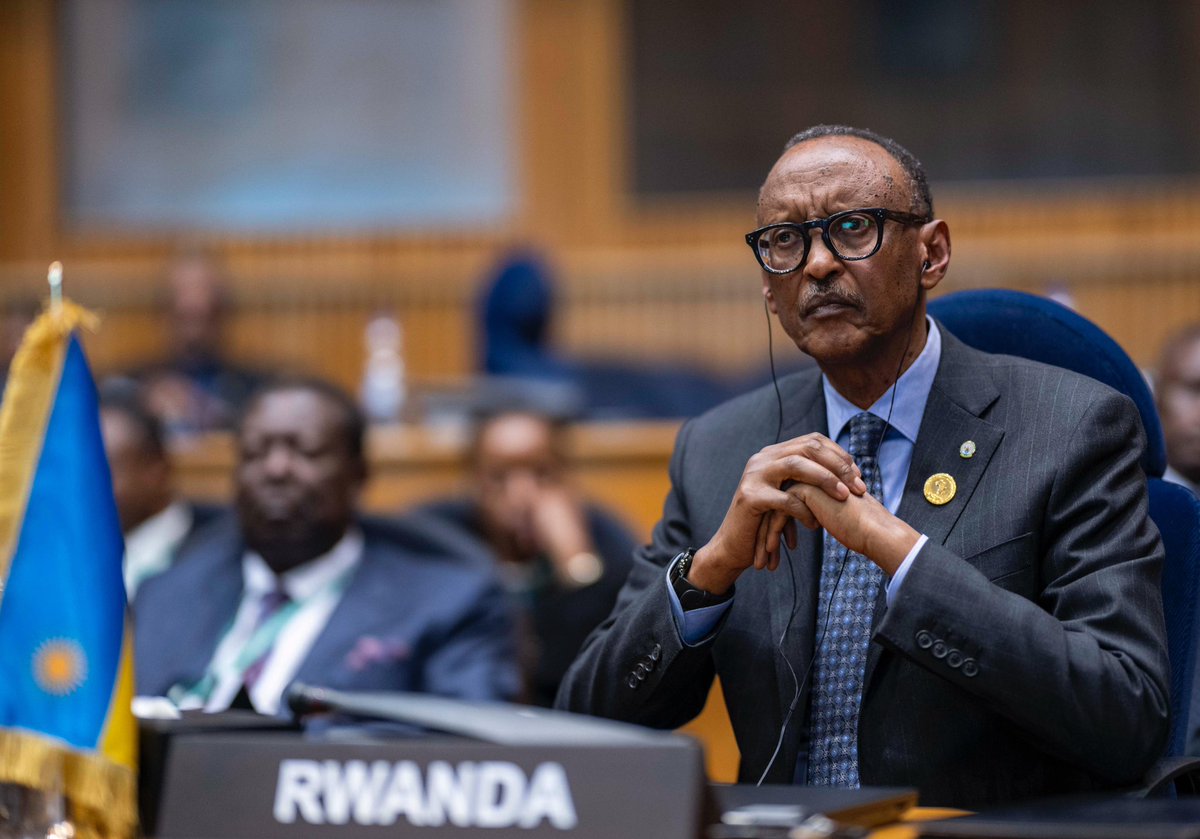
“If the blame game, nice speeches, lies, being shameless, were the solution to this problem, it would have ended long ago. We wouldn’t have this problem. We have people who tell lies without any reason.
How can FDLR not exist in the minds of some people? Or why is it something that is supposed to be trivialized? When you trivialize that; you trivialize my history and I am not going to accept it. It doesn’t matter who you are.
I am not seeking any favor from anybody in this room to be given permission for me to live or for my people to live? Absolutely not. I will live by the fact that it is my right. Just that.
So, when I am listening to some people saying these things; when does Congo take responsibility for its own mess? How does Congo think all their problems come from outside, and therefore they outsource solutions for their problems? Rwanda has nothing to do with Congo’s problems. We have our own problems to deal with. Congo is too big for Rwanda to carry on its back.
As I told you, we are a small country, we are a poor country, but when it comes to the right to live, don’t you be mistaken. I am not begging, I will not beg anyone.” President Kagame | AU Peace and Security Council Meeting on the security situation in Eastern DRC.
Rwanda’s real crime is taking our destiny into our own hands. How dare we protect our security without asking for permission? How dare we think that a dignified, peaceful country is something we deserve?
What is encouraged is the kind of leadership that abdicates any responsibility for its own people, calls on everyone else but themselves to solve their problems and shamelessly sells its dignity to the highest bidder.
An army unpaid, hundreds of mercenaries (rebranded as paramilitaries), genocidaires and soldiers from 4 different countries killing DRC citizens, a President that openly calls for the overthrow of Rwanda’s government, ministers calling for ethnic cleansing, looting of national resources at an unprecedented scale…and somehow not ONE call for DRC’s accountability.
Rwanda is blamed for DRC’s failure of governance, evident on the ENTIRETY of the territory of the 2nd largest country on the continent, not because it is true, but because our quest for self determination is unacceptable.