@Poulin2012 Le discours de vérité sur la situation financière du pays cependant il refuse de justifier les notes de frais des sénateurs : deux poids, deux mesures (en même temps notre système de mesure de poids actuel n'est plus adapté au baron Harkonnen...)
@PhilConte007 Je note qu'à Science Po on doit aussi préciser que deux = 2 ... déjà là j'étais perdu, alors bonne chance à eux future élite de la Nation !
@LeParisien_75 On a bien enregistré le schéma : affaire puante, on laisse couler pendant quelques années ("oulala la justice est surchargée") et doucement on classe le tout... enfin, ça dépend pour qui.
Y'en a qui prennent plus en comparution immédiate pour un sandwich.
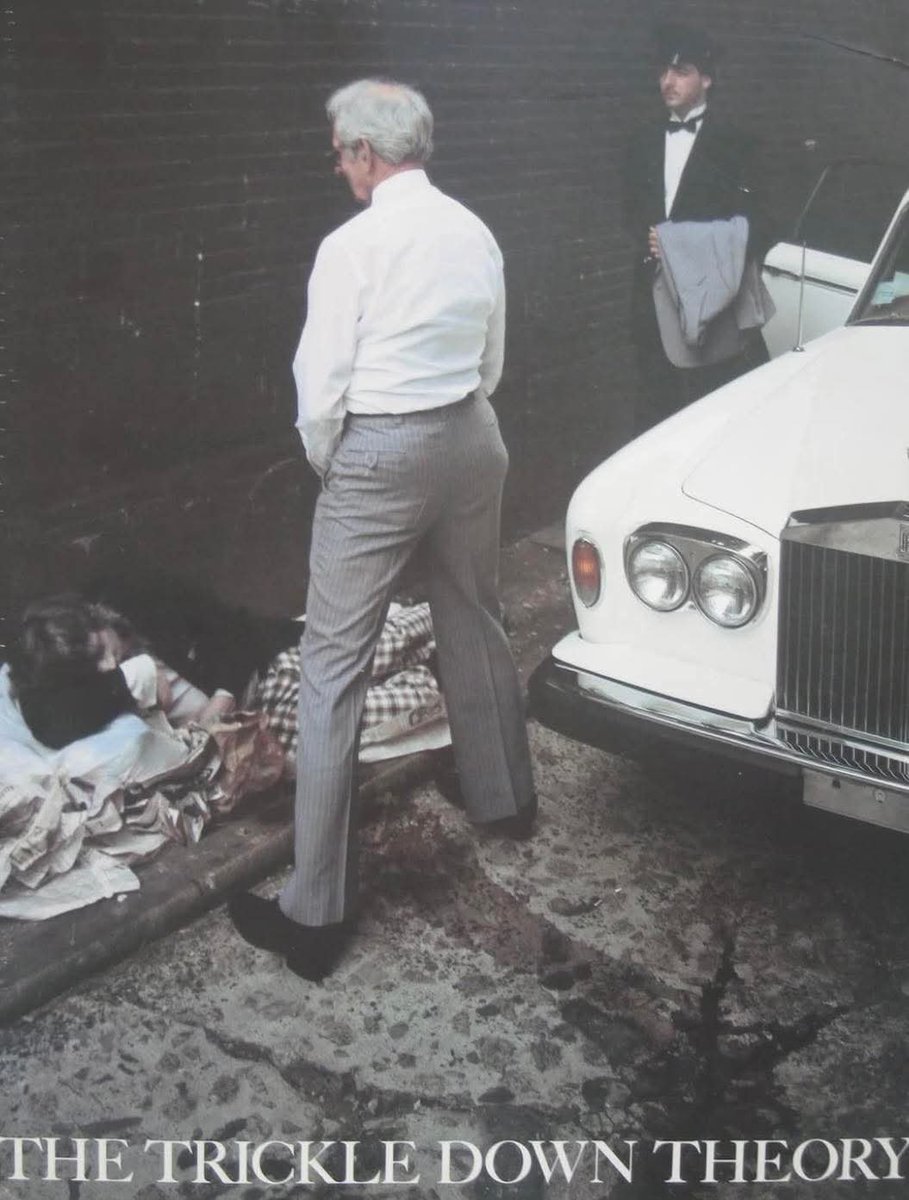
The well-known 1984 anti-Reagan political poster titled "The Trickle-Down Theory"...
The provocative satirical image depicts a well-dressed man standing by a luxury Rolls-Royce urinating on a homeless person sleeping on the sidewalk, accompanied by a chauffeur in a tuxedo. Created during the 1984 U.S. presidential campaign, it served as a sharp critique of President Ronald Reagan’s supply-side economic policies—commonly known as "trickle-down economics"—which argued that tax cuts for the wealthy and corporations would eventually benefit all levels of society.
. . .
This provocative image from 1984 served as a biting piece of political satire aimed at President Ronald Reagan’s economic policies. The “trickle-down theory”, officially known as supply-side economics, argued that reducing taxes on corporations and the wealthy would stimulate investment, ultimately benefiting all levels of society. Critics, however, saw it differently: that the benefits never truly “trickled down” to the working class or poor.
The poster’s stark imagery — a man in a fine suit standing beside a luxury car, facing a homeless person on the street — visualized what many felt was the human cost of Reaganomics. During the 1980s, homelessness in major American cities surged as federal social spending was cut, while Wall Street and corporate profits soared.
The piece captures the era’s deep class divide and remains one of the most recognizable symbols of protest art from the Reagan years — a photograph turned into political weaponry.
By 1988, the wealthiest 1% of Americans controlled nearly 40% of the nation’s wealth, up sharply from the start of Reagan’s presidency.
#archaeohistories
@Poulin2012 Eh oui, parce que Gérard a besoin de deux sièges pour ses fesses mais il ne compte quand même que pour un : il est l'homme de la situation !
@ame_ism Pourquoi follow un compte à surveiller, alors qu'on peut très bien discrètement suivre sans suivre, mapper les followings/followers aussi ?
En plus une fois repéré on peut très bien le virer de notre liste de followers, le bloquer et il perd TOUT ce qu'il voulait.
Maladresse ?