3 days after the fire outbreak, Hong Kong National Security Police arrested a student who initiated an online petition with 4 demands:
‘1. Keep supporting affected residents & ensure proper rehousing
2. Set up an independent inquiry into the fire, incl. suspected collusion
(1/3)
【Tai Po Fire, Bid-Rigging, and Bamboo Scaffolding in NSL-Era Hong Kong】
The Tai Po fire was not just a tragic accident; it was the predictable outcome of a broken system. A system where estate management, renovation contracts, and public safety have long been undermined by collusion, bid-rigging, and zero accountability. And since the NSL, Hong Kong has no civil society or independent media strong enough to hold these networks to account. Even when residents and expert and activists like Jason Poon, took their own samples of the netting and tried to expose the risks, they were ignored.
Wang Fuk Court was in the middle of a HK$330M “mega-repair.” Residents had protested the sky-high cost, accusing the owners’ corporation of force-pushing the plan through despite objections. Transparency was minimal. Oversight was weak. This is exactly how bid-rigging works in HK housing estates: pre-selected contractors, inflated prices, limited competition, opaque decisions, and incentives to cut corners on materials and safety, because no one is genuinely checking, nor can the civil society did what it used to do-- to hold different people to account and raise awareness of these issues.
During the renovation, the contractor wrapped the buildings with mesh, and foam boards that allegedly failed to meet fire-resistant standards. Some residents took a sample of the netting material to test on their own; videos showed it burned and dripped-- hardly in compliance with the regulations [1]. Here, cheaper, flammable materials meant higher profit margins and higher risk. The Wang Fuk Court contractor ignored safety again and again, with a long trail of corruption and violations. In 9 years, they racked up at least 17 regulatory breaches and fines.
When the fire started, the netting as shown in many videos, burned quickly. A slow fire became an inferno in minutes.
Police arrested multiple directors and engineers from the construction company. ICAC launched an investigation into the renovation contract itself — including how a controversial HK$330M plan was approved and whether corruption was involved.
This is the cost of collusion: Bid-rigging doesn’t just overcharge residents. It kills oversight, kills competition, and, in this case, helped create conditions that killed people. Hong Kong’s building maintenance system has tolerated collusion and corruption for years. The Tai Po fire is the clearest possible warning: corruption in estate management is not just a financial issue. It tells us a lot about HK-China relationship.
Beijing could and had rewritten Hong Kong’s political system overnight and crushed organised dissent, but it has never been able to cleanly uproot the entrenched construction and maintenance networks that profit from this model of “business as usual.” And this is where the politics of bamboo scaffolding enters the picture.
There is a long-understood agenda from Beijing to undermine Hong Kong’s bamboo scaffolding industry, not because it is unsafe, but precisely because it is a local craft, part of the Hong Kong identity, practised safely for decades, and one of the last corners of construction work where Chinese state-owned developers and their preferred contractors have never managed to gain a foothold. Bamboo scaffolding is not standard in the PRC; metal scaffolding is. And right now, mainland China faces a record glut of metal scaffolding materials, made worse by recent scandals over fake steel being used in their production , scandals that have no counterpart in Hong Kong’s bamboo trade.
So when the Hong Kong Government suddenly pushes a mandatory shift to metal scaffolding “for safety,” it is hard to ignore the timing. Yahoo Finance reports that Hong Kong experts defending the safety of bamboo scaffolding are being aggressively dismissed by PRC netizens, while the Government doubles down on the same narrative. In other words, this is not really about fire safety. It is a political and economic project to replace a resilient local craft with PRC-standard practices, conveniently absorbing a mainland oversupply while sidelining an industry Beijing has never been able to capture.
Thus, the tragedy is being used to accelerate “integration,” dressed up as technical modernisation. On paper, it’s about protecting the public; in practice, it sidesteps politically connected local players without ever reckoning with the actual causes of the fire: opaque estate governance, weak enforcement, collusion, and the hollowing out of watchdogs under the NSL.
We, Hongkongers, outside or inside the city do not trust the government or any of its proxies. Five years of national security crackdowns, media censorship, and relentless state messaging have not repaired the rupture exposed in 2019. That distrust is alive, deep, and justified.
HKSAR Gov and co are clearly not acting in good faith. Now, as you are reading, volunteers who organised themselves to help were reported to the police for unlawful assembly, a move that looks less like public order and more like spite. It is yet another sign that the Government now treats ordinary civic-minded Hongkongers as adversaries. And I fear reporting them is not the end of it, as Hongkongers came up with 4 very reasonable demands asking for investigation and accountability.
For us, the fact that John Lee decided to thank Xi Jinping first, rather than giving the credit to the brave firefighters, showed us that they are replicating the Mainland disaster-stagecraft: PR-first, people-last; party-state-first, people-last.
Taken together, the political economy of scaffolding, the erasure of civil oversight, and the Government’s behaviour during the crisis reinforce the same truth: the problem is not bamboo. The problem is a system where power, profit, and propaganda take precedence over safety, accountability, and the lives of Hong Kong people.
[1] https://t.co/1kEPkMcyEj
#XiJinping has a known desire for #Taiwan reunifying with mainland #China by force. Since President Trump's 2024 victory, the Taiwan invasion window is closed. Trump told Xi before if China invades Taiwan, he will bomb shit out of #Beijing. Xi couldn't believe his ears. Trump's 14 bunker-buster bombs on the Iranian nuclear sites made Xi a true believer.
Xi is building an underground command center near Beijing, 10 times bigger than the Pentagon as Xi's wartime bomb shelter. After its completion, the bomb shelter still won't stop our bunker-buster bombs.
#CCP also used its proxy Kuomintang (KMT) in Taiwan to deny #Taipei's purchase of U.S. military hardware to defend the island nation. Now 31 KMT lawmakers (2/3 of Taiwan's Legislative Yuan) are facing recalls tomorrow and in August. As a result, KMT/CCP will lose its majority in Taiwan's national assembly.
Last Friday, the U.S. House just passed the DOD Appropriations Act of 2026, which includes US$500 million for Taiwan military aid. As of July 10, 2025, there are approximately 500 US military training personnel stationed in Taiwan.
Nearly 80% of Americans support the US taking military action to defend Taiwan if China invades or blockades Taiwan. Defending Taiwan from #PLA's invasion is our national interest.
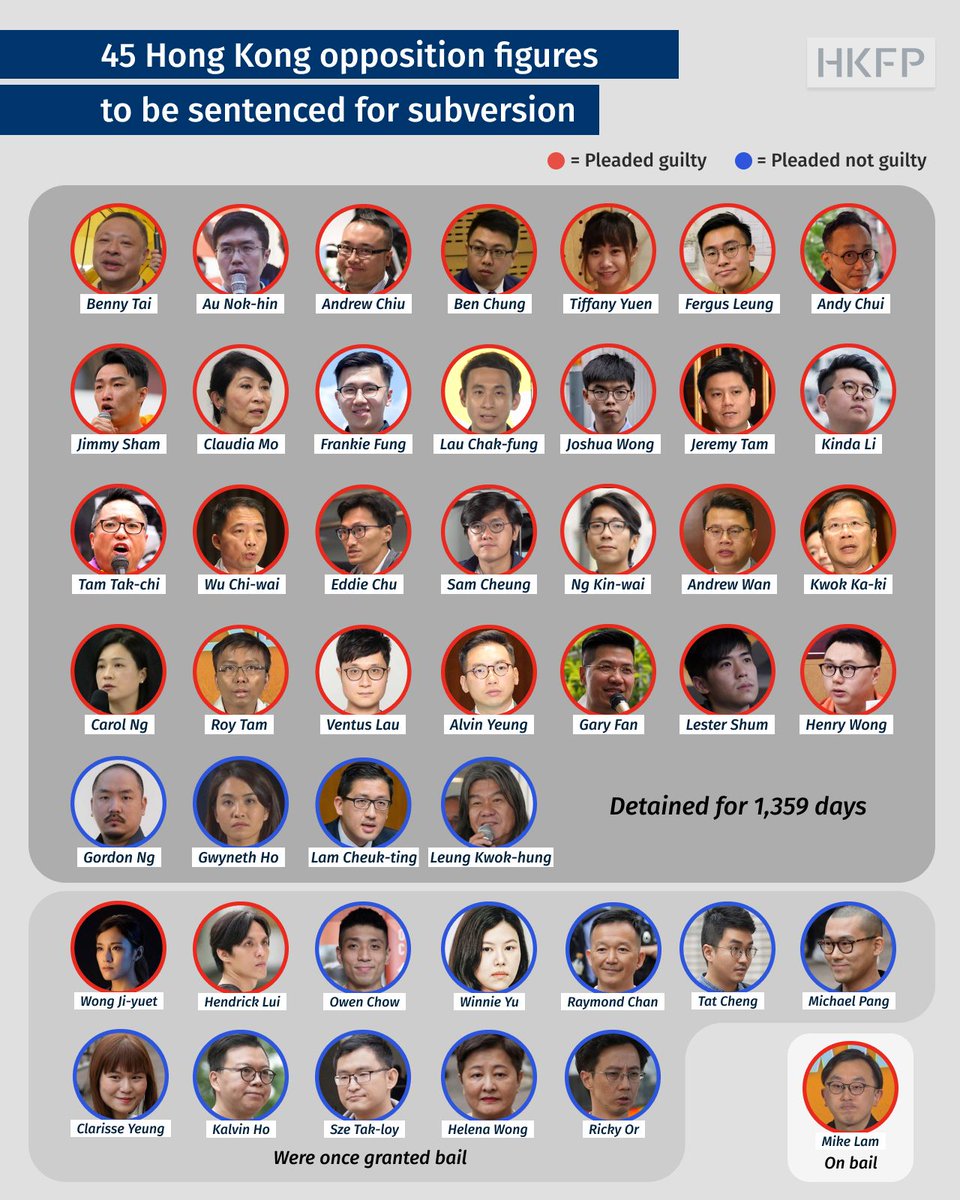
Stay tuned to HKFP on Tuesday as 45 democrats are set to be sentenced under the Beijing-imposed security law: https://t.co/5hQ0Y6kr2F They have been convicted of conspiring to commit subversion over planning to use legislative powers to indiscriminately veto bills, ultimately forcing the chief executive’s resignation and a government shutdown.
Of the 47 democrats initially charged with subversion, 16 pleaded not guilty, while 31 pleaded guilty. The court, presided over by a panel of three designated judges instead of a jury, found 14 guilty, acquitting two.
The scholars, lawmakers, activists and a former journalist could be jailed for life.
Many are relieved that our friends received “only” 7-year sentences instead of life in prison. But none of the #HK47 pro-democracy campaigners (and the other 1,800+ political prisoners), should have been imprisoned at all.
Even one day in jail is too long.
Release them now.
#BREAKING: Hong Kong jails legal scholar Benny Tai for 10 years for subversion, the longest sentence handed out so far under the city's national security law.
Tai and 44 others were earlier found guilty in Hong Kong's largest national security trial.
More to follow.🧵
I will put my 4-point ending the double taxation on a cocktail napkin:
1) No tax return filing if no US-sourced income
2) No expensive CPA bill by using a postcard check box
3) No US-sourced income = no bank reporting on assets
4) Overseas residency requirements as a guardrail




![chungchingkwong's tweet photo. 【Tai Po Fire, Bid-Rigging, and Bamboo Scaffolding in NSL-Era Hong Kong】
The Tai Po fire was not just a tragic accident; it was the predictable outcome of a broken system. A system where estate management, renovation contracts, and public safety have long been undermined by collusion, bid-rigging, and zero accountability. And since the NSL, Hong Kong has no civil society or independent media strong enough to hold these networks to account. Even when residents and expert and activists like Jason Poon, took their own samples of the netting and tried to expose the risks, they were ignored.
Wang Fuk Court was in the middle of a HK$330M “mega-repair.” Residents had protested the sky-high cost, accusing the owners’ corporation of force-pushing the plan through despite objections. Transparency was minimal. Oversight was weak. This is exactly how bid-rigging works in HK housing estates: pre-selected contractors, inflated prices, limited competition, opaque decisions, and incentives to cut corners on materials and safety, because no one is genuinely checking, nor can the civil society did what it used to do-- to hold different people to account and raise awareness of these issues.
During the renovation, the contractor wrapped the buildings with mesh, and foam boards that allegedly failed to meet fire-resistant standards. Some residents took a sample of the netting material to test on their own; videos showed it burned and dripped-- hardly in compliance with the regulations [1]. Here, cheaper, flammable materials meant higher profit margins and higher risk. The Wang Fuk Court contractor ignored safety again and again, with a long trail of corruption and violations. In 9 years, they racked up at least 17 regulatory breaches and fines.
When the fire started, the netting as shown in many videos, burned quickly. A slow fire became an inferno in minutes.
Police arrested multiple directors and engineers from the construction company. ICAC launched an investigation into the renovation contract itself — including how a controversial HK$330M plan was approved and whether corruption was involved.
This is the cost of collusion: Bid-rigging doesn’t just overcharge residents. It kills oversight, kills competition, and, in this case, helped create conditions that killed people. Hong Kong’s building maintenance system has tolerated collusion and corruption for years. The Tai Po fire is the clearest possible warning: corruption in estate management is not just a financial issue. It tells us a lot about HK-China relationship.
Beijing could and had rewritten Hong Kong’s political system overnight and crushed organised dissent, but it has never been able to cleanly uproot the entrenched construction and maintenance networks that profit from this model of “business as usual.” And this is where the politics of bamboo scaffolding enters the picture.
There is a long-understood agenda from Beijing to undermine Hong Kong’s bamboo scaffolding industry, not because it is unsafe, but precisely because it is a local craft, part of the Hong Kong identity, practised safely for decades, and one of the last corners of construction work where Chinese state-owned developers and their preferred contractors have never managed to gain a foothold. Bamboo scaffolding is not standard in the PRC; metal scaffolding is. And right now, mainland China faces a record glut of metal scaffolding materials, made worse by recent scandals over fake steel being used in their production , scandals that have no counterpart in Hong Kong’s bamboo trade.
So when the Hong Kong Government suddenly pushes a mandatory shift to metal scaffolding “for safety,” it is hard to ignore the timing. Yahoo Finance reports that Hong Kong experts defending the safety of bamboo scaffolding are being aggressively dismissed by PRC netizens, while the Government doubles down on the same narrative. In other words, this is not really about fire safety. It is a political and economic project to replace a resilient local craft with PRC-standard practices, conveniently absorbing a mainland oversupply while sidelining an industry Beijing has never been able to capture.
Thus, the tragedy is being used to accelerate “integration,” dressed up as technical modernisation. On paper, it’s about protecting the public; in practice, it sidesteps politically connected local players without ever reckoning with the actual causes of the fire: opaque estate governance, weak enforcement, collusion, and the hollowing out of watchdogs under the NSL.
We, Hongkongers, outside or inside the city do not trust the government or any of its proxies. Five years of national security crackdowns, media censorship, and relentless state messaging have not repaired the rupture exposed in 2019. That distrust is alive, deep, and justified.
HKSAR Gov and co are clearly not acting in good faith. Now, as you are reading, volunteers who organised themselves to help were reported to the police for unlawful assembly, a move that looks less like public order and more like spite. It is yet another sign that the Government now treats ordinary civic-minded Hongkongers as adversaries. And I fear reporting them is not the end of it, as Hongkongers came up with 4 very reasonable demands asking for investigation and accountability.
For us, the fact that John Lee decided to thank Xi Jinping first, rather than giving the credit to the brave firefighters, showed us that they are replicating the Mainland disaster-stagecraft: PR-first, people-last; party-state-first, people-last.
Taken together, the political economy of scaffolding, the erasure of civil oversight, and the Government’s behaviour during the crisis reinforce the same truth: the problem is not bamboo. The problem is a system where power, profit, and propaganda take precedence over safety, accountability, and the lives of Hong Kong people.
[1] https://t.co/1kEPkMcyEj](https://pbs.twimg.com/media/G63Y-cTXcAA0yUp.png)