Check out @KiSchuettler's blog on what it costs to support jobs in FCV contexts. Some insights:
Projects that give capital to workers are more cost effective than training
FCV environments tend to widen the cost gap btw capital support & training/matching
https://t.co/eAQGsMTRZS
How much does it cost to support jobs in conflict and forced displacement settings compared to other contexts? We compiled and analyzed a new dataset .@WBG_Jobs @WBG_Dev4Peace @FCDOGovUK@Refugees@OPMglobal https://t.co/ggww1cyAm9
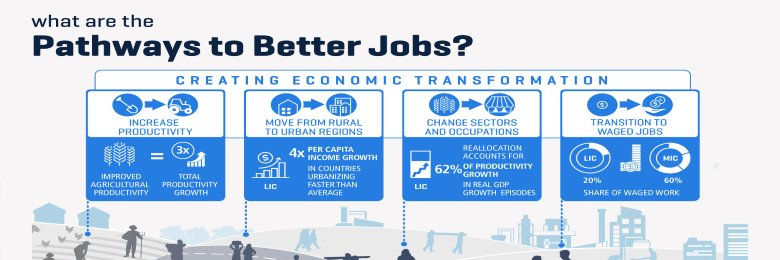
The upcoming Jobs Flagship will show how they are affecting jobs outcomes in four crucial dimensions: sectoral, spatial, organizational and occupational.
Follow @WBG_Jobs or click the link below to learn more about the Jobs Flagship.
https://t.co/JVaXiO2XTS
Jobs megatrends reinforced during the pandemic: faster growth of services jobs; accelerated tech. change (AI, digitalization); altered trading patterns (re/near-shoring); new labor relationships (online contract work) & greater urgency of climate responses
https://t.co/18P3sD6BC1
The @worldbank's Rome Jobs & Labor Mobility Center will award up to four contracts in the range of US$250,000 - US$350,000 each. The call will be open to research centers, thinktanks, IOs, non-profits & firms with strong, evidence-generating credentials
https://t.co/FNQR9x27d3
Help to build the evidence around solutions for jobs & migration! The @WorldBank will soon open a request for proposals to study how new solutions can improve cross-border labor mobility & labor market integration of migrants. Click the link to learn more
https://t.co/FNQR9x27d3
Tomorrow 12PM ET: @gbetcherman delivers
the 3rd Jobs Flagship Seminar- Setting labor market regulations in developing countries- revisiting the plateaus & cliffs highlighted in the 2013 WDR, which tried to build a constructive approach to LM regs.
Link:
https://t.co/40HNr4ukeB
Ground-breaking gender-focused WB development policy loan in Albania supports better jobs for women by tackling biases built into laws and administrative rules. Read the blog here
https://t.co/HDtNBQMqtd
Between 1987-2018 Malaysia achieved remarkable structural transformation. Rapid industrialization followed by a transition to service-led growth brought it close to high-income status. Interesting @WBG_Jobs blog in our Jobs & Structural change series
https://t.co/ierAE8Z6EJ
Nice new @worldbank policy note on human capital reforms for inclusive jobs in Turkiye recommends: expanding green skills; targeting job creation through climate finance; and social insurance reform to reduce labor costs & reduce incentives to informality
https://t.co/r6ThyzvfpA
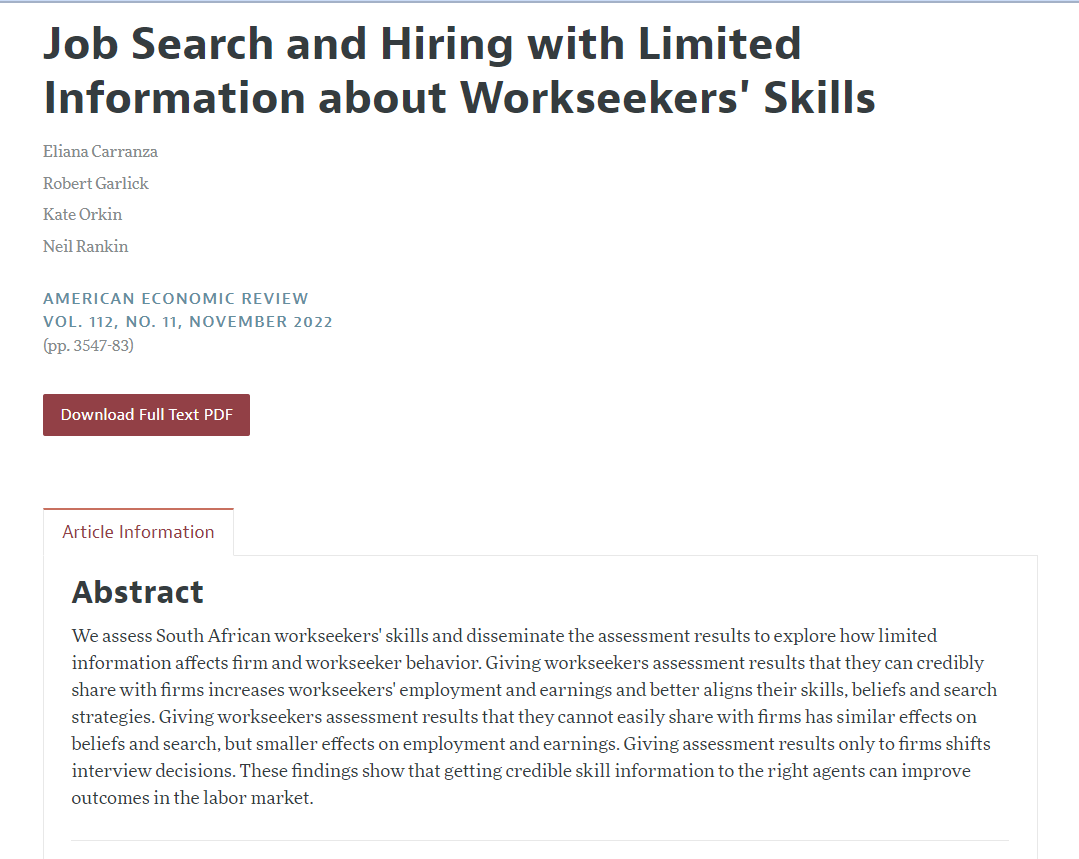
In #SouthAfrica, assessing & certifying jobseekers’ skills in ways they can credibly share w/ firms improved their self-belief & search strategies, & resulted in higher employment, earnings a/c @WBG_Jobs MDTF-funded work by @ElianaCarranza et al.
https://t.co/KAjzexDVkX
In Bangladesh, strong labor demand growth facilitated changing attitudes and increased female labor force participation– good piece from Alice Evans: https://t.co/QJwCUCe9oG
The emissions potential of African development is a climate change time bomb - global carbon taxes and transfers are crucial to a sustainable energy path for the continent’s economic transformation. @FT
https://t.co/7t20mzoJ7L
Appalachian miners have worked through the “stages of grief” for coal’s decline & endorsed Biden’s green transition law, opening new opps in green jobs. Good @FT piece shows coal transition is viable when policies offer alternatives to affected communities
https://t.co/DfL1CRjUlY
Looking forward to hosting @hpatrinos at the @WBG_Jobs Flagship Seminar this week to discuss how to raise returns to education & incentivize households’ education investments by creating #BetterJobs opportunities – esp. for women.
https://t.co/UOgoSPC8fZ
Regulation can’t create better jobs if productivity is lacking. Good piece from @rodrikdani stresses opportunities for productivity gains / better jobs in services in developing countries. https://t.co/n9pP3FXP7J
New @worldbank poverty report shows COVID-19 and Ukraine war hit jobs and incomes (esp. for informal workers uncovered by social protection) & halted poverty reduction. Jobs-centered growth & universal social protection are key to rolling this back.
https://t.co/IptlIF4SNH
MENA needs more contestable markets to address its jobs challenges. Over-protected firms don’t need to invest. Contestability fosters productivity growth & helps create better jobs acc. to new @WBG_Jobs blog
https://t.co/pryMhUaB67
Urban centers in Colombia generate 92% of all formal waged jobs, which only a few people living there have access to. Despite the low odds of securing a job there, rural workers continue to flock to urban areas, acc. blog by @ElianaCarranza@EberhardRuiz
https://t.co/TfQMnHRVyR
In Kenya, @WBG_Jobs@ElianaCarranza is developing an innovative Digital Public Works pilot to ensure better access to urban/disaster risk data while providing a safety net for local communities, promoting skills dev., supporting long-term income generation
https://t.co/iaBJtSgJng
In LMICs, digital public infrastructure (DPI) was critical to the successful implementation social assistance programs during COVID-19. Now donors have pledged ~$300m of investments in DPI & the digital public goods that can help to scale them @DPGAlliance
https://t.co/ygzD1SHfNJ