coming up: batch transcribe + speaker diarization.
done in parallel and you get email notifications once it's ready. this reduces lots of manual clicks (and wait time) if you have multiple recordings to upload.
the plan is to support 10 files with 4 hours max per file for now.
✅ you can now add a short glossary prompt to make the speech to text transcription more accurate on alfie.
hopefully reduce manual edits for the domain specific nouns.
it has come to my attention that this is not universal knowledge
you can just type https://t.co/prfdqNqr5m or https://t.co/HMVIGA1uSh into your browser
and it will immediately open a new google doc or sheet
@JamesIvings@alexmacgregor__ Not sure how to get this but I imagine there’s a surge for domains on the internet since everyone can easily ship and deploy stuff now.
@jackfriks@postbridge_ imo very few software was designed to do many things initially. That’s never the intention.
They grew over time and tried to capture more users by expanding vertically or horizontally in the workflow or industry. Some lost sights and became a monster no one likes to use.
🚨 BREAKING: An extremely important lawsuit in the intersection of PRIVACY and AI was filed against Otter over its AI meeting assistant's lack of CONSENT from meeting participants. If you use meeting assistants, read this:
Otter, the AI company being sued, offers an AI-powered service that, like many in this business niche, can transcribe and record the content of private conversations between its users and meeting participants (who are often NOT users and do not know that they are being recorded).
Various privacy laws in the U.S. and beyond require that, in such cases, consent from meeting participants is obtained. The lawsuit specifically mentions:
- The Electronic Communications Privacy Act;
- The Computer Fraud and Abuse Act;
- The California Invasion of Privacy Act;
- California’s Comprehensive Computer Data and Fraud Access Act;
- The California common law torts of intrusion upon seclusion and conversion;
- The California Unfair Competition Law;
As more and more people use AI agents, AI meeting assistants, and all sorts of AI-powered tools to "improve productivity," privacy aspects are often forgotten (in yet another manifestation of AI exceptionalism).
In this case, according to the lawsuit, the company has explicitly stated that it trains its AI models on recordings and transcriptions made using its meeting assistant.
The main allegation is that Otter obtains consent only from its account holders but not from other meeting participants. It asks users to make sure other participants consent, shifting the privacy responsibility.
As many of you know, this practice is common, and various AI companies shift the privacy responsibility to users, who often ignore (or don't know) what national and state laws actually require.
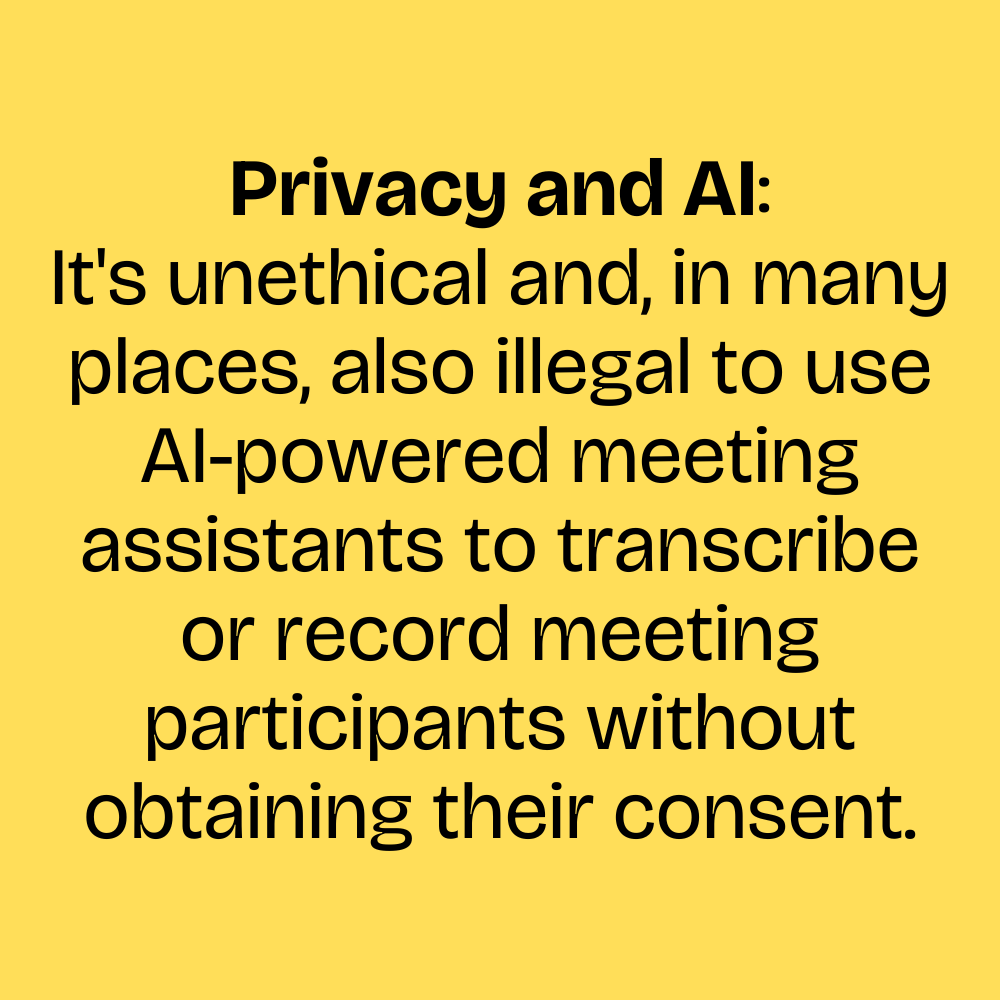
So if you use meeting assistants, you should know that it's UNETHICAL and in many places also ILLEGAL to record or transcribe meeting participants without obtaining their consent.
Additionally, it's important to have in mind that AI companies might use this data (which often contains personal information) to train AI, and there could be leaks and other privacy risks involved.
-
👉 Link to the lawsuit below.
👉 Never miss my curations and analyses on AI's legal and ethical challenges: join my newsletter's 74,000+ subscribers.
👉 To learn more about the intersection of privacy and AI (and many other topics), join the 24th cohort of my AI Governance Training in October.
tbh, the best solution for privacy is to do things locally, which means having a decent computer and setting up the software/models. understandably, not everyone wants (or can) do that.
a friend asked me how to transcribe their recordings locally due to privacy concerns. while it's doable, but not super accessible.
so I built alfie: a privacy-aware transcription app.