🌍✨ Introducing ÌBÍLẸ̀CHAIN ✨🌍
The Pan-African blockchain built on cultural heritage, financial independence, & next-gen innovation.
Inspired by Bitcoin, evolved from IbileCoin, and ready to shape the future. Join us on this groundbreaking journey!
#ÌBÍLẸ̀CHAIN#Blockchain
Community Update
We want to inform you of some important changes. Our Catalyst funding request, which was intended to support the integration and expansion of the IbileChain ecosystem, was unfortunately denied.
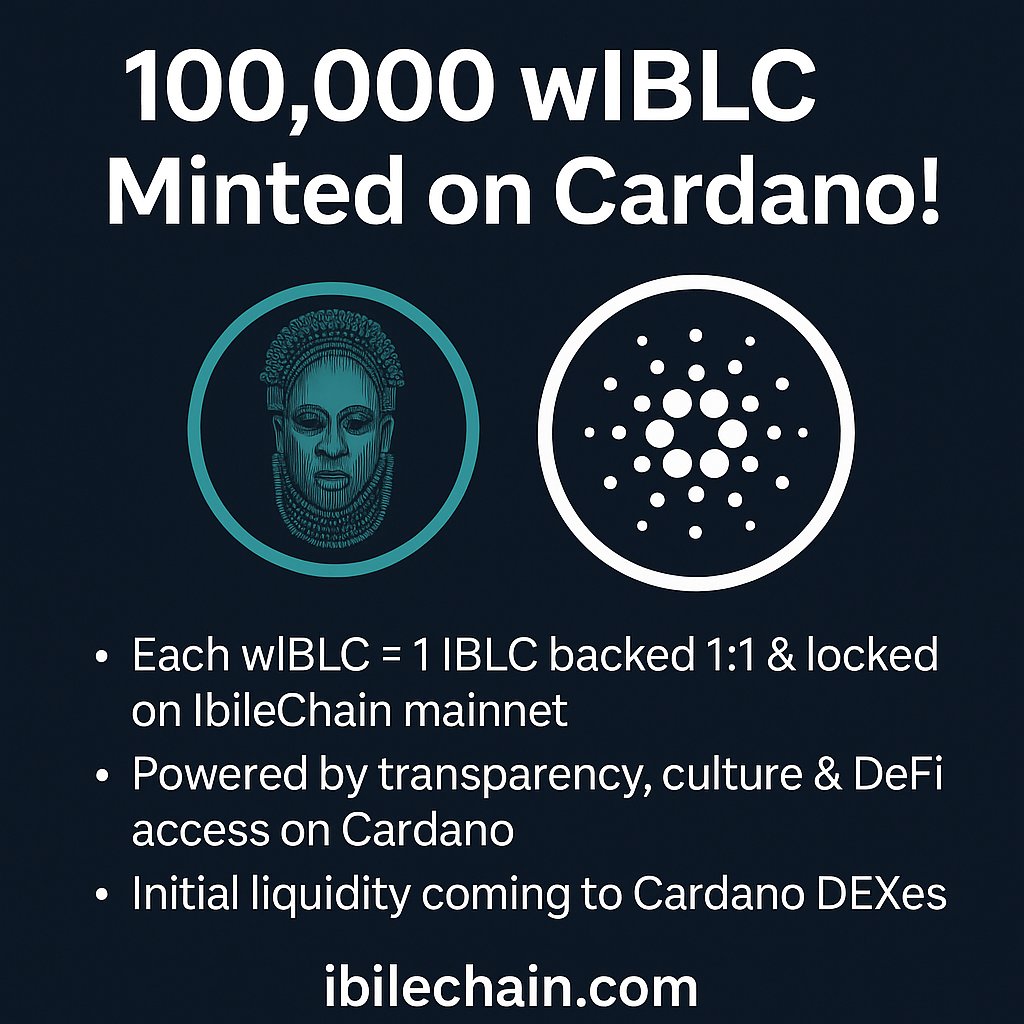
As a result, we will be retiring IbileChain. However, IbileCoin on Cardano will remain live and active!
If you previously exchanged your IbileCoin for IbileChain, we will be refunding your IbileCoin back to your Cardano wallet address.
This is not a setback, but rather a redirection of our priorities. While we haven’t secured the necessary funding to fully realize the IbileChain vision, IbileCoin will continue to thrive on Cardano.
Thank you for your continued support.
🚨 BIG NEWS for IbileChain! 🚨
We’re excited to share that IBLC now has its own page on @CoinCheckup! 🎉
👉 This marks a huge milestone in gaining visibility within the global crypto space.
⚡ Please note: IBLC is not trading yet, so there’s currently no price tracking — but these are Initial organic steps as
with hopeful increased participation of independent masternode operators very soon. 🚀
🌍 IbileChain represents Pan-African cultural value on the blockchain, secured by Proof-of-Stake + Masternode technology, and we’re only just getting started! 💎
🔗
https://t.co/M9f63mnTvE
Asking #AI why Nigeria is corrupt and not achieving its potential? . And it shows how Blockchain technology could be used to combat corruption alongside other innovations of our time.
Here a thread ✨️:
1. Colonial Legacy
When the British governed Nigeria, they ruled indirectly through chiefs and favored groups, creating weak institutions but strong patronage systems.
The colonial state extracted resources (oil, cocoa, palm oil) for export rather than building accountability or inclusive governance.
After independence (1960), Nigeria inherited a state designed for exploitation, not service delivery.
---
2. Oil Wealth & the “Resource Curse”
The discovery of oil in the 1950s turned Nigeria into a rentier state.
Oil revenues dominate the economy (over 80% of government revenue).
Instead of taxing citizens, government relies on oil rents — which weakens accountability (“no taxation, no representation” works in reverse).
Oil wealth became a prize to capture, fueling corruption, rent-seeking, and “sharing the national cake.”
---
3. Weak Institutions
Laws exist against corruption (EFCC, ICPC), but enforcement is selective and often politicized.
Courts are slow and prone to manipulation.
Civil service is bloated, underpaid, and vulnerable to bribery.
---
4. Patronage Politics
Nigerian politics is heavily clientelistic: politicians distribute money, jobs, and contracts to supporters instead of delivering broad public goods.
Political office is seen as an “investment” to be recouped through embezzlement and kickbacks.
“Godfatherism” (wealthy sponsors funding candidates in exchange for loyalty) fuels systemic corruption.
5. Military Rule Legacy
Nigeria spent decades under military dictatorships (1966–1979, 1983–1999, with a short civilian break).
These regimes centralized power, looted state resources, and normalized corruption.
Even after democratization (1999 onward), military-style politics and networks persisted.
6. Social & Cultural Factors
Poverty and inequality push people toward “survival corruption” (bribing for jobs, contracts, even hospital beds).
Many Nigerians view public office as a chance to “chop” (enjoy the spoils), because the system seems rigged against ordinary citizens.
Religious and ethnic loyalties sometimes override merit and accountability.
7. Global Dimensions
Nigerian elites stash billions abroad with the complicity of foreign banks and tax havens.
Multinational oil companies have historically been accused of fueling corruption by paying bribes and royalties with little transparency.
✅ In short:
Nigeria is corrupt not because Nigerians are inherently corrupt, but because of a toxic mix of:
colonial extraction legacy,
oil dependence,
weak institutions,
patronage politics,
military legacy, and
global enablers.
---
👉 The hopeful part: Despite all this, civil society, youth movements, and tech innovations (e.g., fintech, blockchain, whistleblower platforms) are challenging corruption more than before.
#Nigeria #Naija #instablog @instablog9ja@official_Gegeh@falzthebahdguy@officialEFCC@icpcnigeria@PoliceNG@inecnigeria@GuardianNigeria #naija #ChatGPT5 #deepseekai
🚨 BIG NEWS for IbileChain! 🚨
We’re excited to share that IBLC now has its own page on @CoinCodex! 🎉
👉 This marks a huge milestone in gaining visibility within the global crypto space.
⚡ Please note: IBLC is not trading yet, so there’s currently no price tracking — but this is the first step as we prepare liquidity and launch trading very soon. 🚀
🌍 IbileChain represents Pan-African cultural value on the blockchain, secured by Proof-of-Stake + Masternode technology, and we’re only just getting started! 💎
🔗 https://t.co/TvCbCfzIV1
#IBLC #CryptoNews #bitcoin #BTC #masternode
IbileChain: Africa’s Voice in Blockchain Technology.
IbileChain is a fully independent, Afro-centric blockchain I @AkinSoyoye91 built from the ground up, inspired by my Pan-African vision.
It’s designed to represent cultural value, economic self-determination, and financial sovereignty — free from the control of the Bretton Woods system @IMFNews.@WorldBank
Unlike speculative chains driven by hype or VC agendas, IbileChain rewards only those who actively secure the network through mining power, ensuring true participation and ownership. Our mission is to create a decentralized economic backbone for Africa and the global diaspora, where value creation is rooted in our own culture, not dictated by external powers.
#IBLC #IBILE #Crypto #BlockchainRevolution
This is the reality of this millennium . Unfortunately, he that has the power taketh it by force ! . Africa was robbed dry and still being robbed via neocolonialism and supported by Africa's corrupt and nepotism leaders ! . Maybe one day we will reclaim what is ours ! .
#IBLC
I was at the British Museum yesterday & my blood boiled nonstop throughout the 40 mins experience.
Before I share my experience with the Nigerian section, let me tell you about the most chilling view that upset me the most.
This is the tree of life and it is from Mozambique 🇲🇿
The Mozambican Civil War, which started 2 years after they gained independence from Portugal was a 15-year conflict that occurred between May 30, 1977 and October 4, 1992.
Although masked as an internal civil war, it was in fact a proxy war between the Soviet Union and the United States.
This war claimed over a million lives.
After the war, a project called "Transforming Arms Into Tools" launched and it was aimed at incentivizing citizens who had arms from the war to lay them down, in exchange for tools for farming.
Over 600,000 weapons got collected and dismantled.
So, 4 artists took parts from all of these dismantled weapons and weaved it into this 3-metre standing "Tree Of Life".
Somehow, it got "installed" in the British Museum in 2005.
Relics and symbols of cultural heritage that shouldn't have left our homes - sit in glasses as attraction latches, for a show to the same people who came raiding.
This should not have left the soil of Mozambique - it is a symbol of pain, agonizing deaths. It has the fusion of a million blood enmeshed in these arms.
This doesn't belong here.
🎉 100,000th BLOCK MINED ON IBILECHAIN!🎉
A major milestone for our culturally-rooted blockchain!
🔥 Network Hashrate: 2.95 GH/s
🧠 Network Difficulty: 30
Built from the ground up. No VC. No ICO. Just community & code.
This is how Africa builds. 🌍
MINING power = amount of $IBLC token you are staking !.
https://t.co/bNNHtlJcqJ
#IBLC #IbileChain #CryptoAfrica #Milestone #DeFi #Blockchain #cryptocurrency