Building autonomous agents for scientific discovery? 🧬🤖
@GoogleDeepMind Science Skills is now available on GitHub. We've open-sourced this specialized toolkit to accelerate your agentic workflows with scientific grounding and higher token efficiency.
Download now ↓
https://t.co/cwp1HOeKvo
The headline trick is the commutation: r((xW0+z) ⊙ γ)W1 = r(((xW0+z) ⊙ γ)W1), so the row-wise scale slides past the second GEMM into its epilogue. That's why RMSNorm fuses and softmax doesn't. The LLM-written kernels are inside that envelope. What's the next op where you think a similar algebraic move exists?
After some mathematical rewrite, turns out all of transformer is a series of gemm + epilogue. Given a few optimized primitives, LLMs (and novice humans) can write speed-of-light kernels for all transformer ops!
Today we’re launching the OpenAI Deployment Company to help businesses build and deploy AI.
It's majority-owned and controlled by OpenAI. It brings together 19 leading investment firms, consultancies, and system integrators to help organizations deploy frontier AI to production for business impact. https://t.co/GnyjGFaLLA
We have recently clarified our penalties for this. If a submission contains incontrovertible evidence that the authors did not check the results of LLM generation, this means we can't trust anything in the paper. 3/
You chose iText because it was open source. Then you needed OCR.
Then signatures.
Then a different document format.
Then you discovered you were three add-on licenses deep and your legal team had questions about AGPL compliance.
This head-to-head comparison between iText Core and Nutrient .NET SDK breaks down features, pricing models, licensing implications, and real code examples across the full document lifecycle — from PDF generation and merging to OCR, forms, and digital signatures. If your requirements have grown faster than your original license, this post covers which tool fits where. https://t.co/Wz0QDGrKrT
People think learning AI takes months.
It's really just a couple of hours.
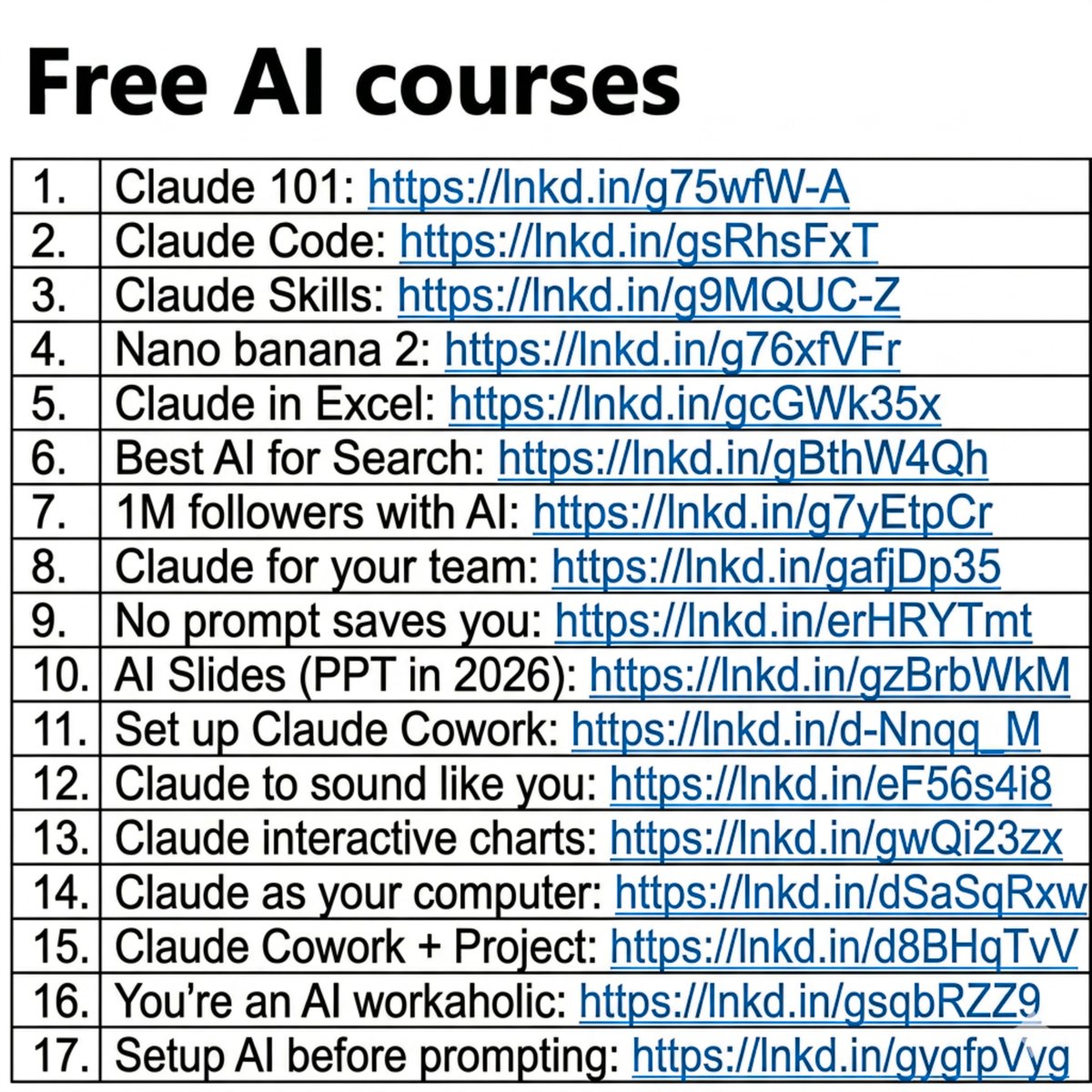
And I wrote 17 free guides to start right away:
Claude 101: https://t.co/Jv1jsvFB7T
Claude Code: https://t.co/WYZd5ltnXo
Claude Skills: https://t.co/jT4uB5AFtY
Nano banana 2: https://t.co/qfHT594CCI
Claude in Excel: https://t.co/mfcXYSA57j
Best AI for Search: https://t.co/77BmjbJjP0
1M followers with AI: https://t.co/1TV9LYAptv
Claude for your team: https://t.co/U1JsBVC299
No prompt saves you: https://t.co/SDKJWykHE4
AI Slides (PPT in 2026): https://t.co/RfcyYRQ2Ad
Set up Claude Cowork: https://t.co/diDhiKjHtU
Claude to sound like you: https://t.co/99RzxXTvzs
Claude interactive charts: https://t.co/ebCHGZqgPt
Claude as your computer: https://t.co/TxYuHPiImn
Claude Cowork + Project: https://t.co/Q7AN9CZ2mg
You're an AI workaholic: https://t.co/mCIvB3ZPA5
Setup AI before prompting: https://t.co/pE3OF722aw
___
1. Save this list for later (three dots, top right).
2. Share it with a friend by ♻️ reposting this image.
3. Subscribe to my free newsletter: https://t.co/psB7XxAv8w.
🚨 BREAKING: A new role is quietly emerging and it’s about to dominate the next 5 years.
It’s not “AI engineer.”
It’s not “prompt engineer.”
It’s the Agent Operator.
And it will sit inside almost every organization.
Most people are still thinking about AI as a tool.
That framing is already outdated.
What’s actually happening is a shift from:
humans using software to humans managing autonomous agents that execute work
This is a fundamental redesign of how work gets done.
So what is an Agent Operator?
An Agent Operator is the person who:
• Designs how agents interact with real workflows
• Connects tools, data, and systems into agent pipelines
• Translates business problems into executable agent behavior
• Monitors, corrects, and improves agent performance over time
They don’t just “use AI.”
They orchestrate outcomes.
and this matter because
Every function marketing, legal, finance, biotech is becoming “agent-compatible.”
Not because companies want it.
Because they won’t have a choice.
Agents can:
• Run research loops
• Execute multi-step workflows
• Integrate across tools without APIs breaking the flow
• Operate 24/7 at near-zero marginal cost
The bottleneck is no longer capability.
It’s implementation inside real-world systems.
Required skills for AI Agent Operator role:
→ MCPs (Model Context Protocols)
Understanding how agents access tools, memory, and structured context.
→ CLIs (Command Line Interfaces)
Because serious agent workflows won’t live in GUIs—they’ll run in programmable environments.
→ Writing skills (the file kind)
Clear specs, instructions, and structured documents.
Agents run on precision, not vibes.
→ agents dot md fluency
The ability to define agent roles, constraints, memory, and tool usage in persistent formats.
→ Business acumen
Knowing what actually matters:
Where automation creates leverage, not noise.
What happens next
Enterprises will begin to redesign workflows:
Not around employees using dashboards…
But around agents executing tasks.
That means:
• SOPs → Agent playbooks
• Teams → Human + agent hybrids
• Tools → Composable agent systems
When that shift happens, companies won’t just need engineers.
They’ll need operators who understand both the system and the business.
The leverage is asymmetric
One strong Agent Operator can:
• Replace fragmented SaaS workflows
• Multiply team output without adding headcount
• Turn ideas into execution systems in days
This is not incremental productivity.
It’s operational transformation.
📣 Open for Comment: The Unfinished Digital Estate
Our digital lives long outlive our physical lives -- but what happens to our digital selves after we die? This paper explores cultural, legal, and technological complexities of digital life after death.
https://t.co/Pvc8939ErV
In 2025, Nutrient migrated a massive website to Astro, open-sourced an MCP Server, achieved WCAG 2.2 compliance across all platforms, and planted 6,000 trees with customers and partners. Not a bad year.
The full 2025 review covers AI Assistant feature parity across every platform, cloud-first Document Web Services infrastructure, mobile PageSpeed improvements from 33 to 76, and how Nutrient evolved from document tools to an intelligent document platform — and what that means for what's coming next. https://t.co/zwh2qrRKTU
Your legal team knows they need digital signatures that are "compliant." What compliant actually means — PAdES B-LT, LTV requirements, eIDAS, FDA 21 CFR Part 11 — is a different conversation entirely.
This comprehensive guide breaks down PAdES, CAdES, and XAdES, explains when each standard applies, and walks through long-term validation requirements including GlobalSign integration for qualified electronic signatures in regulated industries.
Everything your team needs to stop guessing and start implementing. https://t.co/fBPVcMrhAy
@DrunkRepub Yeah, it's hard for me to care about a horrible person who'd wish me ill being strung up by the other horrible people he has spent a career enabling and encouraging.