Some VTubers say stuff like
"2 viewers isn't a lot"
Now Imagine 2 bedbugs in your room-
And don't pretend you wouldn't tear apart your entire bedroom, burning the mattress and then starting a new life in another country
2 viewers is a CROWD actually
Konbannichi wa minna-san!
I'd better toss my hat into the ring of us science communication VTubers sharing our credentials. ;)
I have two undergraduate degrees:
BS in Molecular Biology
BS in Chemistry
And 11 years as a state-certified 6-12 Chem teacher.
So while I may not be as impressive as some having an advanced graduate degree, science communication lives in my blood! There's no greater joy in knowing I helped spark curiosity and intrigue in understanding the world around us.
I invite you all to check out my most recent streams where I am currently teaching an online class in introductory chemistry for @VTeach_U and organic chemistry later this year.
Have a great day minna-san!
Ja, ne
-Ichiro
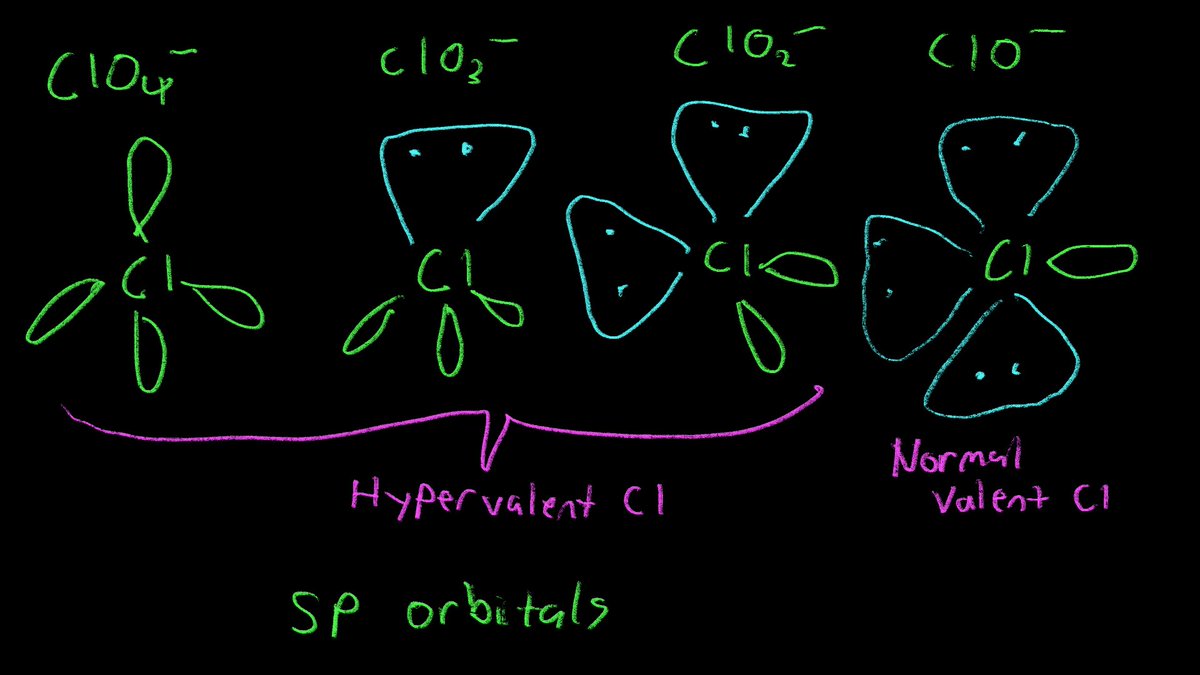
It's the absence of lone pairs in the sp orbitals on the central chlorine atom.
All of the valence electrons are paired up and shared with all the oxygens. That means its valence shell is completely full, and therefore it is happy to just sit there and do nothing.
Compare that to chlorate with one lone pair, chlorite with two, and hypochlorite with three.
Depending on if you are looking at acidic or neutral/alkaline conditions, either chlorite or hypochlorite are the strongest oxidizers. This follows the trend of increasing numbers of lone pairs on the central chlorine.
Thanks for falling down this chemistry rabbit hole with me! Did ya enjoy it? Let me know below!
Sugoi nagai POST desu ne! o.o;;
Ja, ne!
-Ichiro
(5/5)
Konbannichi wa minna-san!
Let me tell you about the other day when a kid caused me to get nerdsniped thinking about perchlorate compounds. Join me as we go from talking about their reactivity, all the way to rediscovering hypervalence via MO Theory.
Hold on to your butts! Here go!
The first unit that is taught in any secondary ed science course is always applying the scientific method. For us, that means doing science projects. One of my students was brainstorming ideas and I saw one that immediately caught my attention: Detection and Removal of Perchlorate from Martian Soil.
I sat down beside the kid and we started talking about it. He mentioned how it was just an idea he had since he's interested in space travel and Mars. I gave him a few guiding directions on where to start looking: gravimetric analysis (precipitating an insoluble salt) or redox titration (knowing that 7+ oxidation state chlorine exists inside it.)
The student decided on a different topic instead, but I kept thinking about it. I figured redox titration would be the best method of detection only to find out that perchlorate is the LEAST REDOX ACTIVE of the chlorine oxyanion species! Excuse me?! You're telling me that 7+ chlorine isn't dying to rip the electrons clean off the nearest atom, oxidizing it into oblivion?! I had to figure out why!
(1/5)
HYBRID ORBITALS! These structures resemble the sp3 hybrid orbital structure! But wait a second... there are double bonds. That means there has to be pi-bond overlaps. But there are no p-orbitals to overlap on the central chlorine.
Enter the d-orbitals.
d-orbitals can form pi-bond overlaps with the p-orbitals.
We tend to forget that chlorine does have d-orbitals. While the d-orbitals first appear in the third energy level, because the 4s sublevel is slightly lower in energy, we associate d-orbitals with the 4th period elements.
So what does this mean?
It means that the central chlorine of all the chlorine oxyanions is sp3 hybridized, while the oxygens are sp2 hybridized. (Resonance structures) The d-orbitals of chlorine form pi-bond overlaps with the unhybridized p-orbital of the sp2 oxygens.
It is these d-orbitals that stabilize the LDS of the anions.
But, it still doesn't answer why perchlorate is the least redox active!
Actually, it does...
(4/5)
Twitter, I need a miracle.
Can anyone maybe recommend a rigger who can attach a hat to my model in less than a week for cheap? It’s kind of an unexpected situation and I don’t have a spare $100 laying around to pay a rush order fee T_T
Konbannichi wa minna-san!
Tonight is our second "Fundamentals of Chemistry" stream. To get us ready to learn about measurement, let me ask you a question.
Have you ever heard of a smoot?
6 PM EST tonight over on the Purple Site!
Ja, ne
-Ichiro
OK I'm scheduling my first VTeachU stream on Tuesday! I'll be reading through a paper about safety in the lab!
No matter your field or level of experience it's always always *always* relevant. Even if you've been doing what you do for more than a decade!
In light of the progress in mathematics, we at Edison Scientific and FutureHouse have assembled a set of Millennium Problems for Biology. They are chosen to be very hard to solve but very easy to validate in a simple laboratory environment. Any of these, if solved, would mark a major advance in biotechnology, and most of them would contribute materially towards curing disease. These are, in some sense, the “last reasonable eval” for AI in biology. This was work primarily by @MichaelaThinks and myself, with contributions from many others.
Short descriptions below. The full descriptions of the problems with acceptance criteria are at the Bio Millennium Problems website, linked in the next post. Share more if you have ideas. If they meet our criteria, we’ll add them to our list (with attribution and permission).