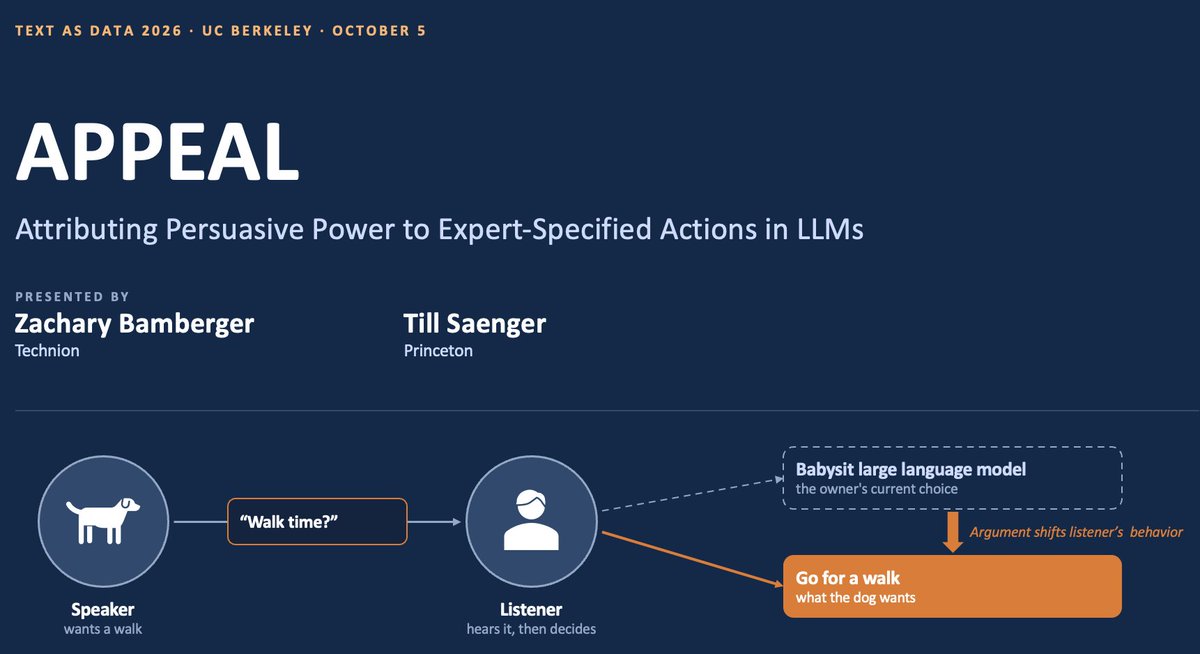
On October 5th @trsaenger and I will give an oral presentation at @textasdata at @UCBerkeley.
We’re incredibly excited to present "APPEAL: Attributing Persuasive Power to Expert-Specified Actions in LLMs"
This is joint work with @GiladMorad12, @ofraam, and @b_m_stewart
The paper, the code, the model and a summary, in one place:
https://t.co/lL0sDYu5Jt
Paper: https://t.co/bTtX0Ddpey
Code: https://t.co/xiDRvcvGGA
Hugging Face: https://t.co/vKipYTP3B9
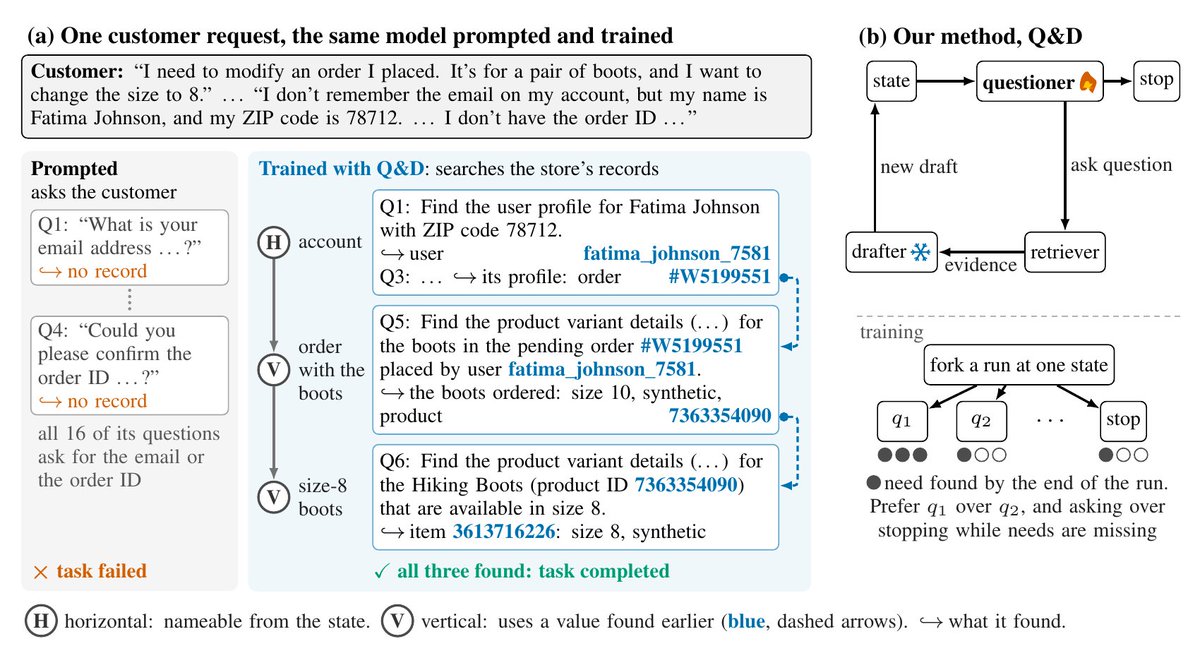
Tool-using agents do what they are asked. Yet a task often needs information the user never mentions.
What should an agent go after unasked, and can we train it to?
New paper, code and model, with @AsafYehudai@segevshlomov Asaf Adi @LChoshen
Still open: it learned what to ask more readily than when to stop, and the extra evidence doesn't yet turn into better final answers.
Code, need-graph metrics, 5,000+ tests and both trained seeds are open.
🚨New Paper (ACL-26)
'Efficient Agent Evaluation via Diversity-Guided User Simulation'
We tackle a core pain in agent evaluation:
Current methods aim for coverage (pass@k) but mostly re-run the same conversations → low diversity, high cost.
We're excited to introduce DIVERT 🧵
@DailyMirror The Daily Mirror took Karim Muammer’s photos from Anadolu Agency, but left out an important detail from the original report – he suffers from Fanconi syndrome, a rare genetic condition that affects the kidneys, liver, and intestines, causing poor nutrient absorption.
🚨New paper alert🚨
🧠
Instruction-tuned LLMs show amplified cognitive biases — but are these new behaviors, or pretraining ghosts resurfacing?
Excited to share our new paper, accepted to CoLM 2025🎉!
See thread below 👇
#BiasInAI#LLMs#MachineLearning#NLProc