$JUMP is coming to @legiondotcc : here’s how The Republic fits into the sale. 🟣🏛️
$JUMP is coming to Legion on September 29. @jumperapp is expanding from swaps and bridging into a broader onchain finance app, making this an interesting next step for the project.
https://t.co/So568p4e1B
The announced sale terms
- $0.075 per token at a $75m FDV
- maximum raise of $3m
- Buyers receive 50% at TGE, with the remaining 50% vesting over four months
- TGE is targeted for Q4 2026.
Through The Republic, participants can earn VP from accepted quests, raids, and useful content, then commit it to the allocation raffle. Each committed VP counts as one ticket, with applicable multipliers affecting the odds. KYC, a Legion application, USDC commitment, and the raffle requirements still need to be completed.
https://t.co/ObC641vjjK
✍️ What interests me is how useful community contributions can open up opportunities to participate. More VP improves the odds without guaranteeing an allocation, while Jumper’s ability to turn product growth into value for tokenholders is what I’ll keep watching. 🏛️
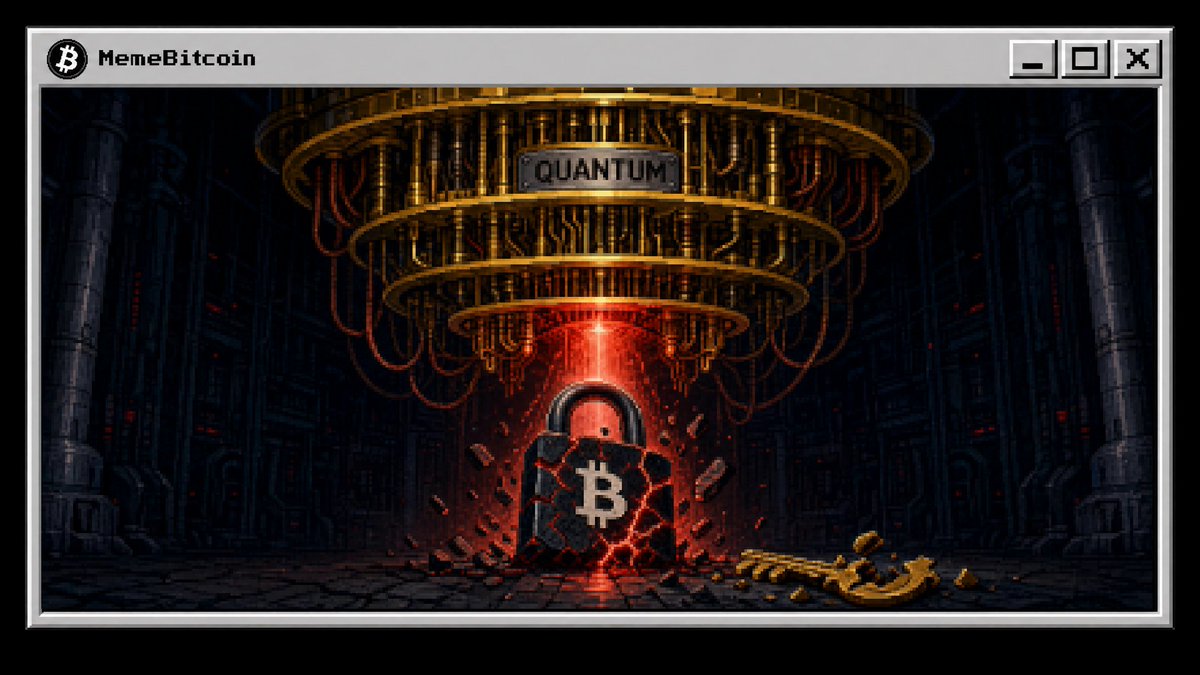
Quantum computing still feels like science fiction to most people in crypto.
But the research is moving faster than many realize.
Earlier this year, Google Quantum AI published new research on Shor's algorithm and secp256k1, the elliptic curve used by Bitcoin.
Under the hardware and error rate assumptions used in the research, the estimated number of physical qubits required for this type of attack fell to roughly one-twentieth of previous estimates.
That does not mean a quantum computer can derive Bitcoin private keys today.
But it does mean that a future quantum computer capable of threatening Bitcoin cryptography may require significantly fewer resources than researchers previously estimated.
And the work is continuing. Researchers are still finding ways to make the algorithms and quantum circuits involved more efficient.
The progress in quantum computing appears to be moving faster than the conversation around it in crypto.
Most crypto users still see quantum risk as something far in the future.
Something to think about later.
But how far away is "later"?
Crypto has a Fear and Greed Index to measure how the market feels every day.
Maybe one day we will need a way to measure quantum risk too.
At MemeBitcoin, Crack has never been symbolic.
Every Crack generates a real candidate private key and checks whether it matches the target associated with Satoshi.
With today's computing, the probability of finding the correct key is effectively zero.
But "impossible" in cryptography is not a law of nature.
It is a statement about how much computation is required.
And that is exactly what advances in quantum computing are beginning to challenge.
For now, the mathematics still holds.
For now, those coins remain untouched.
For now.
An estimated 1,096,361 BTC, held in wallets widely associated with Satoshi, has remained untouched since Bitcoin's earliest days.
We have been cracking toward it, one key at a time.
Soon, there will be another reason to Crack.
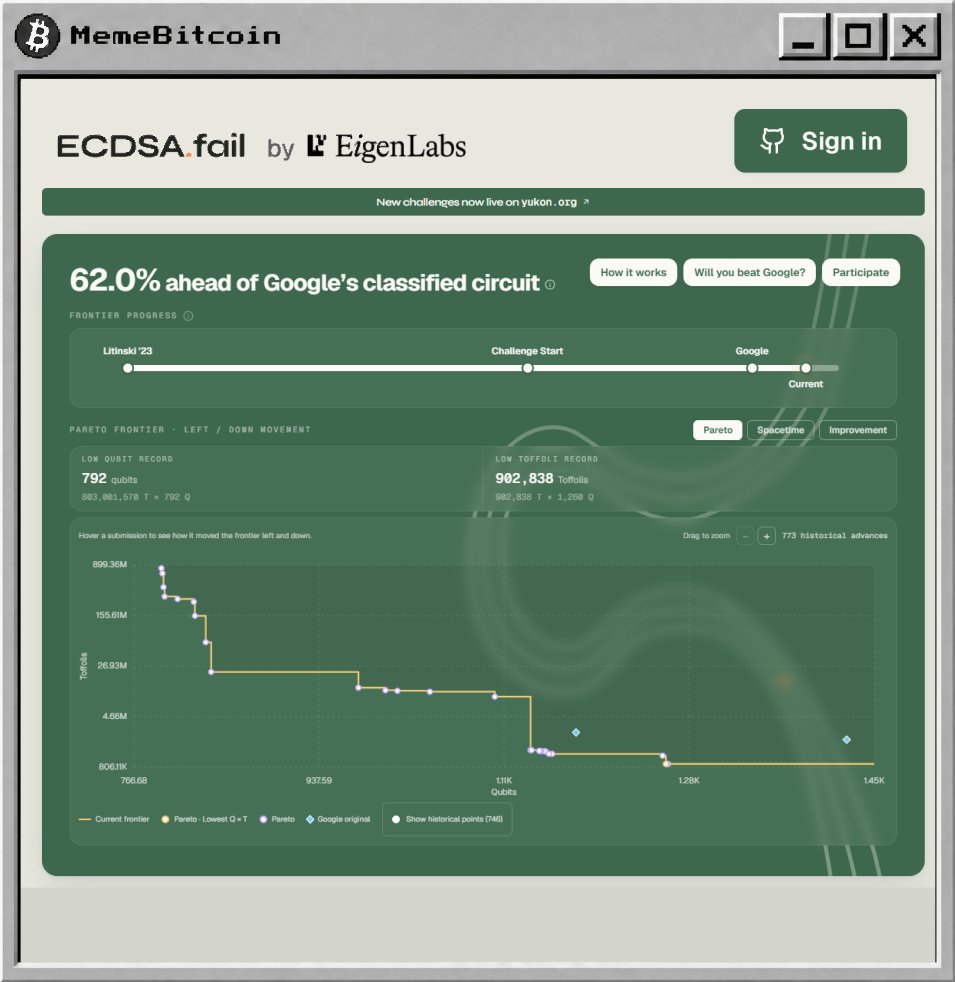
After Google Quantum AI claimed in March 2026 that it had found a much more efficient quantum circuit for breaking Bitcoin and Ethereum signatures, the community on Eigen Labs' Open Autoresearch project, https://t.co/MQGV1RjqTN, has now built circuits that use 62% fewer resources than Google's unpublished result.
This is no longer a distant possibility. It is a threat moving into view. The crypto ecosystem needs to pay much closer attention to this issue.
https://t.co/U6Wd9JNkDk
Mt. Gox, Ronin, DMM Bitcoin, Bybit, and now Bitget.
Another reminder that threats to crypto never stop evolving.
The next threat is quantum computing.
Wallets from Satoshi’s era have had their public keys exposed onchain for more than 15 years.
Together, they are associated with approximately 1,096,361 BTC, making them one of the largest targets in crypto history.
This is where MemeBitcoin is focused.
We are bringing the community together to reach Satoshi’s wallet before quantum computers do.
We are not waiting for the threat to arrive.
We are moving first.
Are you new to republic?
This is my useful tip for you.
Before starting, I read the raid card carefully and make sure I understand exactly what I’m being asked to do. Then I complete the required action, double-check that everything matches the requirements, and submit the proof that the system asks for. The extra few seconds spent checking everything can make the process much smoother than submitting immediately and realizing later that something was missing. What I like about the system is that approved work doesn’t just disappear after submission; it can move into the Republic raid queue where other participants can support it. So my approach is pretty simple now: understand the task, execute it correctly, check the proof, and submit.
Join now on republic.
https://t.co/iWDdFBU343