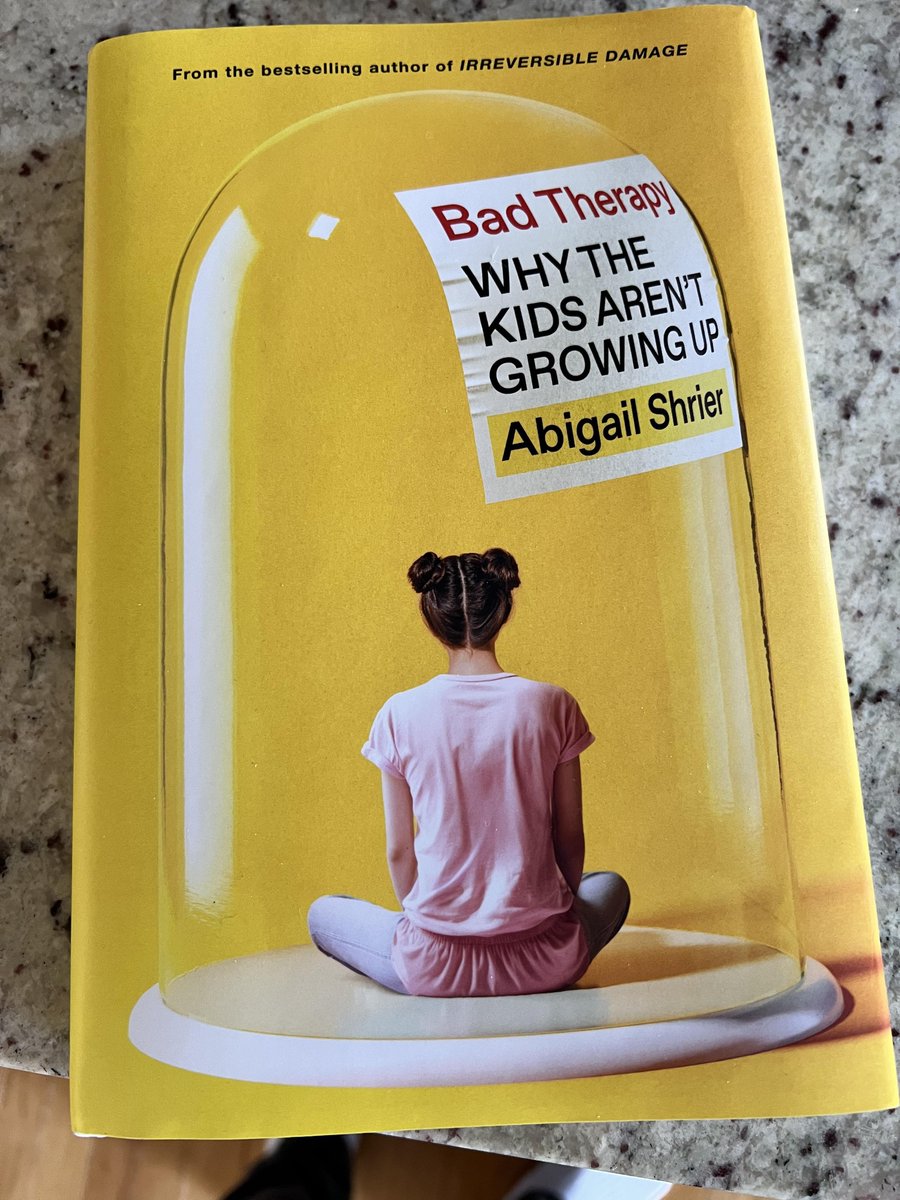
Just finished this book - Bad Therapy by @AbigailShrier
This is one of the most eye-opening books I've ever read. It's a must read for any parent, any teacher, and should be required reading for any school administrator as well.
The book dives into trying to figure out why kids are having so many mental health problems, when there are so many resources devoted to improving mental health outcomes.
Anxiety, depression, suicide, etc are all higher than they've ever been with kids, even though their lives are arguably better than ever before. It just doesn't make sense.
A few key takeaways from the book:
A constant attention on how kids are "feeling" or "thinking" is causing negative outcomes.
Constantly ruminating on your emotions and how you feel negatively impacts your mental health. If all you do is focus on your emotions, you are destined to be anxious or depressed.
We incessantly ask kids how they're feeling, if they're happy, how their mental health is, etc, and this is creating kids who think they're fragile instead of resilient.
Trying to solve every problem for kids has caused a generation who can't do anything for themselves.
We (Gen X) were told to "suck it up" or "you'll live" or "rub some dirt on it" all the time. Many of us came to the conclusion this is "bad parenting" because our feelings were neglected, and we vowed not to do this to our own children.
Because of that, kids immediately over-dramatize everything that happens to them, making mountains out of molehills, and thinking the world must revolve around their emotions and feelings.
You develop confidence and strong mental health by doing things, not by thinking or via therapy.
You can't think your way out of anxiety. You don't gain confidence by analysis of your thoughts or mental health issues.
You gain confidence and eliminate anxiety by doing gradually more difficult tasks, excelling at them, and realizing you are a competent, capable person.
The non-stop attention therapy gives to these small, common emotions we all feel blows them out of proportion to their seriousness (not talking about genuine disorders here, just normal anxieties that millions of people go to therapy to try to avoid).
One of the best ways to decrease your happiness is to chase it.
Our society constantly tells kids they should be "happy" and asks them if they are.
Happiness isn't a state you should be in 24/7. That's not realistic. Joy and bliss aren't permanent states - they are fleeting.
Contentment, stillness, and being even-keeled are much better goals to aim for mentally.
The happiest, most well adjusted kids come from families with loving parents that have strict rules for the household.
This one really set off the confirmation bias in me... I feel really blessed we have 2 well adjusted middle school kids who do great in school, are very respectful and well mannered, and we barely even need to parent them.
But for years, we were very strict with them. Bedtimes, family rules, how we do things, etc. The in-laws and lots of friends thought we were totalitarian.
In reality, we just had high standards. And it's really paying off right now. I found it really interesting that strict rules equals happy kids. Makes sense, though, as kids need to know what their boundaries are.
Constantly surveying school-age kids about their mental health causes more issues than it solves.
Mental health resources is big money. Districts need to validate all the resources allocated towards mental health, and they often do that via surveys.
Asking kids non-stop questions like:
- Have you thought about self harm?
- Have you thought about suicide?
- Have you been so anxious you can't get out of bed?
Etc, etc puts into their heads the idea that themselves, or many of their peers are broken and cannot function properly in the real world.
It normalizes situations that would be incredibly rare at any other time in history.
There's a lot of other takeaways, too, but I'll stop there.
It's a fantastic book. Go pick it up and read it. This isn't an affiliate thing or a promotion thing at all. I just really enjoyed it, and it will further shape the way I parent moving forward.
Ep. 76 As they lecture us endlessly about human rights in other countries, the Biden administration is trying to kill journalist Julian Assange for the crime of embarrassing the CIA. His wife Stella joins us from his extradition hearing.
Lessons Steve Jobs wanted to pass on.
Written right before he died.
In his own words:
1. ON BUILDING A REAL COMPANY:
I hate it when people call themselves “entrepreneurs” when what they’re really trying to do is launch a startup and then sell or go public, so they can cash in and move on.
They’re unwilling to do the work it takes to build a real company, which is the hardest work in business.
That’s how you really make a contribution and add to the legacy of those who went before.
You build a company that will still stand for something a generation or two from now.
That’s what Walt Disney did, and Hewlett and Packard, and the people who built Intel.
They created a company to last, not just to make money.
That’s what I want Apple to be.
2. ON TASTE OVER MARKET RESEARCH:
Some people say, “Give the customers what they want.” But that’s not my approach.
Our job is to figure out what they’re going to want before they do.
Henry Ford once said, “If I’d asked customers what they wanted, they would have told me, ‘A faster horse!'"
People don’t know what they want until you show it to them.
That’s why I never rely on market research.
Our task is to read things that are not yet on the page.
3. ON COMBINING IDEAS FROM DIFFERENT FIELDS:
Edwin Land of Polaroid talked about the intersection of the humanities and science.
I like that intersection.
There’s something magical about that place.
There are a lot of people innovating, and that’s not the main distinction of my career.
The reason Apple resonates with people is that there’s a deep current of humanity in our innovation.
I think great artists and great engineers are similar, in that they both have a desire to express themselves.
In fact some of the best people working on the original Mac were poets and musicians on the side.
In the seventies computers became a way for people to express their creativity.
Great artists like Leonardo da Vinci and Michelangelo were also great at science.
Michelangelo knew a lot about how to quarry stone, not just how to be a sculptor.
4. ON KNOWING WHY YOUR CUSTOMERS PAY YOU:
People pay us to integrate things for them, because they don’t have the time to think about this stuff 24/7.
If you have an extreme passion for producing great products, it pushes you to be integrated, to connect your hardware and your software and content management.
You want to break new ground, so you have to do it yourself.
5. ON WHAT HAPPENS WHEN YOU SHIFT THE FOCUS FROM GREAT PRODUCTS TO MORE SALES:
I have my own theory about why decline happens at companies like IBM or Microsoft.
The company does a great job, innovates and becomes a monopoly or close to it in some field, and then the quality of the product becomes less important.
The company starts valuing the great salesmen, because they’re the ones who can move the needle on revenues, not the product engineers and designers.
So the salespeople end up running the company.
John Akers at IBM was a smart, eloquent, fantastic salesperson, but he didn’t know anything about product.
The same thing happened at Xerox.
When the sales guys run the company, the product guys don’t matter so much, and a lot of them just turn off.
6. ON GREAT PRODUCTS BEING THE FOUNDATION OF AN ENDURING COMPANY:
My passion has been to build an enduring company where people were motivated to make great products.
Everything else was secondary.
Sure, it was great to make a profit, because that was what allowed you to make great products.
But the products, not the profits, were the motivation.
Sculley flipped these priorities to where the goal was to make money.
It’s a subtle difference, but it ends up meaning everything: the people you hire, who gets promoted, what you discuss in meetings.
7. ON BEING HONEST AND DIRECT WITH YOUR TEAM:
I don’t think I run roughshod over people, but if something sucks, I tell people to their face.
It’s my job to be honest.
I know what I’m talking about, and I usually turn out to be right.
That’s the culture I tried to create.
We are brutally honest with each other, and anyone can tell me they think I am full of shit and I can tell them the same.
And we’ve had some rip-roaring arguments, where we are yelling at each other, and it’s some of the best times I’ve ever had.
I feel totally comfortable saying “Ron, that store looks like shit” in front of everyone else.
Or I might say “God, we really fucked up the engineering on this” in front of the person that’s responsible.
That’s the ante for being in the room: You’ve got to be able to be super honest.
8. ON KEEPING THE TEAM EXCELLENT
I was hard on people sometimes, probably harder than I needed to be.
I remember the time when Reed (his son) was six years old, coming home, and I had just fired somebody that day, and I imagined what it was like for that person to tell his family and his young son that he had lost his job.
It was hard.
But somebody’s got to do it.
I figured that it was always my job to make sure that the team was excellent, and if I didn’t do it, nobody was going to do it.
9. ON TAKING ADVANTAGE OF THE GREAT WORK THAT WAS CREATED BEFORE YOU:
What drove me?
I think most creative people want to express appreciation for being able to take advantage of the work that’s been done by others before us.
I didn’t invent the language or mathematics I use.
I make little of my own food, none of my own clothes.
Everything I do depends on other members of our species and the shoulders that we stand on.
And a lot of us want to contribute something back to our species and to add something to the flow.
It’s about trying to express something in the only way that most of us know how.
We try to use the talents we do have to express our deep feelings, to show our appreciation of all the contributions that came before us, and to add something to that flow.
That’s what has driven me.
10. ON CONSTANT REFINEMENT AND PERPETUAL MOTION:
You always have to keep pushing to innovate.
Dylan could have sung protest songs forever and probably made a lot of money, but he didn’t.
He had to move on, and when he did, by going electric in 1965, he alienated a lot of people.
His 1966 Europe tour was his greatest. He would come on and do a set of acoustic guitar, and the audiences loved him.
Then he brought out what became The Band, and they would all do an electric set, and the audience sometimes booed.
There was one point where he was about to sing “Like a Rolling Stone” and someone from the audience yells “Judas!”
And Dylan then says, “Play it fucking loud!”
And they did. The Beatles were the same way.
They kept evolving, moving, refining their art.
That’s what I’ve always tried to do—keep moving. Otherwise, as Dylan says, if you’re not busy being born, you’re busy dying.
Are you finding it difficult to afford expensive paid courses?
I'm offering you access to 10 complimentary courses 🦑:
1. Artificial Intelligence
2. Machine Learning
3. Cloud Computing
4. Ethical Hacking
5. Data Analytics
6. AWS Certified
7. Data Science
8. BIG DATA
9. Python
10. MBA
To receive them, simply:
- Like and retweet
- Comment "Free"
- Make sure you're following (so I can send you a direct message)
Some of the worst crimes in history were committed in the name of fictional stories that people believed. Very few wars are about objective material things: it’s when people can’t agree on the story that conflict arises. How can we create good common stories that benefit people and prevent bad stories that cause huge misery? First, we need to understand that humans like us created the stories – so we can also change them.
See the full interview on @MSNBC here: https://t.co/9drMGUrRyo
Filmed in November 2023.
#stories #history #wars #humanity
LLMs passed a Turing Test, of a sort, for doctors.
149 actors playing patients texted live with one of 20 primary care doctors or else Google's new medical LLM, AMIE. Specialist human doctors & the "patients" rated the quality of care. AMIE beat the docs. https://t.co/swFrgsZpwD
@RadioGenoa London and the rest of the colonialist empire built their ‘identity’ stealing, enslaving, robbing civilizations for centuries… payback time
@cibc extremely disappointed in the service at a #Montréal branch, we were refused service, as Privilege CCardholders this is unacceptable. Looking to switch banks
@cibc was advised by the phone customer service that you prefer to open accounts at a branch because it’s “easier” for you. Seriously @cibc, seriously?!