The European teams fielding Africans as their own in the FIFA World Cup do not demonstrate enrichment or vitality. They reveal a spiritually gelded continent that must rent vital force from without because it can no longer generate it from within.
Traditional contests once affirmed the organic genius of a people, blood, soul, and spirit aligned under their own gods.
FIFA’s global carnival reduces nations to administrative fictions competing in a marketplace of talent. This is the regression of castes: higher forms yielding the arena to sloppy substitutes while the last men cheer their own displacement as moral progress.
Europe fields proxies because it has forgotten how to be itself. The blood runs thin. The pitch is now the stage of its quiet obsolescence. This is the Kali Yuga in fluorescent soccer shoes: games without our ancestral gods, victory without meaning.
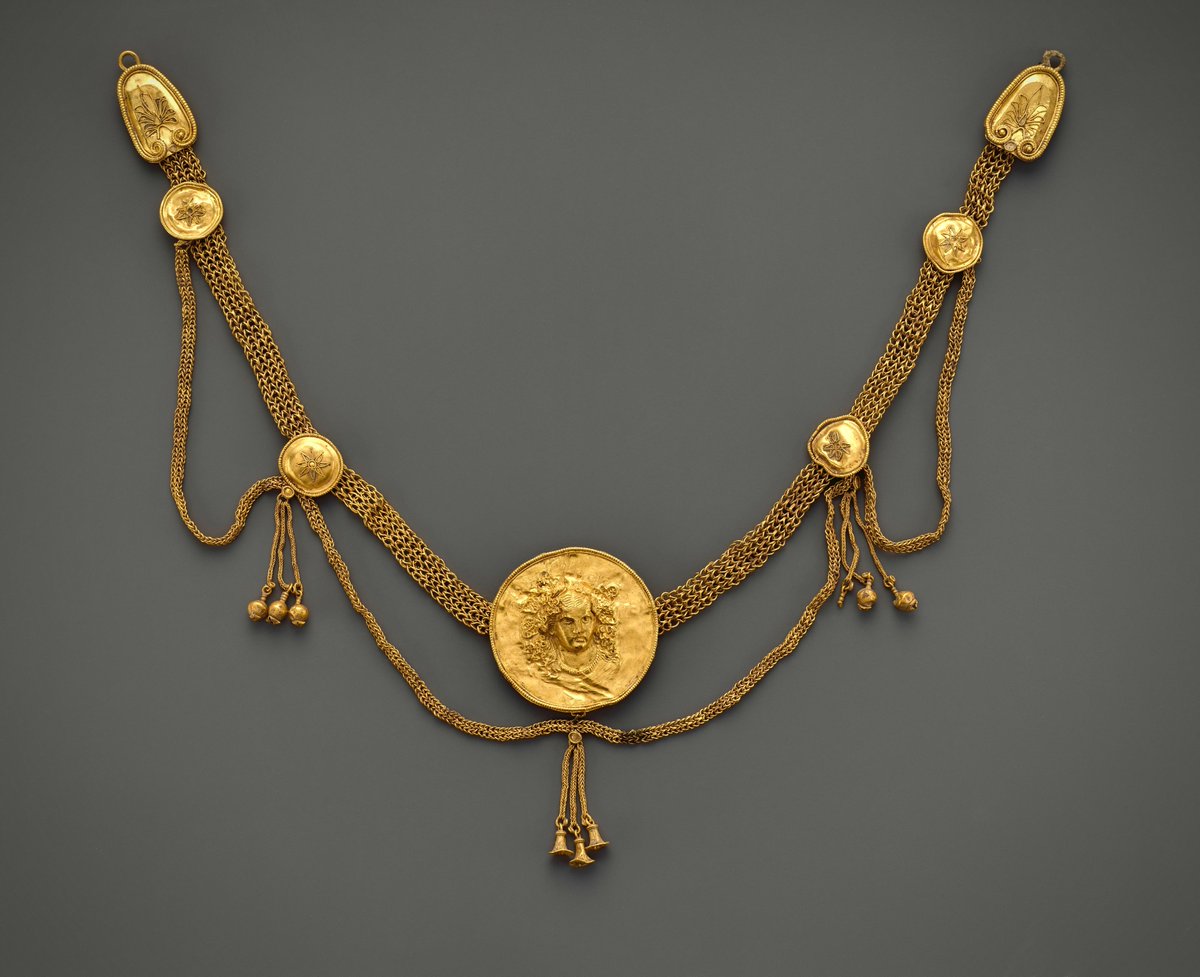
A Hellenistic era gold collar necklace with a medallion of Dionysus. MET, New York.
Ἒν πυρὶ μὲν χρυσόν τε καὶ ἄργυρον ἴδριες ἄνδρες
γιγνώσκουσ᾽, ἀνδρὸς δ᾽ οἶνος ἔδειξε νόον
-
Using fire skilled men determine what is gold and what is silver,
and so does wine reveal the hearts of men
Theognis 499-500
"Seeing, then, that Soul is immortal and has been born many times, and has beheld all things both in this world and in Hades, she has learnt all things, without exception; so that it is no wonder that she should be able to remember all that she knew before about virtue and other
Meno 86AB - If in us the truth of all things be the Soul, then Soul must be immortal for it knows things of which we could not have acquired knowledge in this life and 'must have had this learning through all time'
Theurgic Assimilation to the Gods
According to Iamblichus, the souls descent into the body is similar to an invitation to attend this cosmic liturgy: the theurgists, like the cultic statues of the gods, still living in their corporeal bodies can be united with the gods. Therefore, the theurgical praxis is related to the descent of the eternal cosmic liturgy and the return to the solar barque of Ra. This "supernatural" mystery transcends all discursive reasoning and human understanding; therefore, Iamblichus says:
"Intellectual understanding does not unite theurgists to the gods, for what would then prevent those who philosophize theoretically from having theurgic union with the gods? But this is not true; rather, it is the perfect accomplishment of the ineffable acts, religiously performed and beyond all understanding (he ton ergon arrheton kai huper pasan noesin), and it is the power of the ineffable symbols comprehended by the gods alone, that establishes theurgical union (tois theois monon sumbolon aphthegkton dunamis epitithesi ten theougiken henosin). Thus, we do not perform these acts intellectually; for then, their efficacy would be intellectual and would depend on us, neither of which is true. In fact, there very synthemes (ta sunthemata), by themselves, perform their own work, without our thinking; and the ineffable power of the gods to whom these synthemes elevate us, recognizes by itself its own images (eikonas). It is not awakened to this by our thinking" (De myster. 96.13-97.9).
Pg. 196 Philosophy as a Rite of Rebirth, Algis Uždavinys
THE HISTORY OF THE RESTORATION OF THE PLATONIC THEOLOGY BY LATTER PLATONISTS
Section I
"The Grecian theology, the history of whose restoration by the latter Platonists is the design of the present dissertation, did not originate among the Greeks, but was the progeny of barbarian propagation. This will be evident by considering that Orpheus was a Thracian; Thales, a Phoenician; Hermes Trismegistus, an Egyptian; Zoroaster, a Persian; Anacharsis, Scythian; and Pherecydes, a Syrian. Yet though Greece was not the parent of theology, she was notwithstanding her benevolent nurse, by whom she was kindly educated, and received the full perfection of her nature. Indeed, though illustrious men flourished in the East, and theology was there particularly cultivated, yet her education was limited and rough, entangled with inexplicable ceremonies, and guarded by the sanctity of inviolable oaths. But when she was into the Grecian soil, and experienced the happy temperature of its climate, her genius became both elegant and profound; her person magnificent and graceful; and her ceremonies rational and sublime. Particular nations, indeed, seem to have been distinguished for particular pursuits. Thus the Egyptians appear to have excelled in the powers of invention; and the East, in general has been remarkable for its attachment to the most recondite and mystic philosophy. Thus the Romans were famous for the arts of eloquence and war; and the Greeks have ever been celebrated as a people by whom every branch of knowledge received its ultimate perfection. They were a nation equally favoured by the graces, the muses, and philosophy; who celestial union formed the divine genius of Homer, and inspired that elegance and depth with which the works of Plato are replete. They were in short, the standards of excellence to the ancient, and are objects of imitation to the enlightened part of the present world; and their theology, as well as their arts, will be admired when modern systems are no more."
Oracles And Mysteries, Thomas Taylor - Pg. 129