I genuinely don't understand how this design was considered acceptable when it completely loses the character's defining signature traits. Please show some respect for the character, and for the feedback people have been giving. Those comments weren't made just for the sake of being heard.
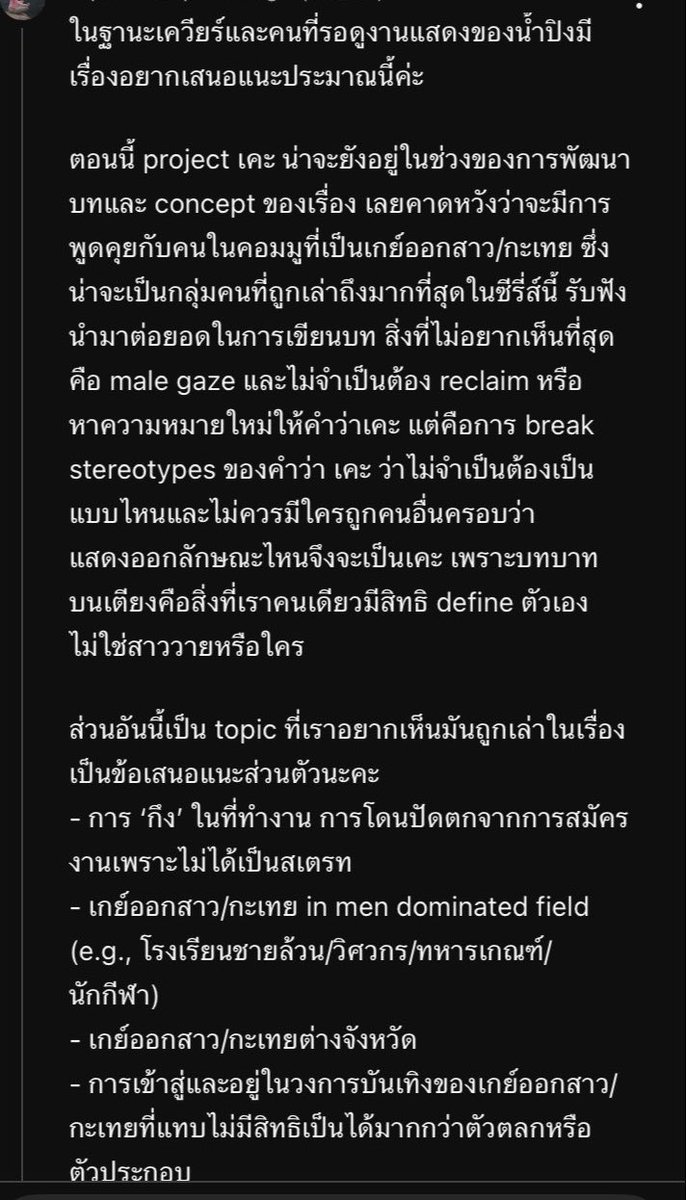
Never wanted Uke to be just a response to netizens. Hope it gives a voice to those who have been hurt, fosters understanding. You can't cover everything at once. If you choose certain issues, give them the depth. And leave the rest for second ss.
#เคะTheSeries#UKETheSeries
Each emotional state carries its own physicality, and further exploration of behavioral psychology may help make these expressions more natural.
Regarding voice, even without understanding Thai, emotion can still be felt through rhythm, tone, and vocal energy. Panic often comes with short breath and fragmented speech. Sadness may carry a sense of heaviness or emptiness. Anger creates a completely different vocal intensity. Expanding vocal expression can greatly enhance emotional clarity.
Because of this, I hope Namping will dedicate more time to character preparation: studying the script, understanding objectives, actions, and psychological states before stepping on set. With current experience, reaching the correct emotional state immediately on camera is still a challenge, so preparation beforehand is very important.
This is also a personal observation regarding on-screen presentation. Since the eyes are one of the most important acting tools, a neater hairstyle or a fringe is important too
@nampingnapat
What I hope Namping can improve the most is the ability to fully transform into a character.
In acting, one of the most important principles is “don’t play the result”. Don’t try to perform the emotion or outcome that the audience is supposed to see. Emotion is not something directly “created,” but a natural consequence of actions, circumstances, and the objectives a character is pursuing in each moment. When actors try to “play sadness,” “play crying,” or “play grief,” the performance can easily become technical and lose its sense of life.
The character should be placed in a situation and driven by a clear objective: what are they listening to, what are they going through? When the objective is clear and the situation is under pressure, emotion will naturally emerge as a reaction.
From my personal perspective, the current issue is the gap between understanding emotion and truly living within it. I still sometimes see an actor trying to express emotion, rather than a character genuinely existing within the situation.
From the “don’t play the result” principle, elements such as facial expression, eyes, breath, voice, and body language should be treated as natural reactions to what the character is experiencing. When the internal state changes, the body adjusts accordingly. If only external expression is focused on, the performance can easily become presentational rather than experiential.
With crying scenes, tears are not the only important element. Crying carries many emotional layers: grief, anger, desperation or even happiness. Each state leads to different changes in the eyes, facial expression, breathing, voice, and physical behavior. At the moment, the emotional range in Namping’s crying scenes still feels relatively similar, which sometimes makes it harder for certain moments to fully convey the intended emotional depth.
One detail I often notice is that when crying, the eyes tend to narrow quite a lot, while the mouth and cheek muscles are slightly lifted. This unintentionally draws attention toward the cheeks, making it harder for the audience to read emotion through the eyes, which are one of the most important tools in close-up shots.
However, acting through the eyes does not mean ignoring the rest of the body. An effective emotional scene requires the full integration of eyes, facial muscles, breath, voice, and physical behavior. The eyes may carry the inner life, but without aligned breathing, vocal tone, and facial response, the performance can lose emotional weight. Conversely, forcing expression or tears without changes in breath, gaze, and voice also makes the performance feel less natural.
In the opening part of the pilot, the crying scene did not fully establish a clear emotional state for the character. However, it is also difficult to fully evaluate without understanding the complete context and psychological state in the script. That said, the emotional intention was not yet consistently readable.
Another example is a psychologically intense situation. When a character sees someone they love standing on a rooftop with suicidal intent, the reaction is usually not an immediate emotional explosion, but a series of very small shifts over time. The first moment is realization: the body freezes, the eyes try to confirm what they are seeing, and the face shows disbelief or shock. The voice at this point is usually very soft, almost as if speaking to oneself, just a name or a faint “don’t.”
After that, as the information is processed, the emotion shifts into panic. The body becomes more active: faster movement, heavier breathing, and increasingly unstable voice. This layered progression creates psychological depth rather than jumping directly into an emotional peak.
Regarding body language, Namping is naturally relaxed in daily life, but on screen there are moments where the body can feel slightly tense. A character is not only built through dialogue but also through how they occupy space, react, and move.