@Iikechukwu2@Chuka_ndu You are right. 'Chi ukwu' is an attempt by modern Igbo philosophers at creating a replica of the Christian God. It has no place or meaning in original Igbo Cosmology.
I’m not impressed by people who pull down their fathers/grandfathers house all in the name of erecting a mansion....go and buy land somewhere else and build....leave that old house alone, it brings memories
The present-day usage of Chineke ‘god who creates’ to mean the supreme god ‘Chukwu’, is a colonial-Christian construction.
Chineke as a single entity is far from the meaning of Chineke in Igbo traditional usage.
The present-day usage of Chineke ‘god who creates’ to mean the supreme god ‘Chukwu’, is a colonial-Christian construction.
Chineke as a single entity is far from the meaning of Chineke in Igbo traditional usage.
The present-day usage of Chineke ‘god who creates’ to mean the supreme god ‘Chukwu’, is a colonial-Christian construction.
Chineke as a single entity is far from the meaning of Chineke in Igbo traditional usage.
@TOkereke@saylessplz@IgboHistoFacts It would be important to note, for clarity's sake that the 'god' in question here implies a worshipped creator. Ndi Igbo never worshipped their chi.
@maduchris@saylessplz@IgboHistoFacts Your ancestors are not just "a few people." They created and gave meanings to words that are far spiritual than your modern interpretations. Chi is not a god.
@jeomaltd@saylessplz@IgboHistoFacts How can you call what you do not understand a lie? The chi you claim you know is anglosized to mean god because the British could not understand Igbo Etymology. Chinaeke is a combination of two words Chi na Eke. just like you have Nne an Nna, Ezi an Ulo.
@saylessplz@IgboHistoFacts Chi does not translate to god. Chi is the fate-controlling force. Each person is assigned a Chi at birth that controls the person's fate on earth. Chi works with Eke, the life-creating force. Both accompany an individual in his life's journey.
The leaderships of markets in precolonial Igboland were headed by women and only women engaged in trading of items except slaves. Having the skill to haggling prices was considered a strenght for women. ‘Abo/Avo’, a woven shopping basket was an indispensible property of a woman.
19th century 'Ogba' anklets; This made in pre-colonial 'Oka' (Awka) ankle ornament was worn by women of high-ranking status. Walking in them was so difficult that women who wore them developed a certain gait which was regarded as a beautiful and feminine way to walk.
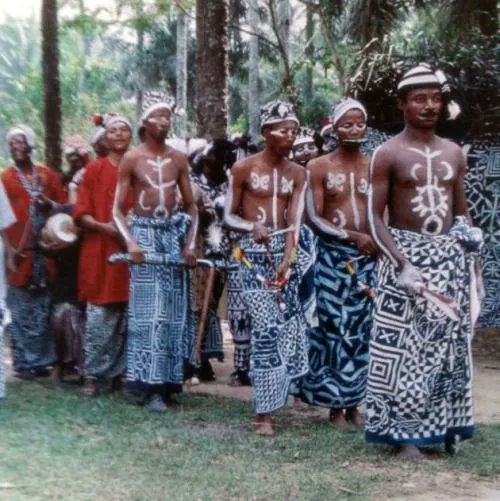
The 'Ukara Ekpe' an Igbo textile, designed with Nsibidi ideographic characters and was used strictly by members of the Ekpe society. They were designed by Ohafia, Abiriba and Arochukwu men, woven by Abakeleke men and secretly dyed by post menopausal women.
Photo:Svelte magazine
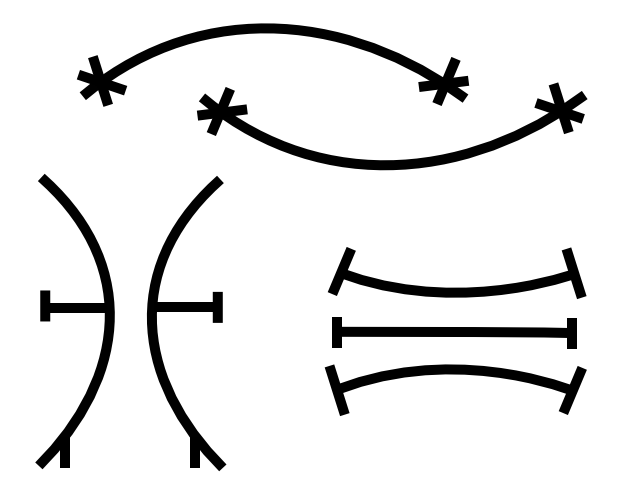
The Nsibidi characters, was used by lovers and secret society members in pre-colonial Igbo land. Though not a generally accepted claim, it was said that the characters were taught by baboons to a man from an Igbo speaking part of the northern Cross River region.
'Akpu' ‘silk cotton tree’ almost extinct now, was believed to have protective powers against bullets. Warriors preparing for war would embrace it, believing that the tree rather than their bodies would absorb any bullet directed at them. It is called ‘ọghọmgbọ’ in Igboukwu.
Carved hair designs were once envogue in pre-colonial Igbo land. Note the use of 'uli' motifs in the hair designs on these 1911 photos of ‘Nwamadu’ and ‘Mboye’ from Awka and Nibo respectively in present-day Anambra State, Nigeria.
Source: https://t.co/heo4BGtwrA
Ofo, a carved hand-held staff, obtained from the twig of the ofo tree (Delarium Senegalese) is the traditional symbol of justice and truth in Igbo land. It also symbolizes ancestral authority and is held by the eldest son in a family.
Photo: Barakat gallery
The Akwete fabric is the traditional hand woven cloth of Ndi Igbo. Its making is dominated by the highly talented women of Ndoki town in Akwete of today Abia state where it originated. This art has been attributed to one “Dada Nwakwata”, the acclaimed founder of Awkete weaving.
"Ugo" the eagle represents excellence, respect and honour in Igbo land. Its feathers are affixed to caps of title holders to symbolize honourable achievements- a concept known as “ituru ugo”. It inspires such names as Ugonna, Adaugo, Ugochinyere, Ugomma...