The Holy Spirit challenges us today regarding our relationship with technology and the ongoing digital revolution. Technology has the power to heal, connect, educate and protect our common home; but it can also divide, exclude and generate new forms of injustice. #MagnificaHumanitas
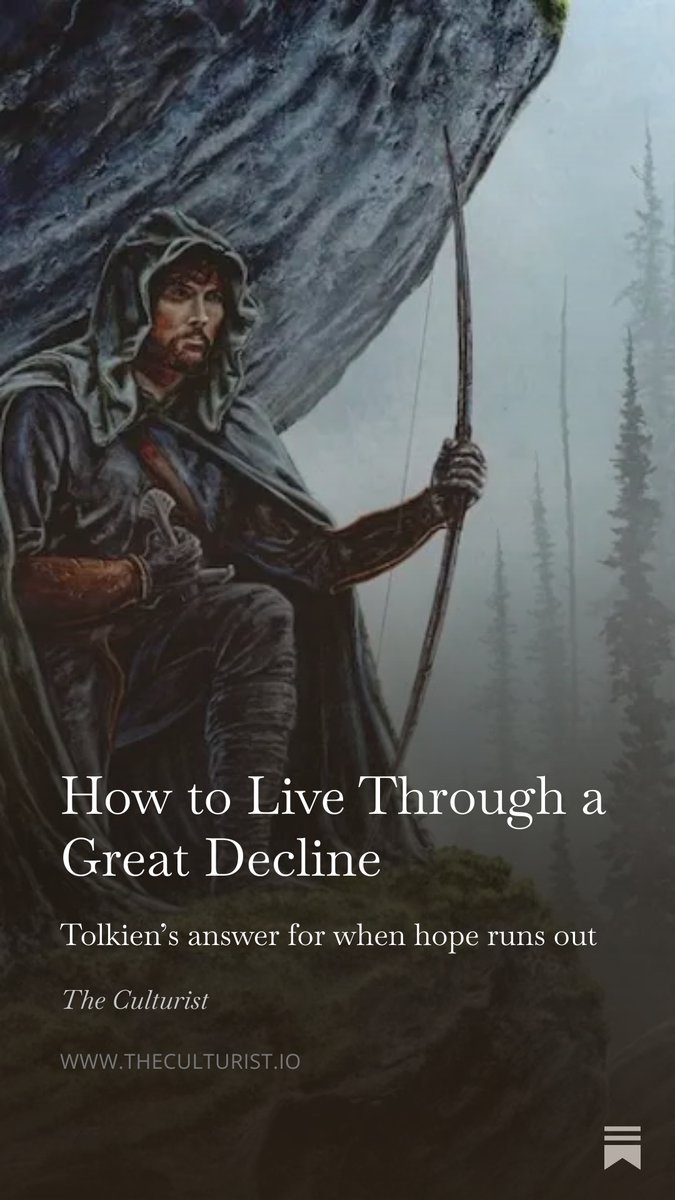
If you're living through a great decline, how should you personally live and act in the midst of it?
This is the question at the heart of "The Lord of the Rings," and it's best answered by the scene following the death of Boromir.
After Boromir gives his life to save the Hobbits from Saruman's Orcs, the Fellowship is in tatters. With time against them, Merry and Pippin swept away by the enemy, and Frodo passing out of their control, Aragorn and company make a decision that seems strange.
They pause to mourn Boromir's passing with a proper ritual.
To many readers, this feels entirely reckless. Their "best" course of action is surely to prioritize what is most urgent: that the fate of their quest hangs in the balance. We recognize that, in any "normal" context, it would be wrong to let Boromir's body lie out in the open, but the nature of their mission surely doesn’t allow for the luxury of a funeral — right?
But the fact that abandoning Boromir's body is wrong in normal times is precisely why it is wrong even now. At the heart of LOTR is the idea that moral decisions lie beyond their immediate context: some things just are wrong and others right, and once context becomes an arbiter of that distinction, you've lost your grip on what it means to be good.
Aragorn's next statement helps us understand this further:
"I would have guided Frodo to Mordor and gone with him to the end; but if I seek him now in the wilderness, I must abandon the captives to torment and death. My heart speaks clearly at last: the fate of the Bearer is in my hands no longer."
Aragorn makes yet another decision to halt progress on the greater mission in favor of that which speaks directly to his heart: he will pursue Merry and Pippin, rather than sacrifice them for the "more important" quest.
Tolkien's heroes recognize that they are not in control of everything. They cannot force the Ring to be unmade through their own will to power, and they're aware that their universe is guided by forces beyond their own and of their enemies. All they do is done in that humility, and they are bound by moral laws beyond themselves.
Indeed, Middle-earth is guided not just by the opposing wills of Good and Evil but by another, providential force beyond the material.
It is precisely because Tolkien's heroes believe in objective good that they can trust that a great, providential turn in fortune — a "eucatastrophe" — is around the corner. To believe in the objective good is to live in accordance with destiny, and to act on what is inherently good at all times, and to die for it if necessary.
To live in submission to divine providence is to recognize that the right actions also lie in the little things, and that you yourself play only a small part in the grand story.
A good world is brought into being by small acts of courage and kindness, even when they seem superfluous in the wider context of your quest...
https://t.co/HyhHZGGYde
@BisEsse2@ElPrincipe22__ È finito il rito collettivo di guardare tutti la stessa cosa in tv. E con questo perdono di importanza miti nazional popolari come il calcio e la nazionale. Forse siamo noi un po' ehm... anzianotti
🚨BREAKING: MIT hooked people up to brain scanners while they used ChatGPT.
What they found should concern every single person reading this.
ChatGPT users showed 55% weaker brain connectivity than people who didn't use it. Not after years. After just four months.
Here's how they tested it. 54 people were split into three groups: one used ChatGPT to write essays, one used Google, and one used nothing but their own brain. They wore EEG monitors that tracked their brain activity in real time across four sessions over four months.
The brain-only group built the strongest, most widespread neural networks. Google users were in the middle. ChatGPT users had the weakest brains in the room. Every time.
Then the memory test hit. Participants were asked to recall what they'd just written minutes earlier. 83% of ChatGPT users couldn't quote a single line from their own essay. They wrote it. They couldn't remember it. The words passed through them like they were never there.
It gets worse. In the final session, ChatGPT users were told to write without AI. Their brains were measurably weaker than people who never used AI at all. 78% still couldn't recall their own writing. The damage didn't go away when the tool was removed.
Meanwhile, brain-only users who tried ChatGPT for the first time? Their brains lit up. They wrote better prompts. They retained more. Their brains were already strong enough to use AI as a tool instead of a crutch.
The researchers also found that every ChatGPT essay on the same topic looked almost identical. More facts, more dates, more names. But less original thinking. Everyone using ChatGPT produced the same generic output while believing it was their own.
MIT gave this a name: cognitive debt. Like financial debt, you borrow convenience now and pay with your thinking ability later. Except there's no way to pay it back.
The question isn't whether ChatGPT is useful. It's whether the price is your ability to think without it.
@Cazzaccimiei1 La Canzone Italianah è sempre stata canzonette popolari. Quartetto Cetra, Toto Cotugno, Celentano, 883, Vasco, fino a Tananai e Annalisa di oggi. Quella piace e vende. Il commento di Linus è da "ok, boomer 👍"
@Cazzaccimiei1 Esempi stupidi se ne possono fare a milioni. La "funiculi funiculà" della Grande Tradizione Napoletana IGP è un motivetto scritto da un maestro altrimenti sconosciuto per fare pubblicità alla funicolare del Vesuvio.
@paesinocel2 I film mentali se li fanno tutti, e tutti gli adolescenti tendono all'alienazione in certi periodi. Anche quelli con una vita sociale normale. Il punto è riuscire a capire quando il film sta diventando una mania e trovare la forza di allontanarsi.