It’s now been 4 years since I gave my dad a kidney and we are still doing great. If you have a loved one in need, take the time to learn the facts about kidney donation. If you need a transplant, don’t be afraid to ask. I hope this article helps. https://t.co/JZtWI4j8xc
במשך שבוע שלם, הלשכה הקטארית של נתניהו מפמפמת את הטענות של אחד ברט מקגורק, לשעבר יועץ של ביידן, שכאילו נתניהו לא קשור למותם של כמעט 50 חטופים ישראלים בשבי החמאס.
עכשיו, עזבו שהפוסטים והכתבות בנושא כללו שלל השמטות ועיוותים (גם מקגורק כתב, למשל, שנתניהו היה אדיש לגמרי לגורל החטופים).
אחרי שבוע של מופע תעמולה בלתי פוסק, מגיע פיל גורדון, שהיה בתפקיד בכיר יותר ומשפיע יותר בכוורת של ביידן, ובאנגלית וושינגטונית מנומסת כותב: חרטא.
נתניהו, הוא מזכיר לכולם, הציב תנאים בקיץ 2024 שסיכלו השגת עסקה , כמו בידוק ישראלי לפלסטינים שעולים מדרום הרצועה לצפון - ואז נרצחו ששת החטופים ברפיח.
חצי שנה אחר כך, הוא הגיע להסכם הפסקת האש של ינואר 2025, שבמסגרתו ישראל נסוגה מציר נצרים ובעצם לא היה שום בידוק למאות אלפי הפלסטינים שחזרו צפונה.
על זה נאמר, "השקר מקיף את הטלגרם של פרשני נתניהו שלוש פעמים, בזמן שהאמת קושרת שרוכים".
אבל בסוף האמת מופיעה. והאמת מנצחת.
והכי כואב: למרות אותם 50 חטופים שנרצחו בשבי, ולמרות 1300 חיילים הרוגים, ממשלת ישראל בראשות נתניהו לא הצליחה להכריע את חמאס. הארגון שולט גם היום בעזה עם 30 אלף מחבלים חמושים. למרות המחיר הכבד כל כך ששילמנו
והיום בפינתנו, "דברים שלא תקראו אצל עמית סגל".
פיל גורדון, שהיה בכוורת של ביידן לענייני המזרח התיכון, מפוצץ את הבועה השקרית של הביביסטים בנושא נתניהו והחטופים.
Netanyahu supporters seem to be taking advantage of @Brett_McGurk’s book and interviews to claim vindication for Netanyahu’s conduct of the war in Gaza. But while Brett’s front-row account is valuable, that doesn’t mean it is definitive or its perspectives widely shared—including among former members of the Biden administration.
I would say most of my former colleagues think that President Biden should have put more pressure on Israel to conduct the war differently and end it sooner, and few think that the biggest mistake Biden made was to show daylight with Israel. And even Brett’s account makes clear that hostages were not the top priority for Netanyahu and that when U.S. pressure actually was applied—as after the World Central Kitchen strike—it worked.
Brett tells the story of the Biden phone call after that tragedy, but not the story of how Biden called Netanyahu on July 4, 2024 to press him to conclude the hostage deal after Hamas had finally accepted the basic framework, dropping its demand that Israel commit to a permanent ceasefire before any hostages were released. Netanyahu instead added so many of his own conditions—against the advice of his own security chiefs—that the deal became impossible for another six months, during which nearly 9,000 more Palestinians were killed and more Israeli hostages died, including the six that Hamas executed in August. The Israeli changes included a demand that Israel retain forces along Gaza’s entire border with Egypt, which the IDF had seized only after the original proposal, and a new enforcement mechanism to screen Gazans who were returning home to the north which would have required Israeli troops to remain in central Gaza. Both of those new conditions were dropped in the deal ultimately concluded in January 2025.
Nothing in the book or elsewhere changes the reality that October 7 happened on Netanyahu’s watch; that he prioritized “total victory” and the maintenance of his coalition over a hostage deal or an end of the war; that his conduct of the war and management of its humanitarian consequences catastrophic; that it has left Israel more isolated and insecure; and that it has deeply damaged, perhaps irreparably, Israel’s relationship with the United States—which should have done more to change Israel’s conduct rather than enable it. There was never an easy way forward in Gaza, but no version of the story vindicates Netanyahu.
Every life stolen was an entire world.
The point is not to pretend that all we need is shared mourning, or to equate the suffering on both sides. Reckoning and accountability are required. But on this third anniversary of October 7th, a good start is to try to resist the flattening of empathy, to let ourselves weep for all the lives lost, the children killed, the families torn apart, the homes destroyed.
Join me tonight in Union Square, to mourn together, and to demand a future that doesn’t compromise on anyone’s humanity.
https://t.co/FF2OrX2IhN
On the third anniversary of Israel’s darkest day, our hearts are with the families of the 1,200 people murdered that day, as well as the dozens of hostages who died in Hamas captivity. We hold close, too, the survivors and all those whose lives were forever changed by the violence, terror and trauma of that day.
We also find space to celebrate the freedom and safety of the 166 hostages who made it home alive, and for whose release we fought so hard. The joy and relief we feel at their freedom remind us of the immeasurable value of every human life.
As we commemorate the Israeli lives lost in that horrific terror attack, we also recognize the devastation Israel’s response inflicted on Gaza. For the last three years, Gaza’s more than two million residents have endured an unrelenting nightmare that has not yet ended. Our hearts are with the families of the tens of thousands of civilians – including more than 20,000 children – killed in the war that followed.
This time last year, we were still desperately fighting for a ceasefire and the return of the hostages. That agreement came soon after, but the work of securing a fundamentally different future for Gaza and Israel remains unfinished. The United States and international community must push urgently to implement the ceasefire plan that would see Hamas disarm, Israel withdraw and real reconstruction begin.
As we feel the pain of October 7 and of the three years that have followed, let us redouble our efforts to build a future in which Israelis and Palestinians alike can live in freedom, security and self-determination and recognize that neither people will achieve lasting freedom and security until the other does too.
I am reminded today of the words of J Street’s dear friend Vivian Silver, a peace activist who dedicated her life to building that shared future and was murdered on October 7:
‘This could be such a haven to both of our people here.’
Indeed it could. That future remains possible – and we will continue to fight for it.
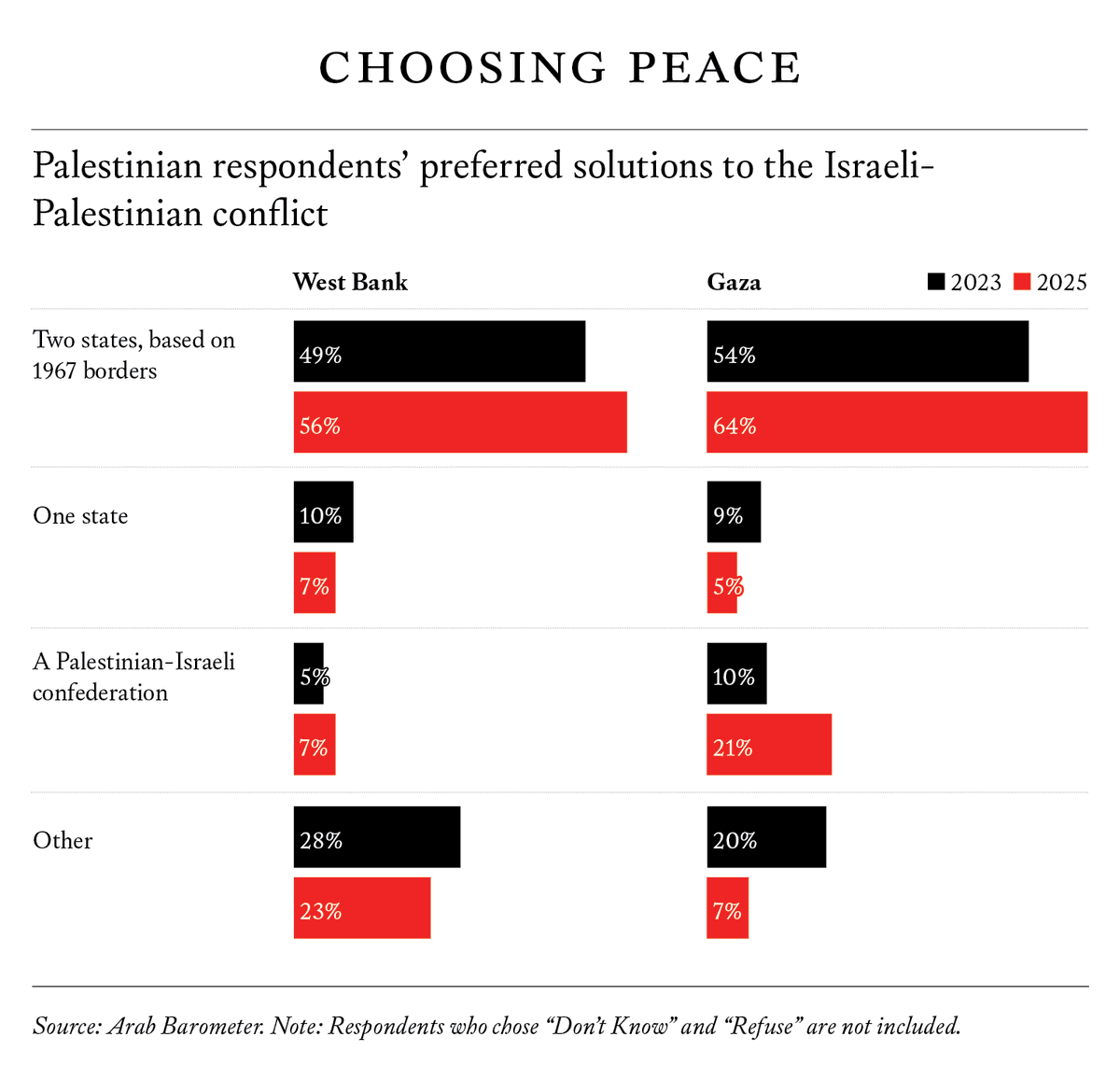
“Although there is Palestinian opposition to a two-state solution, a growing proportion—now a majority—wants it, and yearns for more capable and responsible leadership that addresses their needs and provides security,” write Michael Robbins, @AmaneyJamal, and Mark Tessler. https://t.co/9qoSqMFaqz
Castro’s bill is a smart first step towards finally curbing Israeli settlement expansion. It would require sanctions on new settlements like E1, which is designed to prevent the existence of a future Palestinian state, and give the president the authority to impose sanctions on existing settlements—and the infrastructure they rely on—if Israel refuses to work towards Palestinian statehood.
The bill would also prohibit Americans from importing goods produced in Israeli settlements in the West Bank and Gaza, as some European countries have done. This would only marginally discourage settlement expansion, but it would send a powerful political signal of U.S. opposition to the settlement enterprise. The first Trump administration’s decision to require settlement products to be labeled as “Made in Israel,” unfortunately never reversed by the Biden administration, was a U.S. green light to settlement activity that this bill would help turn red.
There is no chance this Congress will pass the bill, of course, or that Trump would act on it even if it did. But it is a useful framework for a future Democratic administration to put obstacles in the way of ongoing de facto annexation, which both causes enormous harm to Palestinians and threatens Israel's future as a democratic and secure state.
There is a grave and immediate threat to Israel's business sector. Not months away, days away. It is participation in bidding for tenders for the construction and financing of the doomsday settlement of E-1.
Any Israeli bank or financial institution that will finance the bids for the construction of E-1, that are to be submitted NO LATER THAN OCTOBER 19 runs the very real risk of being sanctioned by the international community. The same applies to developers, suppliers, professionals etc.
Who says so? The UK, France Canada, legislation currently before the US Senate and the House of Representatives enjoying broad support of the Democratic Party - and the final word has not been said.
They specifically and unconditionally single out E-1.
E-1, don't bank on it.
In the past 24 hours, two former top level Israeli officials, Nitzan Alon (former head of the hostage negotiations) and Dror Shalom (the former head political-military Bureau in the Ministry of Defense), said that the Netanyahu government could have reached a hostage agreement before the one that was reached because of US pressure.
The two also said that the objectives of the war could have still been achieved despite reaching a hostage deal.
It's clear from what they said that Netanyahu and his government did not want a hostage deal.
Go and read @Nadav_Eyal piece interviewing Dror Shalom
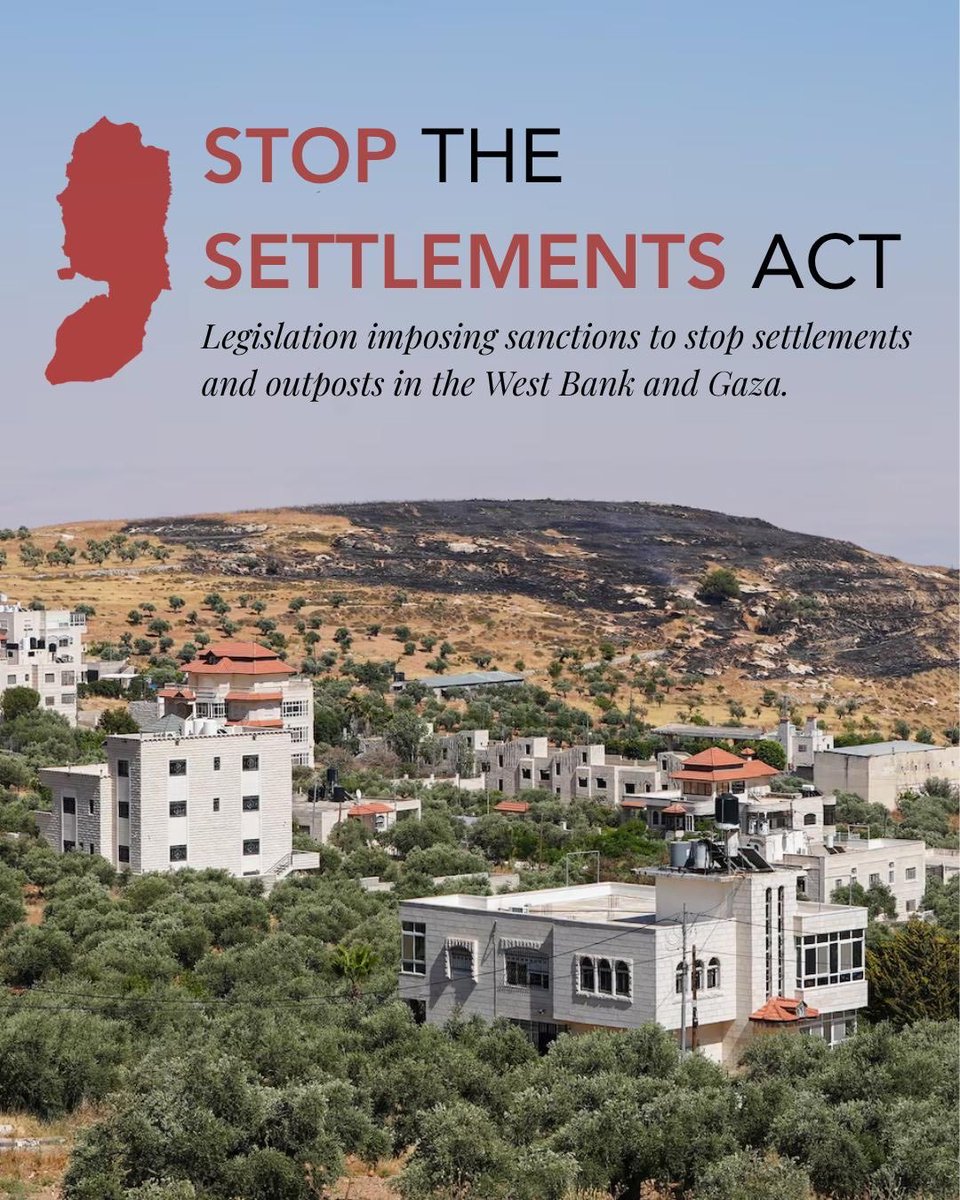
Israel’s support for settlements means the continuation of displacement & forced statelessness. That is why I join my colleagues @JoaquinCastrotx, @RepDean, @RepCasar, @RepSaraJacobs, & @RepEscobar in introducing the Stop the Settlements Act.
I witnessed firsthand how Israeli settlers in the West Bank pursue violent attacks on innocent Palestinians every day. The settlements must end.
This is either incredibly dishonest or just a very lazy lazy take. Read the legislation. It focuses on new settlements in the West Bank and Gaza or existing settlements in areas that threaten a viable Palestinian state. No that doesn’t include the Jewish quarter of the old city.
This is exactly the type of deceptive/lazy “analysis” you used to help tank the JCPOA making things up about the agreement and how it would quickly lead to a nuclear bomb while claiming that of course you didn’t want a war just more pressure. Now we’ve had that war you supposedly didn’t want, but then cheerlead for, and it’s been a catastrophe for US interests. Glad you are bringing your sharp “analysis” to this new problem.
So here’s the question for these Democrats: what exactly counts as “illegally occupied territory”?
Under UN Security Council Resolution 2334—which the Obama administration allowed to pass in 2016 by abstaining—East Jerusalem is treated as occupied territory, and Israeli settlement activity there as having “no legal validity.”
That raises an obvious question: would these sanctions apply to Jews living in the Jewish Quarter of Jerusalem’s Old City where Judaism holiest site is located?
And if the principle is that Jews should not live in those parts of Jerusalem or the West Bank (Judea and Samaria), these Democrats are demanding those areas be emptied of their Jewish residents.
Settlers are driving Palestinians from their homes in a violent land grab. Sanctions can stop it.
I'm introducing legislation—alongside Reps. Dean, Beyer, Casar, Jacobs, Escobar—that imposes sanctions against anyone looking to take Palestinian land in the West Bank or Gaza.
Under the Stop the Settlements Act, anyone pursuing settlements can’t do business with the United States.
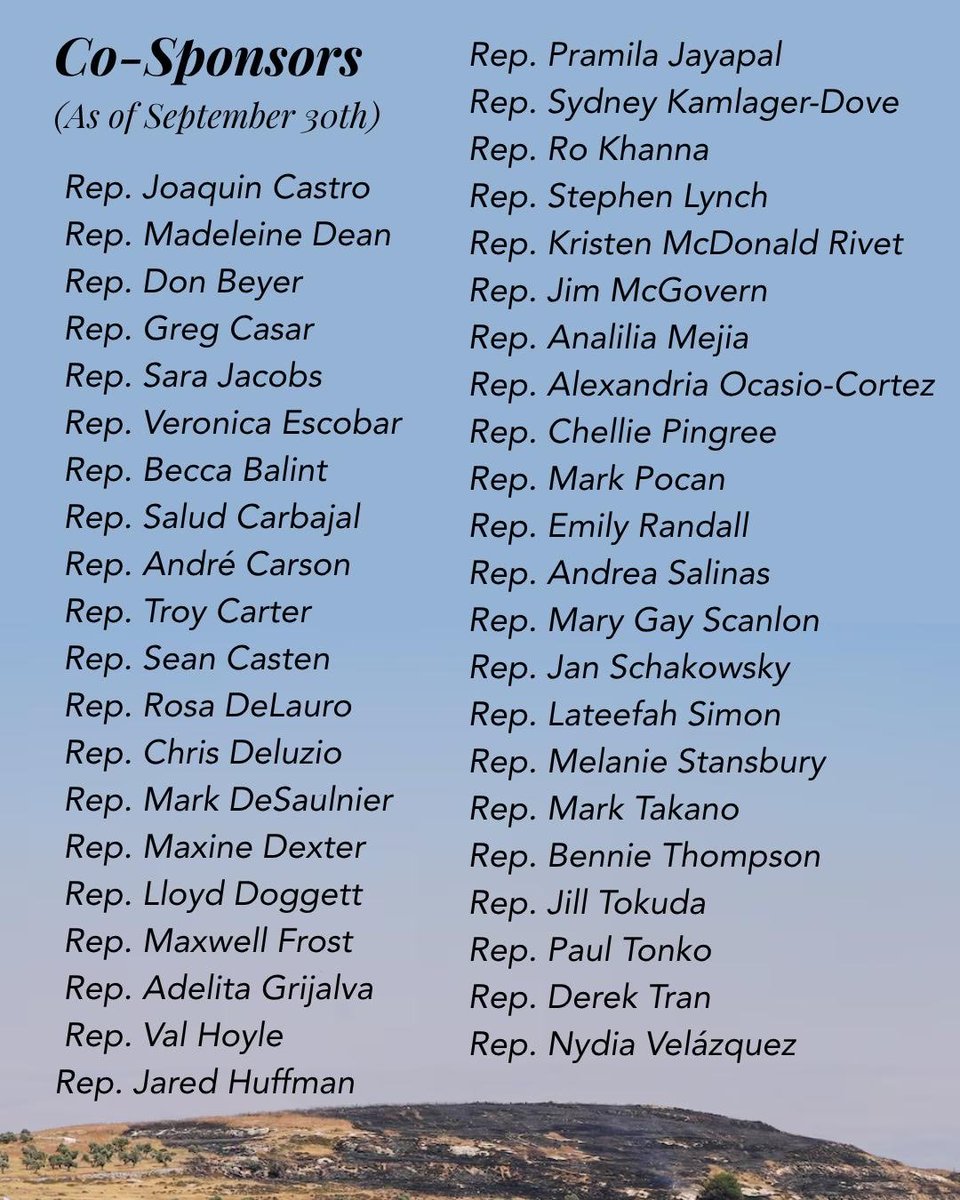
In addition, thank you to all of the my colleagues who are co-sponsoring this bill:
Rep. Becca Balint (VT-AL)
Rep. Salud Carbajal (CA-24)
Rep. Troy Carter (LA-02)
Rep. Sean Casten (IL-06)
Rep. Rosa DeLauro (CT-03)
Rep. Chris Deluzio (PA-17)
Rep. Mark DeSaulnier (CA-10)
Rep. Maxine Dexter (OR-03)
Rep. Lloyd Doggett (TX-37)
Rep. Maxwell Frost (FL-10)
Rep. Adelita Grijalva (AZ-07)
Rep. Val Hoyle (OR-04)
Rep. Jared Huffman (CA-02)
Rep. Pramila Jayapal (WA-07)
Rep. Sydney Kamlager-Dove (CA-37)
Rep. Ro Khanna (CA-17)
Rep. Stephen Lynch (MA-08)
Rep. Kristen McDonald Rivet (MI-08)
Rep. Jim McGovern (MA-02)
Rep. Analilia Mejia (NJ-11)
Rep. Alexandria Ocasio-Cortez (NY-14)
Rep. Chellie Pingree (ME-01)
Rep. Mark Pocan (WI-02)
Rep. Emily Randall (WA-06)
Rep. Andrea Salinas (OR-06)
Rep. Mary Gay Scanlon (PA-05)
Rep. Jan Schakowsky (IL-09)
Rep. Lateefah Simon (CA-12)
Rep. Melanie Stansbury (NM-01)
Rep. Mark Takano (CA-39)
Rep. Bennie Thompson (MS-02)
Rep. Jill Tokuda (HI-02)
Rep. Paul Tonko (NY-20)
Rep. Derek Tran (CA-45)
Rep. Nydia Velázquez (NY-07)
A half-century of the U.S. asking nicely has failed to stop ISRAELI settlement expansion.
NEW TODAY: The Stop the Settlements Act, introduced by @JoaquinCastrotx , @RepDonBeyer Dean, Casar, Jacobs would finally impose consequences—sanctioning those driving expansion and banning settlement goods from the U.S. market.
Congress finally playing a role. Long overdue.
https://t.co/8Qujl6Gqyi
For 50 years, American leaders have asked Israel to stop expanding settlements in the West Bank. For 50 years, Israeli governments have refused. It is past time to stop asking and start imposing consequences, and in the past week we are starting to see the beginnings of a new approach.
First with a narrower bill in the Senate led by Senators Coons, Warren, Wyden, and Gallego that would impose sanctions on anyone supporting construction in E1. And now a broader bill in the house led by Castro, Dean, Beyer, Casar, and Jacobs with 40 of their colleagues.
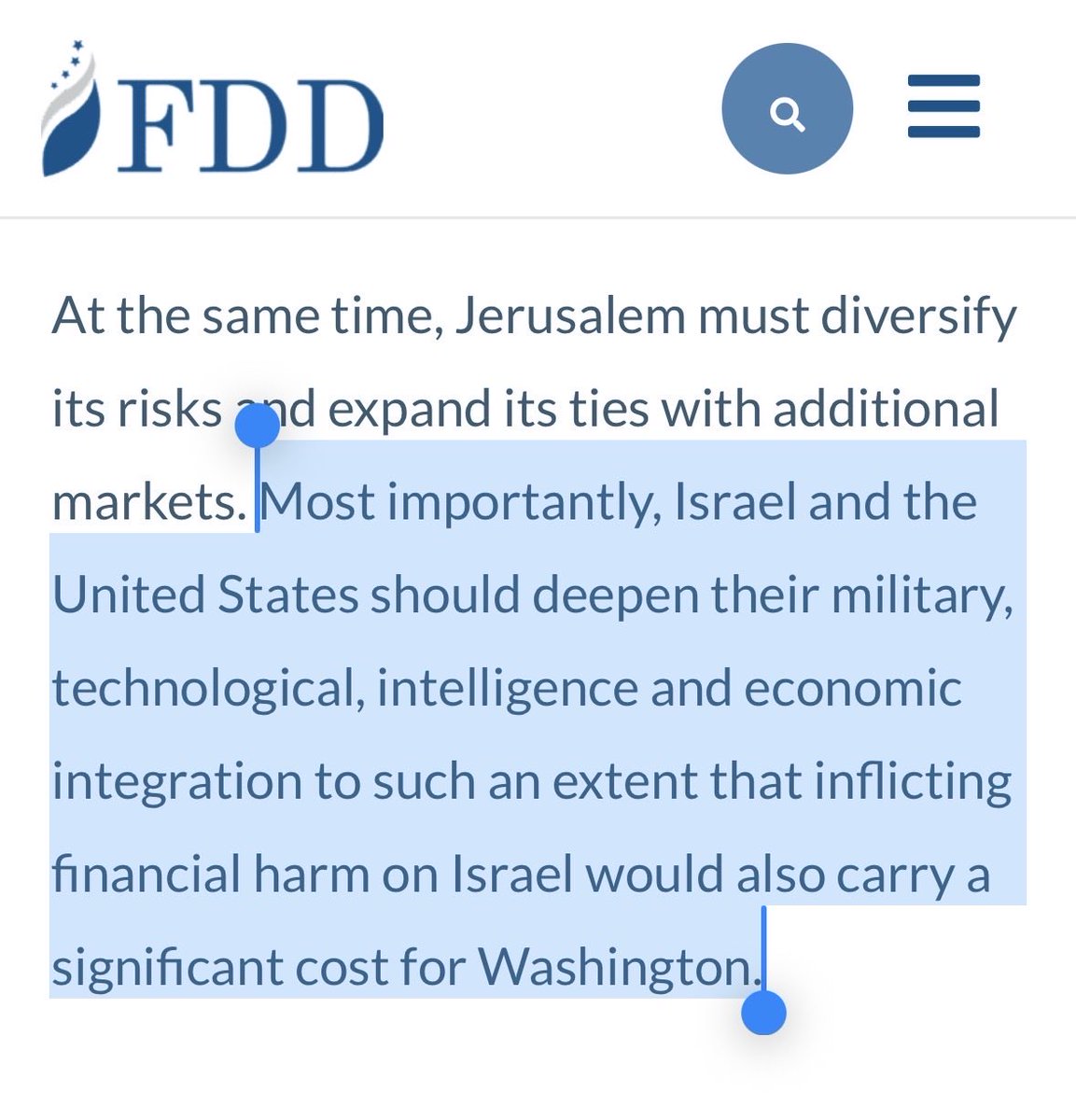
It is time for the United States to impose targeted sanctions on entities that finance, build and support settlement expansion that threatens the viability of a Palestinian state, and on officials responsible for it.
This is bigger than Netanyahu. Settlement growth has continued under Israeli governments across the political spectrum. The settlement movement is organized and politically powerful. Palestinians living under occupation cannot vote in Israeli elections. There is little domestic political counterweight. Polite or even loud American objections have never been enough to change that calculation. Targeted sanctions could.
How would you do this? Start by actually designating the worst offenders: organizations and entities supporting the tremendous boom in farming outposts over the past few years from which most of the violent attacks and officials such as Bezalel Smotrich and Itamar Ben-Gvir who are behind the effort. Make an example of them and make it much harder for them to operate.
Then give other companies and financial institutions a deadline to wind down activities that support settlement construction.
What you would likely get relatively quickly is a de facto settlement freeze on Israeli construction in the West Bank. Israeli banks are quite risk averse and deeply value their connection to the U.S. and international banking system. They would respond relatively quickly by pulling out from all of these projects. You’d have to couple that with continued targeting of the most problematic settlements and activities that threaten the viability of a Palestinian state, but you could fundamebntally shift the momentum.
Over time there would also be a change in incentives for settlers. Many live in the West Bank because housing is cheaper and subsidies are generous. If living in the settlements becomes financially harder, if new construction and roads aren’t happening, if businesses are pulling out since it’s simply too risky to operate, some of these settlers will choose to move inside green line Israel and you start changing the overall momentum on the ground.
Importantly, this approach targets the settlement enterprise, which makes it distinctly different from the BDS movement which calls for sanctions on al of Israel and boycotts on Israelis including those working for a better future with Palestinians.
And once Palestinians and Israelis can agree on a map, which likely means Israel keeping many of the settlements in exchange for unpopulated land beyond the Green Line, Israelis can build to their hearts content inside those borders.
The reality is that only the President of the United States with the tools of the executive branch can fully implement such an approach. But it is vital for members of Congress to start going on the record, building political support for a future policy, and beginning to signal to Israeli companies that it's time to stop investing in or supporting the settlements. That is why the new legislation this week is so important.
After 50 years of failed persuasion, the settlement movement needs to face consequences.
https://t.co/MS3OPNTC02
Every Senate Democrat but Fetterman just voted to force U.S. Gov to account for Americans killed in West Bank—and potentially restrict military aid to ISRAEL if it refuses. It failed because nearly every Republican voted no.
Now a House bill is reportedly coming soon to sanction those driving Israeli settlement expansion on Palestinian land and ban settlement goods from the U.S. market.
Many have worked for decades to get even close to this modest step: aligning U.S. law with stated U.S. policy. Long, long overdue.
https://t.co/3qDTBRAWKR
In '24, 11 Dems voted to advance a resolution seeking a State Dept report on whether human rights violations had occurred in Gaza.
Tonight, ALL Ds except Fetterman voted to advance a similar measure, in a rebuke that would once have seemed unthinkable.
https://t.co/1HrENMOYvP
Harris was hardly the only U.S. official to warn, publicly and privately, that an Israeli assault on Rafah would be a “huge mistake” with potential "consequences." Biden had by then already called it a "red line" and later went on CNN to threaten to withhold offensive weapons over it. And he was right to do so to prevent Israel from launching a ground offensive without a plan for the more than one million civilians sheltering there. It is implausible that a U.S. green light would have unlocked a favorable hostage offer from Hamas, which made no such offer even after Israel went into Rafah (or for eight months after that) or that Netanyahu would have agreed to end the war with Sinwar still alive. Whatever the administration's “biggest mistakes,” pressing Israel to change its Rafah plans was not among them.