We're on the precipice of massive sociotechnical transformation. In thinking about what root-level technologies will matter most, I keep coming back to two themes.
The first is Coordination. Non-linear and asymmetric technology acceleration is going to push things way out of equilibrium over the next couple of decades. We'll need counterforces that hold and pull society together. New technologies, institutions, and movements that can:
- amplify trust, connection and collaboration.
- drive collective flourishing while preserving individuality.
- get us closer to the pareto frontier of shareholder and social value creation.
The second is Neurotechnology. Neurological disorders are humanity's biggest barrier to productivity, agency, happiness, and peace. Meanwhile, powerful AI is about to challenge the very foundations of human identity and experience. Applying frontier engineering and invention to frontier neuroscience, I think we can massively shift the trajectory of human flourishing:
- understand what makes us “us.”
- gain control over psychiatric disorders, learning, cognition, and bias.
- solve alignment and symbiosis with hyperintelligent machines.
- protect, enhance & preserve the human experience.
Thrilled to explore these topics as part of @RenPhilanthropy's growing community of scientists, funders, and entrepreneurs working to slingshot humanity into a better future!
We are beyond excited to announce @ilangur as a Senior Fellow at @RenPhilanthropy.
Ilan was the founding CEO of @ARIA_research, is the founder of Activate, supporting scientists and researchers to turn breakthrough research into world-changing products and businesses, a founding Program Director at @ARPAE, and the founder of two startups.
At Renaissance Philanthropy, Ilan will scope new opportunities across neurotechnology and frontier science, driven by a deep belief in our collective potential to drive a step change in human flourishing.
Ilan has been a long-standing collaborator and friend of our community and we couldn't be more thrilled to make it official.
To explore this work, get in touch: [email protected]
I’m building a multifamily office for this population, where philanthropic capital will be managed as seriously and creatively as investment capital. We’re not at “public launch” stage yet, but since Nan’s tweet is doing numbers I wanted to put up a signal flare.
I'm so proud of what @TimMLatimer and @JackNorbeck have built with Fervo -- both in its impact and the grace with which they executed their vision since day 1 (when every onlooker was certain geothermal was a dead end). The goal of @activatefellows was always to help more leaders like this win and have a bigger role in shaping the future. Big win for all of us today!
Fervo, a geothermal energy developer, raised $1.89 billion in a US IPO that priced above the marketed range, after upsizing the deal earlier this week https://t.co/0fQDCtJ6hn
People who more folks on here should follow: @AdamMarblestone . Has his hand in an unreasonable amount of the most interesting science happening elsewhere; sometimes writes very clear and balanced threads on him. <10k followers for one of the highest-value contributers out there.
We have more scientists and more research funding today than at any point in history. Yet, progress often feels very hard.
@ilangur argues that our current system actually "traps" talent in rigid silos. At @ARIA_research, they’re trying something different:
- Betting on the ideas that experts think won't work (because that’s where the real breakthroughs hide)
- Letting researchers start their own labs or companies instead of just writing papers
- Creating spaces that attract the world's most ambitious minds and spark great opportunities
If you’re interested in how we can speed up the next century of innovation, this is a great talk to check out ↓
Our February update is live. 🚀
Dive into:
- The latest from ARIA, including funding across multiple programmes and our new Scaling Inference Lab
- PD Yannick Wurm on the thinking behind our Accelerated Adaptation programme, which aims to expand the conservation toolkit responsibly
- A Q&A with Samuele Marro – a Creator driving one of our pre-programme discovery projects in Scaling Trust, studying whether agents can automatically design, negotiate and follow game-theoretic interaction protocols
- Recommended reads across biology’s cutting edge, from age-related disease to gene expression, shared by ARIA Frontier Specialist Alice Pettitt
Read it + subscribe to get our monthly updates directly to your inbox: https://t.co/KZcLZkqc7z
Great piece in @thetimes on @ARIA_research’s new Scaling Inference Lab, which launches today. There’s a huge opportunity for the UK in compute and this is an important piece of the puzzle
Startups and research groups developing innovative AI hardware face a key bottleneck: the lack of an open platform to showcase their technologies due to the dominance of large, closed systems in today’s AI hardware market.
This is why we've committed £50m to the creation of the Scaling Inference Lab – an open AI testbed within our Scaling Compute programme prioritising rapid iteration, open collaboration, and long-term sustainability.
Learn more: https://t.co/mE8fqXvzsq
It's official, we are LIVE!
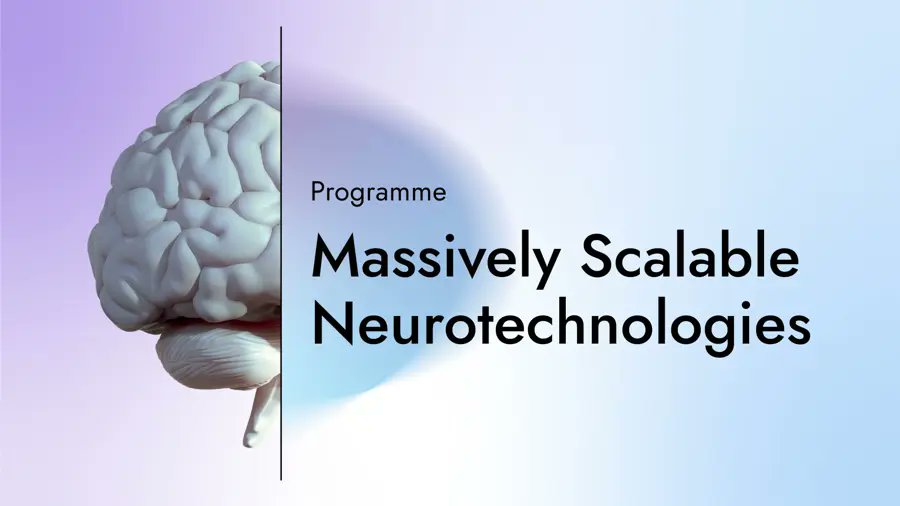
@ARIA_research newest programme: *Massively Scalable Neurotechnologies*
£50m programme to develop radically new ways to deliver neurotechnologies to the brain without transcranial surgery:
Join our webinar – 2 March
Concept papers – 17 March
Could you help unlock a digital infrastructure layer between the Earth and space?
Full proposals are open for our £50m-backed Enduring Atmospheric Platforms programme – where we’re aiming to develop persistent, low-cost atmospheric platforms capable of meeting the demands of the burgeoning global telecommunications industry.
From lighter than air vehicles to aircraft exploiting unconventional approaches to remain aloft, we’re open to pursuing a range of pathways.
Our funding spans three areas:
- Enabling Technologies
- System Integration + Testing
- Deployment + Communications Architecture
Apply for funding by 2 April: https://t.co/gGi49DlxZx
Today, we are launching a £50m programme – Massively Scalable Neurotechnologies – to decouple advanced brain therapies from complex surgery.
Led by @JacquesCarolan , this initiative seeks to reach the central nervous system through the body’s natural pathways, aiming for a system deployable in under 30 minutes.
Share your concept papers with us by March 17
Learn more here: https://t.co/f1IVSbrUtQ
Also! ☝️Apps for our new residency cohort (salary AND research budgets included) are now live https://t.co/DazXIlFKGp -- technical innovators, check it out to see if we might be a great home for your ideas/work
As a young org, it was amazing to have @RenPhilanthropy selected as an @ARIA_research Activation Partner.
It gave us amazing collaborators, and a live testbed for identifying/catalyzing “big if true” ideas and talent.
Great opportunity as ARIA gears up to invite new orgs in:
We launched our Activation Partners initiative a year ago to bridge the gap between high-risk discovery and scalable impact.
Building on the momentum and lessons from our first cohort, we’re preparing to launch a call this spring for new partners to design activities that accelerate the pace and impact of breakthroughs. Alongside our focus on translating R&D, we're expanding our scope to include the application of AI capabilities to research.
Learn more about our Activation Partners work so far: https://t.co/KrTHBIp5sx
Discover our early thinking for cohort two: https://t.co/oGAGReM5b7
Biology has proven that proteins can produce materials with almost any function from only locally abundant molecules – yet today, our use of proteins is mostly limited to drugs and enzymes.
Backed by £50m, our Universal Fabricators programme will leverage breakthroughs in protein engineering + build a new, interdisciplinary community that can harness proteins to produce a functionally universal range of materials at scale.
We’d like that community to consist of experts in protein engineering, self assembly, complex matter physics, inorganic materials engineering, process engineering, and reactor design. They’ll be challenged to develop scalable processes that use proteins to template the assembly of inorganic + composite materials with structures that can’t currently be mass manufactured.
Submit your concept paper by 9 March + sign up for our webinar to learn more: https://t.co/87woAyad1D