@ExinTx is hosting The Programmable Brain event during JPM Healthcare Week.
We're bringing together an all-star panel to explore how advances in neuroAI, BCIs, and circuit-targeted therapeutics are changing our ability to understand, predict, and intervene in brain function.
Panel:
- @mardinly, Co-founder & CSO, @ScienceCorp_
- @AdamMarblestone , Co-founder, @Convergent_FROs
- @SumnerLN , Co-founder, @merge
- @AToliasLab , Professor, @Stanford
RSVP link below.
CBN Nano (https://t.co/kOliwvJBzn), turning the #mechanosynthesis world on its head. "Inverted-Mode Scanning Tunneling Microscopy For Atomically Precise Fabrication," open-access (and arXiv-expanded) in ACS Nano - https://t.co/3t7mb89WRZ. Commentary: https://t.co/ESwcQv0eO9
👀What if you could record calcium dynamics in as many cells as you want simultaneously, and read the temporal records in situ with a single endpoint imaging session?
🚀Introducing TCaMP, a genetically encoded calcium recorder.
🧬TCaMP is a new member of the CytoSense family, and writes Ca²⁺ dynamics along a protein tape (CytoTape) that elongates inside the living cell. Time becomes position along the tape. Like tree rings :deciduous_tree:, but for Ca²⁺ dynamics.
〽️The record is analog and continuous: Ca²⁺ levels on a single intensity scale along a continuous time axis, for scalable endpoint readout.
🔗TCaMP is built on split-1POK, a split tape monomer scaffold whose two halves reconstitute when the domains fused to them interact. Split-1POK is programmable: swap the interaction pair fused to it, and the same scaffold records that pair’s interaction dynamics across time instead.
🔬In human cells, TCaMP recorded Ca²⁺ from transmembrane entry, receptor activation, and intracellular store release, and detected stimulations as brief as 10 minutes.
⏱️At hour-scale kinetics over days, TCaMP complements fluorescent Ca²⁺ indicators, trading sub-second temporal resolution for scalability and recording duration. We envision TCaMP and the general split tape monomer strategy being useful for questions that span large cell populations across hours to days and beyond.
👏Work by Yixiao Yan, a PhD student in the lab.
📄 Preprint: https://t.co/ZWhnebfuAA
James Maynard (Fields Medal 2022) says that he was shocked by the proof of the quasi-Riemann hypothesis (from the OpenAI math dump) because he held a very strong prior belief that the problem required the development of an entirely new theory.
He felt the solution was completely out of reach for current mathematical techniques, so seeing it included in the results drop was a massive shock to him. He explains that the proof turned out to rely on the theory of metaplectic forms, which had been developed in the latter half of the 20th century but was an underappreciated and slightly obscure part of the field that most mathematicians had not realized was powerful enough to resolve the hypothesis.
Source: Oxford Mathematics in Conversation on AI - Ben Green and James Maynard with Jan Obloj uploaded on Youtube 6 days ago.
Applications are open for Astera Residencies, now through January 7, 2027! Up to $2M in funding, based out of our Emeryville hub. This round, we’re sharing a few specific project requests. Read more and apply here: https://t.co/Girmg7xXSl
Reshare with folks who should see this!
Thus, the transformer appears a compelling candidate for a canonical cortical microcircuit, capturing computations happening at the scale of a single neuron or small groups of neurons.
Your brain is composed of a wide range of cell types connected into intricate circuits. The properties of these cell types underpin our ability to perceive, reason about, and interact with the world.
Cell types coordinate their electrical signals to drive behavior. When something goes wrong with one of these cell types, we develop diseases like Parkinson’s or blindness.
Many other mental health problems may stem from problems with a single cell type, but we currently lack an easy way to link neural activity to cell type identity.
Cell types have been cataloged extensively in fixed brain tissue, but they are difficult to identify in recordings from living brains. So how do we overcome this gap?
Josh Siegle has a plan that he outlines in a new piece in the Launch Sequence: https://t.co/eqSrZwMG1z
Announcing a major milestone achieved by my team @GoogleDeepMind: we have proven key security properties of the machine code underlying the Signal messaging protocol. This is the first time the actual production code of a widely deployed protocol has been formally verified – by any method, with or without AI – and at this depth.
More than a research breakthrough, it’s a prime example of how frontier AI can be a force multiplier to counter the speed and scale of modern cyber threats.
Formal verification offers a higher standard of security; however, it’s extremely complex and time consuming, which is why in many cases it’s considered to be impractical. Similar efforts could take teams decades of combined effort. We did it in a month’s time.
Using AlphaProof Code, Google DeepMind's new agentic framework for formal verification that runs on LLMs including Gemini Carbon, we verified the Signal protocol down to the actual code running on devices. This milestone lays the groundwork for a future in which vital systems, from medical device firmware to power grid software, ship with mathematical proof that their protections work.
Reaching that future will take continued research from our community. In that spirit, we're open-sourcing our formal specifications and verification artifacts so others can build on this work.
On a personal note, this moment is of deep significance to me. I started my own research journey more than two decades ago as an intern working on checking the consistency of complex software systems. Seeing this grand challenge made practical with modern AI is extraordinary.
I'm extremely proud of my team members: Swarat Chaudhuri, Andrew Ferraiuolo, Anton Kovsharov, Tej Chajed, Sam Schlesinger, Karn Seth, Jonathan Katz, and Charles Sutton for taking on this grand challenge and delivering, and grateful to the Signal team for their partnership.
https://t.co/kN1eRYQ8fF
[Claude helping me understand]
Here's the same model written in terms of effective compute and research effort, with no logs.
Quantities
E, effective compute: hardware H times software efficiency S. Here "progress" just means E going up.
R, research effort per unit time: researchers, human or AI, weighted by how fast and how good they are.
1. Research produces software efficiency, with diminishing returns
dS/dt = a · R^λ · S^φ
λ < 1 is the parallelization penalty. Doubling the number of researchers gives less than double the output.
φ is the "ideas get harder to find" term. If φ < 1, each extra unit of S takes more effort than the last one did.
2. Automation ties research effort to effective compute
With H fixed, AI labor grows with what that hardware can run:
R ∝ E^α = (S·H)^α
When S doubles, you can run twice as many copies, or the same copies twice as fast, so α ≈ 1. If smarter models also help, α is above 1.
3. Combine them
dS/dt ∝ S^(λα + φ)
Call the exponent n = λα + φ. Then:
n < 1: growth slows down over time. Diminishing returns win.
n = 1: steady exponential growth. S doubles every fixed interval.
n > 1: faster-than-exponential, hyperbolic growth. S runs off to infinity in finite time.
The condition n > 1 is the same as λ/(1−φ) > 1, which is Epoch's and Davidson's "r > 1" condition.
What this means for doubling times
The growth rate is (dS/dt)/S ∝ S^(n−1). Each time S doubles, the speed of progress gets multiplied by 2^(n−1).
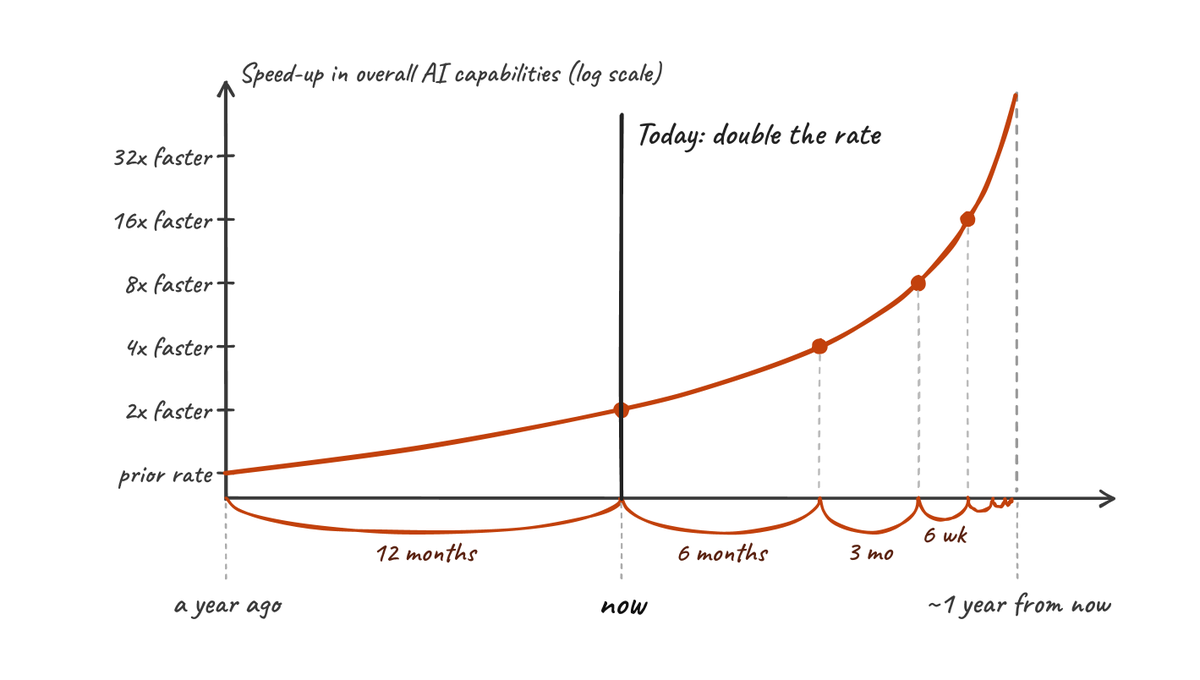
With n = 2, every doubling of S doubles the speed. That gives doubling times of 6 months, then 3 months, then 6 weeks, which is the figure/footnote's pattern.
Those intervals add up to a finite total: 6 + 3 + 1.5 + … = 12 months. That's where the "within about a year" figure comes from.
With n only slightly above 1, the doubling times still shrink, but slowly, and the blowup comes much later.
The footnote's "rate exponential in cumulative progress" is the case n > 1 written in log units. In the units above, it just says the growth rate of effective compute rises as a power of effective compute.
Before automation R was the human research workforce. It grows on its own schedule, independent of S. So dS/dt ∝ R^λ · S^φ with φ < 1 gives steady exponential growth that depends on hiring. Automation closes the loop by making R grow with S, which raises n.
Where the real argument is
φ: how quickly ideas get harder to find at the current frontier. If φ is quite negative, the loop fizzles.
λ: whether a million parallel AI researchers duplicate each other's work and fight over the same compute for experiments. Being limited by experiment compute effectively lowers λ.
α: whether extra S really turns into more research capacity. It does for inference, but not if experiments need training-scale compute, which H limits.
METR's empirical claim amounts to saying n is currently above 1, or at least not clearly below it. The open question is whether φ falls as S climbs.
As AI improves, uplift will get even higher. If it overcomes diminishing returns and bottlenecks, a naive extrapolation implies we would reach ASI within a year. The authors say they found no clear bottlenecks or sharp diminishing returns, though they are very uncertain.
@JacquesCarolan is a fantastic leader in this space that has so much potential for transformative benefit! Exciting to see what the next frontier here is
Beautiful. Most useful mathematics for humans is converging to some shape and probably can be studied with topology to navigate relevant theorems faster
Stanford Digital Brain Project has launched! We're hoping to make a seriously useful model of the human brain. Please come join us! https://t.co/Gnzm6wJS8d
After two wonderful and rewarding years at @ARIA_research, I’m excited to share that I am joining the @FoundationOAI as Program Director of Formal Methods.