Help us build the next frontier of AI, inspired by the brain. @naturecomputes and I are hiring a Chief of Staff at @metamorphiclabs ! If you’re high energy, super ambitious, and know how to get things done, apply. Please repost
Andreas Tolias & I are hiring a Chief of Staff to work closely with us at @metamorphiclabs.
Seeking a high-agency generalist with strong judgment and exceptional execution who thrives in a dynamic environment and has a track record of owning complex projects from ambiguity to results.
You’ll work directly with us across strategic projects, fundraising, partnerships, and business operations, with substantial autonomy and room to grow.
If this sounds like you or someone you know, we’d love to connect.
About Metamorphic: https://t.co/riPAZMemap
Role & Application: https://t.co/lDvjzabI74
Do LLMs have better training intuition than top AI researchers?
The answer is mixed -- humans can beat LLMs in some categories.
Top AI researchers have good training intuition, but it's not distilled into language yet, hence LLMs are incapable.
GPT-6 Astra vs Opus 5.5 vs Grok 4.7 vs MolmoAct2.
Real time. No sped-up demos. Zero-shot. No cherry-picking.
LLM robot control is progressing, but we’re definitely not there yet. Low-level control for robotics still matters according to Moravec’s paradox.
Announcing Discovery Loop!
I am very excited to announce that, along with my longtime friends and collaborators @Sanjay_Ghemawat, @OriolVinyalsML and @quocleix, we are founding Discovery Loop (@DiscoLoopAI), a Public Benefit Corporation whose mission is to automate machine learning, science, and engineering to accelerate discoveries and progress. The four of us have worked together for 14 to 30 years, and have helped build some of the world’s most used products, infrastructure and AI models, and we’re excited to turn our attention to this ambitious endeavor.
♾
Learn more at: https://t.co/Rv3LMdLluK
It's sad to see how much we are hurting the USA in future competitiveness and talent! Most people don't realize how much of tech innovation and hence GDP growth comes from foreign talent in the USA. Innovation and GDP growth is sure to decline.
I agree with @BillAckman . We will lose the global race for talent if we don't attract the best and brightest. Especially true of the AI race against China. Talent is a bigger factor in that race than the next three or four factors combined, including chips. We should push for a bipartisan effort. I think it can be done despite the administration's MAGA wing. Who in the administration can help this lady?
Kimi CEO Zhilin Yang:
"Claude didn't win on reasoning - they bet everything on agents
but the layer everyone skips - a great agent needs a great base model, that's all we do at Kimi 3 "
in 90-min workshop he explains why the smartest agent still fails - if you can't configure it correctly
his one big idea: most people are still solving the old one
"the real goal? we want K2 to help build K3 - without agent skills, that's impossible"
watch & bookmark - then learn the article on best agent system ↓
Mice perform active sensing to acquire visual info: check out our collaborative effort, which is our 1st in motor+vision!
Great to work with @AToliasLab Xaq and Cris - 💰by the Brain Initiative @NIH! Led by @celia_bqt & @sainsbury_tom@CurrentBiology
https://t.co/xFnDhnHUOl?
Very excited that our paper is now out at @arxiv🎉
As a neuroscientist🧠, I wand to understand how (single) neurons encode the visual world. But how to do this in an automated yet interpretable way when we record thousands of neurons to complex natural stimuli?
Here, we use vision language models, specifically @GeminiApp, to convert neural selectivity in monkey visual cortex into language, i.e. a semantic hypothesis, which we verify with text-to-image generation!
Check out the below post and this beautiful homepage by @vedanglad: https://t.co/Q9IOwlP7cd
Great team effort with @AToliasLab@naturecomputes@SuryaGanguli@TamarRottShaham Nikos Karantzas & star first author @vedanglad 😍
This work was done at @StanfordMed and funded through The ENIGMA Project by @jamesfickel 🙏
Agentic coding makes it possible to specify a neuroscience model in hours instead of months, writes Brian DePasquale. The field risks becoming prolific but shallow—generating models faster than we can generate insights.
https://t.co/nxhwvdy471
Our new paper lead by @vedanglad w/@AToliasLab "Letting the neural code speak..." https://t.co/B6H1Vvcmso
We show how to get *monkey* visual neurons to TELL us in *human* language what images make them fire. We do this is an automated verifiable way at scale! How?
1) Build a digital twin of monkey visual areas that can accurately map visual inputs to neural activity.
2) Perform in-silico experiments on this twin to find many complex images that make a model neuron fire.
3) Use a vision-language model to describe these complex images.
4) Verification: use a language-conditioned diffusion model to generate new images, and check they make the monkey digital twin neurons fire a lot.
To our knowledge, for the first time, we have a way to convert monkey vision to human language, and from *human* language to sample infinitely many images that make any given *monkey* visual neuron fire, all in an algorithmic fashion.
For more exciting details, see @vedanglad's excellent thread!
🧠 Mechanistic interpretability for the brain 🧠
Early visual neurons have had a clean mathematical description for decades (Gabor functions), while higher visual areas have remained notoriously hard to characterize.
Our new paper, led by @vedanglad, shows that natural language can provide that missing framework: concise, human-readable, verifiable descriptions of what higher visual neurons encode.
To get there, we pair neural digital twins with vision-language models to run virtual neuroscience experiments at scale.
Check out the full paper below.
A hundred years ago, Edgar Adrian recorded from a single nerve fibre and showed the stimulus out in the world is carried in the rate of its firing — he started calling the impulses a "code." We've been trying to read that code ever since.
For parts of the brain like V1 we've had a good answer for more than fifty years, and it was written in math: a Gabor filter. Orientation, spatial frequency, phase — compact, and you could measure how well it fit. Deeper in the hierarchy, in areas like V4, we never had the equivalent. We mostly had qualitative descriptions — they fire to shape, color and texture — but couldn't write down a more precise one for a single neuron, let alone put a number on how well it captured what the neuron responds to.
Our new paper from The Enigma Project, led by @vedanglad, uses vision-language models to write that correspondence in ordinary human words. The words don't just give a qualitative description of what each neuron is tuned for; crucially, they let you quantify how well that language captures the tuning. Take a neuron's description, regenerate fresh images from it with a diffusion model, show them to a digital twin, and measure: descriptions written to drive V4 neurons pushed 96.1% of them into the top 5% of their responses to natural images; descriptions written to suppress pushed 97.6% into the bottom 5%.
So we now have an automated way to describe the map between neurons and the world — in human language, in the macaque brain.
That opens a new avenue: describing biological neurons in the same currency we use to interpret artificial ones, and comparing mechanistic interpretability across brains and AI directly.
This work is together with Nikos Karantzas, @kfrankelab@naturecomputes@SuryaGanguli@TamarRottShaham
Many thanks to the rest of the team at the Enigma Project @Stanford and @jamesfickel for generous support
How well can you describe the feature selectivity of a vision neuron … with words? Interpretability has long borrowed from neuroscience — and maybe it can give back too! 🧵
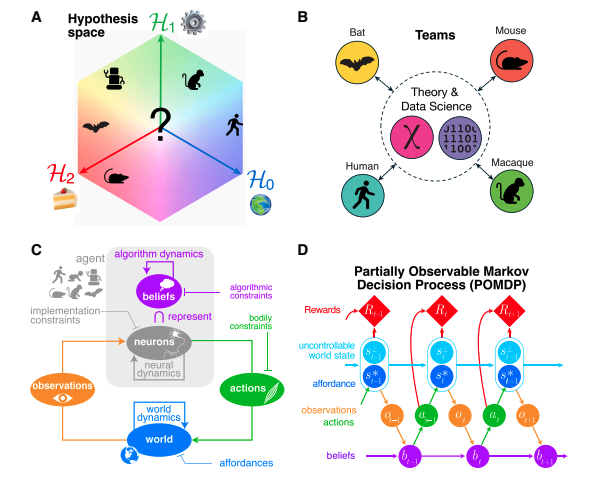
🥳 Excited that our Perspective about our new @SimonsFdn Collaboration: SCENE is out in @NeuroCellPress !
A great team effort across all the PIs, championed by @lengyel_m and @JP__NOEL 🙏
➡️ https://t.co/jvs6EGUMXR
If you're at @CVPR this week, come meet the Metamorphic team. We're hosting a happy hour tomorrow evening with @SpiralDB on NeuroAI, AI for Science, and multimodal modeling — and we're hiring. Find @KonstantinWille and @AdrianoCardace
there. 👇 https://t.co/kEgeh9MT7T
Metamorphic is at @CVPR this week.
Join us tomorrow evening for a kick-off happy hour co-hosted with @SpiralDB to talk AI for Science, multimodal modeling, and what comes next.
We’re growing the team - find @KonstantinWille
and @AdrianoCardace there if you’re curious.
https://t.co/ucjDnqUHCS