Excited to release what we’ve been working on at Amaranth Foundation, our latest whitepaper, NeuroAI for AI safety! A detailed, ambitious roadmap for how neuroscience research can help build safer AI systems while accelerating both virtual neuroscience and neurotech. 1/N
After staring at the activation atlas for a while, I'm less and less convinced about the idea that ANNs have "clean" latents. Nick makes the argument that neurons deep in medium + large ConvNeXt are clean; and they do look cleaner, to my eye, than inceptionv1's neurons at similar stages.
But the initial layers seem more entangled to me. InceptionV1 had clean preferences for edges in its initial layers. ConvNeXt's initial layers look like texture superpositions, or a random rotation of V1/V2 neurons. It's really only at the later stages that we start to see clean, nameable directions.
Is that really surprising? These networks are trained to separate images into different buckets through linear decision boundaries. @klindt_david has a paper deriving a theory of when we should expect this to force the network to separate latent variables. The technical conditions involve the number of dimensions in the representation vs. the number of latents, the objective function, and the shape of the activation functions.
So perhaps we have stumbled into a regime where we have cleaner late-stage representations compared to earlier efforts, but worse early stage representations: where are the Gabors and curve neurons? How can I trust that the features leveraged by the models are robust and generalizable?
https://t.co/aBwCwP4tdQ
interpretability might be the most important scientific problem in the world right now, as I don't think we can solve alignment if we don't know what we're building. I think I have good news about it. I co-authored early work in mechanistic interpretability at OpenAI and came away pessimistic, because neural networks appeared to fold into arbitrary tangled knots. years later, I started openai's first large-scale automated interpretability project, finding about 2% of neurons legible with the primitive tools we had
with modern agentic tools and a much closer look, the picture looks totally different. the vast majority in models up to trillions of parameters are legible, and their circuits beautiful. many famous examples of tangled neurons turned out to be misunderstood. The roadblocks I expected mostly aren't there. I now think ambitious interpretability will be solved by the time we need it most, and possibly quite soon, as automated scientists keep improving. it may be a bitter lesson for interpretability: the simple thing, at absurd scale, works
https://t.co/zHij5zwKGT
Andreas Tolias & I are hiring a Chief of Staff to work closely with us at @metamorphiclabs.
Seeking a high-agency generalist with strong judgment and exceptional execution who thrives in a dynamic environment and has a track record of owning complex projects from ambiguity to results.
You’ll work directly with us across strategic projects, fundraising, partnerships, and business operations, with substantial autonomy and room to grow.
If this sounds like you or someone you know, we’d love to connect.
About Metamorphic: https://t.co/riPAZMemap
Role & Application: https://t.co/lDvjzabI74
Cancer patients with the same diagnosis often have very different tumor biology.
Molecular testing can reveal underlying differences, but that's slow and expensive.
Introducing Holon-S1, our platform to predict genes and biomarkers from routine pathology slides.
• beats two other models at predicting spatial gene activity in a controlled comparison
• has identified potentially novel biomarkers in breast cancer and colon cancer
• evaluated across 16 organ types and more than 15 scanners, using slides from both formalin-fixed, paraffin-embedded and fresh-frozen tissue.
We believe Holon-S1 has the potential to help researchers find new biomarkers in slides they already have, discover treatment targets, and bring more personalized cancer care within reach!
I have a lot of respect for @nickcammarata and Goodfire, but I will add some thoughts from brains/neuroscience.
First, polysemanticity and distributed representations are ~widely~ seen in biological brains. (In some ways this is what I have spent my career on.) 1/
Our paper is out in @NatureAging. We looked for factors that make old cells' gene expression young without erasing their identity. SRSF1 came out as a promising rejuvenation target that reduced aging hallmarks in human cells and extended median lifespan of aged mice by 14%.
1/4
For a while now, @kirancodes has been excitedly telling everyone at @BasisOrg who would listen about a crazy idea she's been pursuing. Not everyone thought it was possible, but it's starting to work. See https://t.co/A2FyTJzSsA
TL;DR: The bottleneck in verifying the world's software is shifting from theorem proving to specifications and semantics. We now have a way to verify semantics that can scale across all programming languages.
The basic idea:
To verify that a program is correct, you need the program, a specification you want to prove, and a semantics that defines what programs and specs mean.
Most programming languages (Python, Ruby, Lua…) have no formal semantics, because semantics are painful to write for complex languages.
You can ask an LLM to write a semantics for you, but it'll probably have mistakes.
But (i) programming languages do have interpreters/compilers, which ultimately are compiled down to machine code, and (ii) some instruction sets do have formal semantics. RISC-V has an official formal model.
So, crazy idea:
Step 1: Compile your interpreter (e.g. Python's) down to RISC-V. Now its behaviour is formally defined. It's exact, but unreadable: thousands of machine instructions.
Step 2: Ask your LLM to write a semantics for your language.
Step 3: Ask the LLM to prove, in @leanprover, that its semantics agrees with the compiled interpreter on every possible program. If the semantics is wrong, the proof gets stuck, and the LLM goes back to fix it.
Step 4: If the proof goes through, you have a semantics you don't need to trust, and you can verify programs in a language that never had one, with guarantees that reach the binary that actually runs.
Kiran has now done this end to end for a simple WHILE language, and we're scaling it up to Lua and OCaml, with Python as the north star.
1/
New preprint! 🦇 🤖
We built a functional “digital twin” of the hippocampus: a transformer trained on Neuropixels recordings and 3D flight in freely flying bats.
Probing its latent space revealed previously unknown structure in hippocampal population activity.
🧵
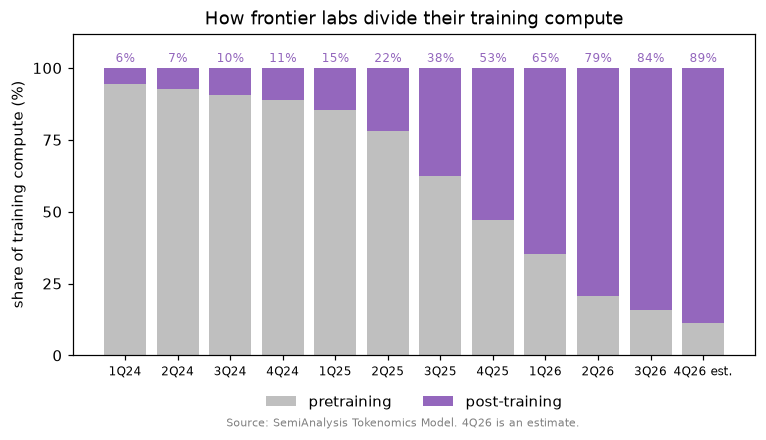
How AI shifted from a transductive paradigm (token-by-token answer completion) to an inductive paradigm (on-the-fly reasoning chain synthesis), in one chart. This is the big story of 2025 and 2026. This is what made coding agents work.
From a NeuroAI perspective, it's really annoying that feedforward neural nets rule the world. Unrolling equivalence notwithstanding, what inductive biases does recurrence buy us? Looking forward to reading this.
Microscopes have historically imaged organisms on a flat surface. You basically take some cells, put them under a coverslip, and image them. But cells in the wild don’t live like this; they move in 3D.
The Gravity Machine from Manu Prakash’s lab is such a brilliant way to solve this problem. It came out a few years ago, in 2020, but it really emphasizes this idea that discoveries are easier to make when we design our instruments in a way suited to observing them. This is basically a microscope that can record (marine) organisms moving in three dimensions. It looks like a car tire, with a water-filled channel running around its rim. You put your organism in the water and place the microscope on the side. As the organism swims up or down, the wheel rotates to compensate, keeping it in view.
The video below was taken with this Gravity Machine. It shows a single cell, Volvox aureus, swimming upwards. As it swims, the researchers flash a light, and you can see the cell rapidly shoot upwards. This is something we could never record with a normal microscope!
What else in biology are we missing because of poor measurement tools? (Apparently, for example, there are marine organisms that float up or down an entire kilometer as they are dividing.) I’ve seen 3D images of plant roots, but only after all the bacteria attached to them have been killed off. What if we could image the gut microbiome or an entire cube of dirt across space and time, without killing the organisms first?
Leading AI models appeared to predict brain activity equally well…
…until we asked them to synthesize images that precisely control neural firing, like these 👇
Across 25 neural sites, closed-loop experiments revealed striking hidden differences in model-brain alignment.
🧵
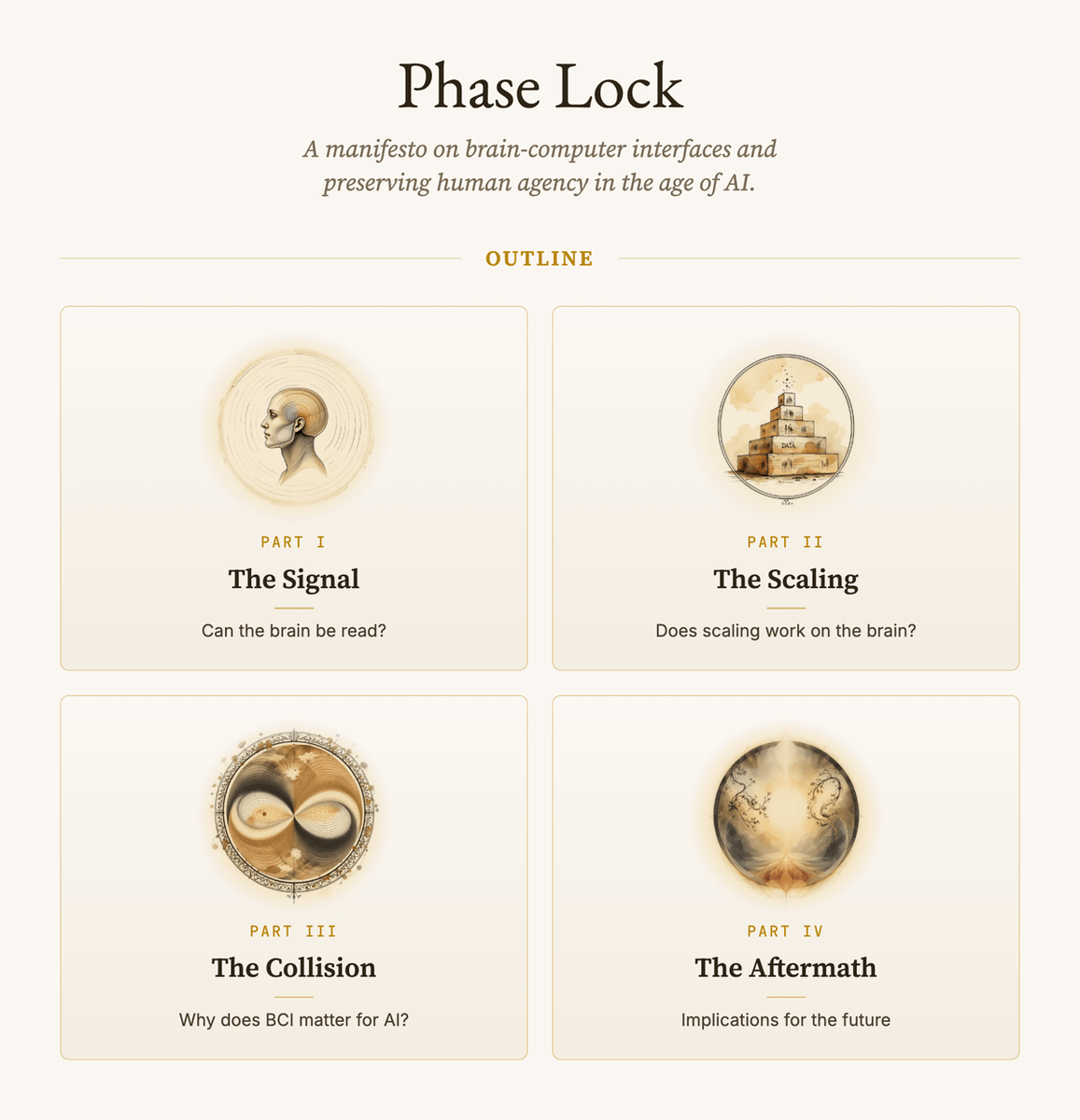
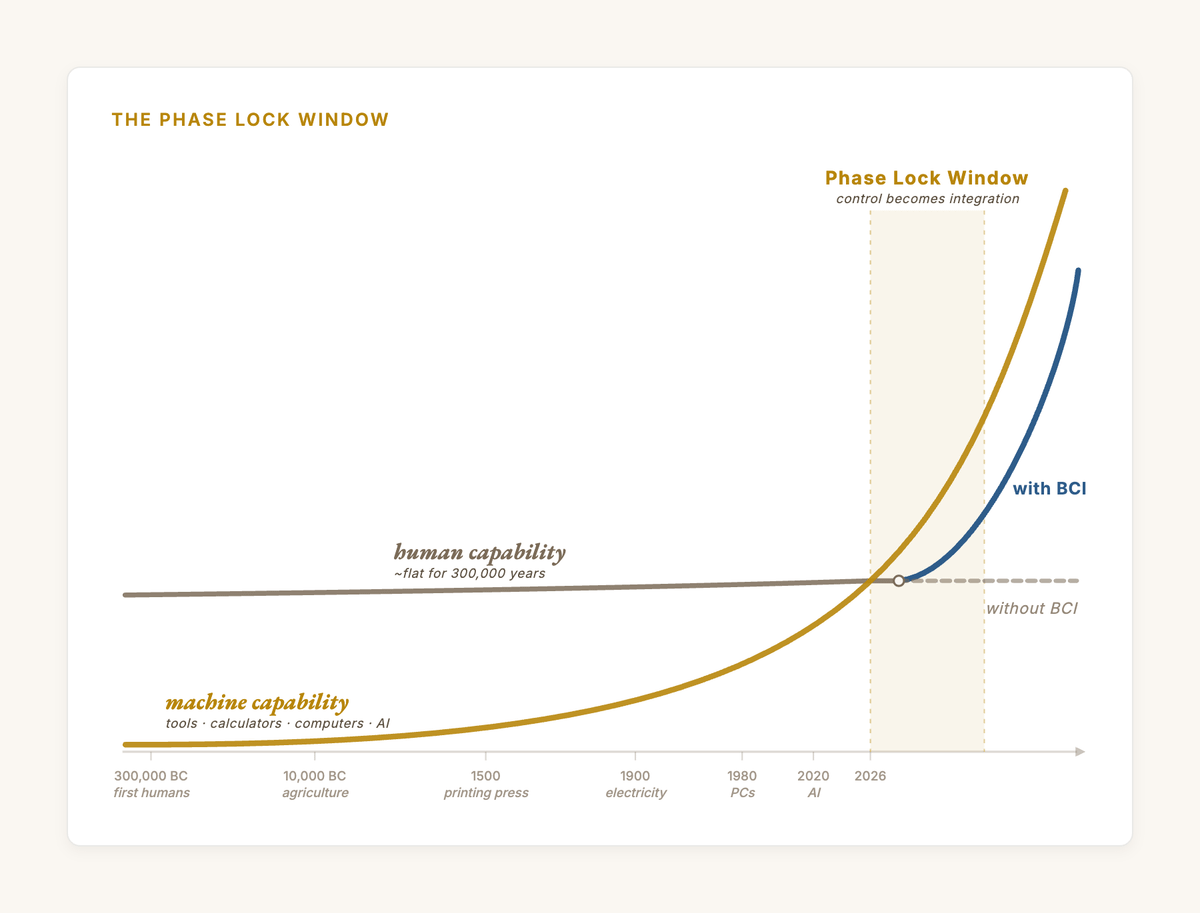
The human brain is approaching its ChatGPT moment.
I spent 6 months writing Phase Lock: a manifesto on how brain computer interfaces can help align AI and preserve human agency.
If you only ever read one thing from me, read this.
I feel like the progress of AI is actually making systems neuroscience more exciting.
It's not like current AI has a particularly good angle on physical intuition, common sense, world models, planning/reasoning, motivations/drives, emotions, etc.
We may now have the tools to implement and test cognitive architectures.
Questions in Systems Neuroscience are indeed changing, but to me the new ones are even more exciting! Some years ago, @JamesJDiCarlo showed an old clip of Hans-Lukas Teuber (the founder of @mitbrainandcog: https://t.co/A3rLJ9UtG9) saying that science goes through stages: explain, predict, control. #NeuroAI first moved us to predict, and I think it's super exciting that we're firmly moving into control:
- prediction is pretty well established by now (e.g. https://t.co/u8nY6lgcEf; https://t.co/JcHs1hQRvs), although models are not perfect and can fail on simple stimuli (what is missing?)
- the field is actually making progress on a theory for why this works (@dyamins & @aran_nayebi https://t.co/LOzwk624Lw, @tyrell_turing https://t.co/49F28Um65X).
- model-synthesized stimuli can neuromodulate visual cortex and the human language network (@PouyaBashivan@KohitijKar https://t.co/v6xxS7RA8C, Walker @sinzlab https://t.co/1lyOBLx9ic, @GretaTuckute https://t.co/HhduIHQlZC, and more)
- even for invasive techniques, topographic models predict and steer the behavioral effects of microstimulation; optogenetics and muscimol (https://t.co/lNLH4OnmFc, https://t.co/gHQkZMJCyu)
- and finally model-brain alignment is not strong enough that we can model atypical processing in dyslexia, autism, aphasia, and anhedonia (@melikahnd_1 https://t.co/NFg1q0KEDC, https://t.co/yimaRex5Ph, https://t.co/1swJ3pLf04, @melikahnd_1 https://t.co/gzqOwAI059)
How processing breaks down, and how we can push it back toward healthy, are very much algorithmic questions about the brain with a clear real-world impact. And now we can actually test them, how cool is that!