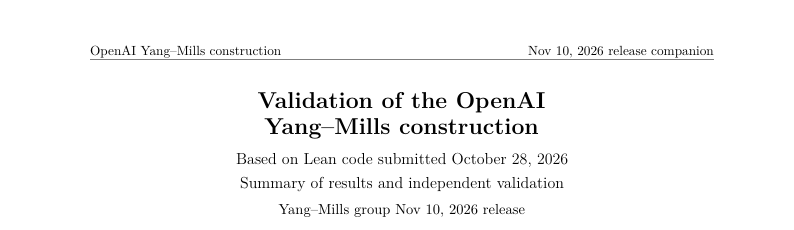
The Shepherds referred to “releasing the full lean code submitted to the group on October 28”
Does that mean they have released ALL the lean that they have received, to date?
Or did they receive more after October 28?
It would be great if they could clarify this. @KITP_UCSB
@jdlichtman Great. As far as I understand, this is conditional on numerical results. There is another (not quite complete) formalisation by Gershon Bialer, who went to great pains to also formalise these numerical results.
https://t.co/IiD04blBGC
https://t.co/nBjZpntveW
[Yang-Mills Working Group]
Validation of the OpenAI Yang–Mills construction
(November 10, 2026)
OpenAI-YM-20261028: https://t.co/znUeZnqmpz
https://t.co/2mexFCQXEF
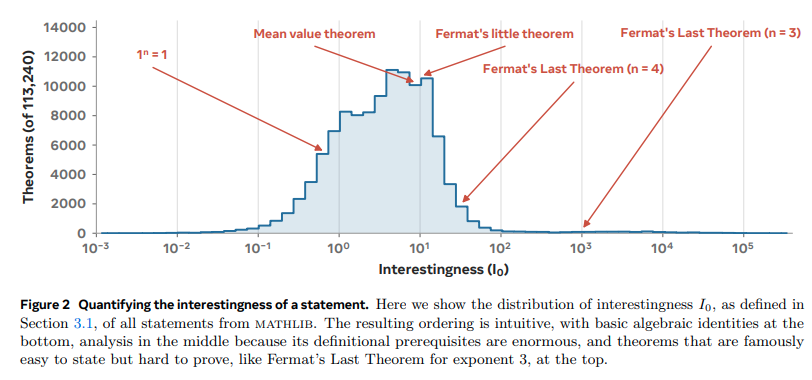
Yes, this is a start, as Mike Freedman et al. wrote in "Compression is all you need" https://t.co/5qWpaxlE5C
In particular, Grothendieck's results have highest ratio in Mathlib.
In this fascinating paper (https://t.co/lw4kN8owTY) they formally define 'how interesting' a maths result is as the ratio (length of statement)/(length of proof).
What are examples showing the limits of this? e.g. Interesting results with long statements/short proofs?
[Yang-Mills Working Group]
Validation of the OpenAI Yang–Mills construction
(November 10, 2026)
OpenAI-YM-20261028: https://t.co/znUeZnqmpz
https://t.co/2mexFCQXEF
[Yang-Mills Working Group]
Validation of the OpenAI Yang–Mills construction
(November 10, 2026)
OpenAI-YM-20261028: https://t.co/znUeZnqmpz
https://t.co/2mexFCQXEF
@jdlichtman The formalization was mostly done by Charlie Reams using AI - actually, I don't know all about his tools. I helped finish the job - removing unnecessary condition - using Claude. The primary goal has been achieved, but we are still polishing. Others are also helping.
This is a historic milestone for mathematics & formalization
Their repo is ~200K lines of Lean, supported by previously established numerical calculations.
https://t.co/y4tViKgvBt
Claude has formalized Ternary Goldbach!!
Harald Helfgott announced a proof initially in 2013, and followed by several updates.
Many computations were long & hard to follow, leading some experts to be concerned about its correctness. 🧵
Errors in the proof were indeed found, and the resulting code has several other points of difference.
However, it appears the overall proof strategy is robust @AlexKontorovich@ChrSzegedy
We all know that autoformalization is here, proofs are getting cheap, and Lean checks them for free. As a field, we now need to focus on autoinformalization, decomposition, and abstraction quality into reusable concepts (cc @patrickshafto), so the community can trust and reuse results.
There's already great work here (just to quote a few): @scottnarmstrong's autoformalization skills aim to prove "the theorem the mathematical source actually states", @cameronfreer's lean4-skills ship with axiom checks and guardrails, and @Jack______M and the Mathlib Initiative's Literature Links and companion-faithfulness skill say how close each Lean statement is to the text.
Lean itself has great tools too, like Comparator for checking a proof against a frozen statement. The community's Project Intentions board is a great idea as well, so people can find collaborators and avoid quietly duplicating each other's work. And there have been various other great discussions from @JasonRute, @tqft, @TaliaRinger, @IlinVasily29521 and others that shaped a lot of my thinking :)
And the frontier keeps growing: Tau Ceti for math, where humans write the roadmaps and agents write and review the code, and we're already seeing similar efforts for CS, physics and ML.
I think all of it will eventually be formalized. For now humans still need to review the statements, and agents keep getting better at that too. I believe this will age well, and the real challenge will be building reusable abstractions!
I'll write separately about compiler trust and code verification :)
>The deeper issue is the distinction between what constitutes a phenomenon operationally and what subsequently represents it
This sounds to me like the distinction between what it "is" vs. what it "does".
My claim is that "is" (i.e. identity) is itself constituted of "does" at all possible scales (ie. all the higher-order relations). This is a perspective akin homotopy type theory
Yes, this is a practical social question, separate from the information-theoretic one.
But regarding social ones: we should not underestimate humans so easily:
Both Euclid and Grothendieck are cut from the same evolutionary cloth, and the human mind can push abstraction much further than we might think at first blush
I think the distinction of constitutive vs. descriptive is one of (human) convenience, or anthropocentrism, more precisely.
At whatever description language one takes as primitive (e.g. at conventional English, at the Lean term primitives, all the way down to machine code 0-1's, at the hardware transistor level, etc.), then one can ask how the primitives can be configured to create compressive representations (which will be hierarchical in nature)
@axiommathai should address these comments ASAP.
Many are quick-fixes:
1. Mathlib duplication
2. Incomplete formalizations
3. Outdated dependencies
4. Library build warnings
5. Quality audit, with unnecessary hypotheses and verbose proofs
https://t.co/ooZy1i8xM3
In my view, autoformalization won't be Mathlib-level quality for another few months, but should ultimately be the goal.