Knobs cover the surface of a red blood cell infected with malaria. They make cells clump to the walls of blood vessels, causing the disease’s most dangerous symptoms including organ distress, seizures, and coma.
https://t.co/JyPSUT29CU
As Election Day approaches, writer Alex Stone explores what topology teaches us about democracy and the strange paradoxes it can give rise to: https://t.co/GIopSlQKNM
Spider silk is tougher than the Kevlar inside a bulletproof vest and stronger than steel. Researchers are figuring out how the “silk dope” from their glands forms this remarkable substance. https://t.co/5EOh07Jzcn
This is the first microscopic video of 𝘗𝘭𝘢𝘴𝘮𝘰𝘥𝘪𝘶𝘮 entering a red blood cell, taken in 1978. Upon entry, the parasite infects a cell with malaria. Within days, millions of compromised cells could be lurking in the bloodstream. https://t.co/JyPSUT29CU
The French mathematician Nicolas de Condorcet identified a paradox about voting in the late 18th century: A majority can sometimes vote itself into a logical loop. https://t.co/GIopSlQKNM
Researchers have gained more insight into how the parasite that causes malaria gains entry into red blood cells. On the latest episode of The Quanta Podcast, writer @jojofoshosho0 dives into just how malaria got caught breaking and entering: https://t.co/xi19Hnqu1g
Chi-Min Ho and her team were able to image the exact moment malaria invades a red blood cell, in unprecedented detail. This knowledge could help inform the next generation of malaria treatments. https://t.co/JyPSUT29CU
With 2 candidates, picking a winner is easy.
With 3, there’s no perfect way to do it.
I wrote about the math behind this for
@QuantaMagazine
https://t.co/brWB08Wbux
The French mathematician Nicolas de Condorcet was a passionate believer in democracy. He also discovered a frustrating paradox within it. Now, mathematicians have found that this centuries-old voting paradox has a strange topological shape. @imalexstone reports: https://t.co/e6ohgoZN4m
OpenAI’s new proof of the quasi-Riemann hypothesis didn’t introduce any new concepts — it unearthed hidden connections between old ones. “The proof is a surprising synthesis of well-known ideas,” said Alexander Dunn of the Georgia Institute of Technology. https://t.co/TYcUFB8eWo
“In science, we often rely on cold data and numbers to understand disease, but photomicrography bridges the gap between logic and emotion.”
Enjoy the Nikon Small World competition winners: https://t.co/xtNKy7hyg2
In pursuit of an alternative to dark matter to explain the universe we see, some scientists posited that we might not understand gravity as well as we think. But a trio of weird galaxies without dark matter has put that tottering theory to bed. Hear more on The Quanta Podcast: https://t.co/tqwL1a75oR
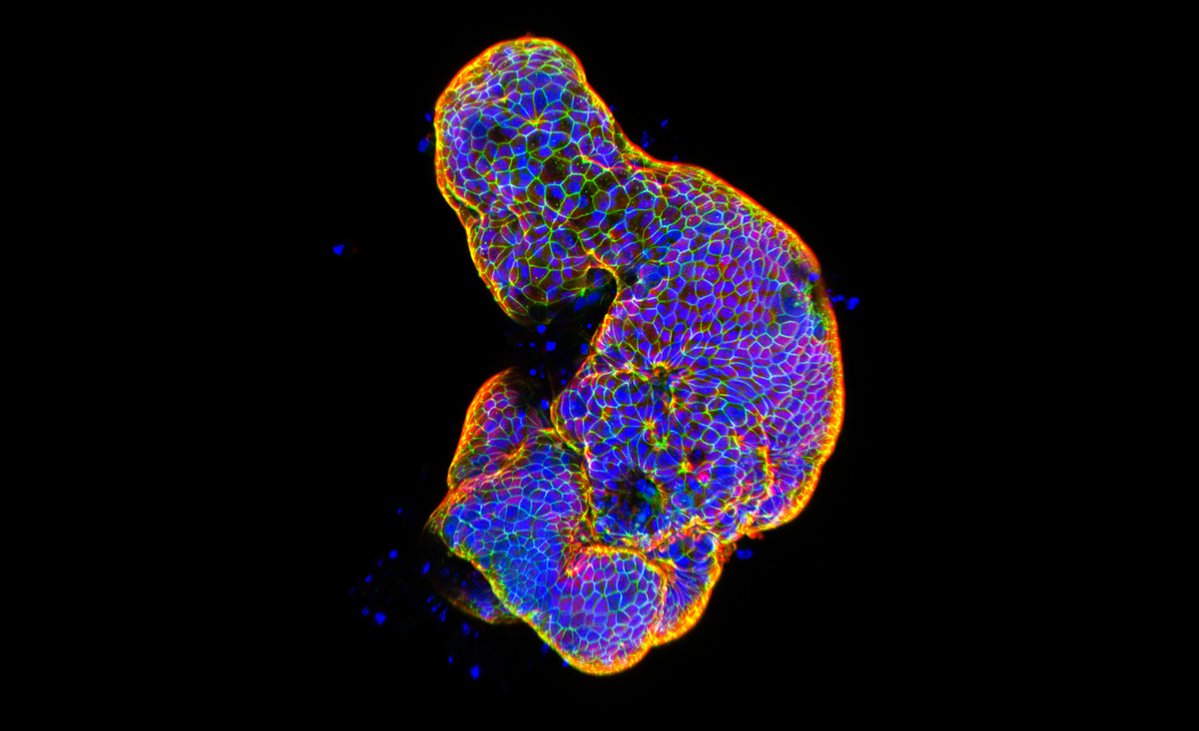
To study diseases, Gauri Kulkarni of Wake Forest University grows miniature organs in her lab, including the 1.3-millimeter human gut tissue shown in this image. https://t.co/xtNKy7hyg2
This is a mouse trachea. That faint layer of blue at upper right? That’s “the kind of mucus you cough and spit out,” said Julien Resseguier, who created the image to study the interplay between neural and immune systems. https://t.co/xtNKy7hyg2
To invade red blood cells, malaria parasites create a temporary molecular portal that lets it slip into the cell — and then disappears behind it. Researchers have finally detailed the proteins that let it break in without tripping the alarms. https://t.co/JyPSUT29CU
This is the Weierstrass function, a “monster” that is continuous everywhere but differentiable nowhere. First published in 1872, it prompted scrutiny of assumptions in calculus. Similar functions are used to study random motion and analyze risk. https://t.co/tMXyKuJIrC
New analysis reveals that development is not a mere readout of a genetic program, but rather a dynamic process in which communities of cells build themselves, and the very landscape they navigate, by mutual negotiation and interaction, into an organism.
https://t.co/MjiZa14iSq
The annual Nikon Small World contest has charted not only the evolution of creative photomicrography but also the progress of imaging technology. Here are our favorite winners and honorable mentions that reveal the intricacies of the cellular world: https://t.co/xtNKy7hyg2
The Riemann hypothesis has been an open problem for over 160 years. Resolving it would enable mathematicians to better understand the nature of prime numbers, one of math’s most crucial building blocks. And that’s just for starters.
AI just made a major advance toward an answer: https://t.co/GHb62yF14M