What do vault particles do? Scientists have been asking this for 40 years. Our biology team at Anthropic set out to tackle this long-standing open question in cell biology, working with Claude.
We haven't uncovered their biological function yet, but we've found something new: vault proteins in prokaryotes that assemble into complexes that are larger than human vaults. And we show that we can engineer their shapes to produce even larger nanocapsules!
The mystery of vaults goes deeper than anyone knew...
Read the blog and technical report to learn more!
Blog: https://t.co/cLy5gq7aFN
Technical report: https://t.co/t3KXpKKB4s
Very grateful to have such fantastic coauthors who made this research project possible, including Januka Athukoralage, @ntperry13, @PeterHYoon, @ekabrams, and @amirshanehsaz. A big thank you to Dr. Leonard Rome, who discovered vaults in 1986, for providing feedback on the technical report. Thank you to @FutureHouseSF for supporting me as a research fellow when I first started learning about vaults. And, of course, grateful to my many @AnthropicAI teammates that work tirelessly to make Claude the best model for biology!
Video and sound made by Claude (with artistic direction from @ntperry13). Showing the new bacteriophage-derived vault structure that we solved.
Career update/news including that I'm hiring!
Late in the summer, I made the jump to @AnthropicAI to help co-lead a moonshot effort in genetic medicine.
I'm hoping to have a proper update to share publicly fairly soon, but if you know my collection of interests (AI, clinical genetics, therapeutics, rare disease non-profits), you are unlikely to be surprised. Much of the upfront effort here requires infra for moving atoms as well as bits, and we explicitly want to lean deeply into collaborations with academics, non-profits, and key industry partners in the space. If either of the below roles sound like you, please apply through the link. More to come!
Program Manager:
https://t.co/GHmp3S5fEw
CMC and Manufacturing Lead:
https://t.co/97teIeHPmK
"You must be psychic" That was the reply Lenny Rome, aka the Vault Guy, sent when asked him a few weeks ago if he has sought help from AI companies to solve the elusive function of the odd cellular structures he discovered decades ago. Rome hadn't, but Anthropic called him. 1/2
What do vault particles do? Scientists have been asking this for 40 years. Our biology team at Anthropic set out to tackle this long-standing open question in cell biology, working with Claude.
We haven't uncovered their biological function yet, but we've found something new: vault proteins in prokaryotes that assemble into complexes that are larger than human vaults. And we show that we can engineer their shapes to produce even larger nanocapsules!
The mystery of vaults goes deeper than anyone knew...
Read the blog and technical report to learn more!
Blog: https://t.co/cLy5gq7aFN
Technical report: https://t.co/t3KXpKKB4s
Very grateful to have such fantastic coauthors who made this research project possible, including Januka Athukoralage, @ntperry13, @PeterHYoon, @ekabrams, and @amirshanehsaz. A big thank you to Dr. Leonard Rome, who discovered vaults in 1986, for providing feedback on the technical report. Thank you to @FutureHouseSF for supporting me as a research fellow when I first started learning about vaults. And, of course, grateful to my many @AnthropicAI teammates that work tirelessly to make Claude the best model for biology!
Video and sound made by Claude (with artistic direction from @ntperry13). Showing the new bacteriophage-derived vault structure that we solved.
@JessicaSacher Not that we know of! Only a handful of vault homologs in prokaryotes have had been identified to date, our metagenomic database search greatly expands the number.
@DvirYuval Good question! Leonard Rome has done some interesting work looking at this, we do have a good idea for how they're assembled in eukaryotes at least: https://t.co/7cc8LoMgzt
Everyone should check out Leonard Rome’s YouTube channel. He discusses vaults, their history, his career, and some of the sociopolitics of academic publishing
https://t.co/1Fb16wDJgK
Exclusive: Artificial intelligence has tackled a mystery that has flummoxed cell biologists for decades.
Today, Anthropic reports its key #AI model, Claude, has helped unearth new clues about vaults—strange, barrellike structures, found by the thousands in animal and plant cells, that still have no known function despite scores of studies.
In a blog post and related preprint, Anthropic describes how its small team of in-house biologists, guided by Claude, produced the first direct evidence that bacteria, viruses, and perhaps other simple microbes also make the odd structures.
Learn more: https://t.co/n5WvlyL3xO
Thrilled to share new work from our experimental biology lab at @AnthropicAI. Led by world-class biochemist Januka Athukoralage, we built a rapid method for the isolation and structural characterization of vaults. It turns out these massive structures are not just found in eukaryotic cells, but also in prokaryotes and even phages. We solve the structure of one of these phage vaults, and then demonstrate we can engineer additional repeats into the wall to make it bigger.
One thing I can't get over about these vaults. They seem to be widespread across life - we assembled them from 8 different bacteria and bacteriophages. But they are just so massive - bigger than ribosomes, AAV, and even some phage capsids. Why devote so much energy to making these huge complexes? They have to be doing something useful - I hope that's the question that gets answered next.
Amazing collaboration with @PeterHYoon, @amirshanehsaz, @eric_kabrams, and @mgdurrant! Grateful to our team for making Claude an amazing labmate and to Anthropic for supporting this type of work on fundamental biology.
Natural mysteries abound - let's get to solving them!
Links here:
Blog: https://t.co/O6VtahFIvo
Technical report: https://t.co/erue23SFWl
We’re sharing how our biology research team worked with Claude to map the first 3D structure of a vault particle from bacterial life.
Vault particles are a longstanding mystery. They are barrel-shaped objects, among the largest protein structures found in our cells. They were first discovered by Leonard Rome and Nancy Kedersha in 1986, but their function remains unknown.
With Claude, we’ve found results that might bring us closer to solving that mystery.
Until now, vaults were only known in the cells of complex things like animals and plants. We have shown that similar proteins from bacteria (and the viruses that infect them) can also assemble into vaults. Finding the structures in these simpler forms of life may make it easier to investigate their function in our own cells.
For our life sciences team, the project was also a demonstration of the potential (and the limitations) of using AI to accelerate science.
In our full piece, we discuss how Claude was able to dramatically speed up some stages—manually determining the vault particle’s structure would have taken weeks to months of painstaking work, but here it took days. We also discuss how Claude made some simple mistakes along the way, and how we collaborated with our machine learning researchers to address them.
Read more: https://t.co/KowVVCSPp8
It seems like a lot of folks are missing the larger point. There is something pretty cool here: "genome gazing".
As someone who spent the last decade working on (or adjacent to) gene discovery projects, the armada/swarm of agents look capable of this.
This is the "expert intuition" skillset that is that's the difference between a gene discovery project capturing "novelty" or not. You know it when you see it.
This human side of this team is comprised of some of the best people at this type of work (my somewhat biased opinion) and they definitely know this.
They likely know that a "reverse transcriptase" doing weird things with a cognate RNA in phage biology is a pretty reliable place for very interesting and creative evolutionary outcomes. I've been saying for a while that RT-centric ideation is probably the most reliable place to start for new mechanisms in biology. They also know that identification/ideation of important RNA elements and ideation is a hard problem if you don't have a prior to look for (ex. CRISPR repeats).
I've grappled with this sort of problem in a pre-agentic and so have at least 4 of the authors on the technical report.
They know the true uplift here is genome gazing.
Biology manifests through sequences, and we can learn a lot from examining sequence databases. That is traditionally hard because the databases are huge. So we put troops of Claude on a mission: find new partner genes of reverse transcriptases (RTs) in 1.9B protein clusters.
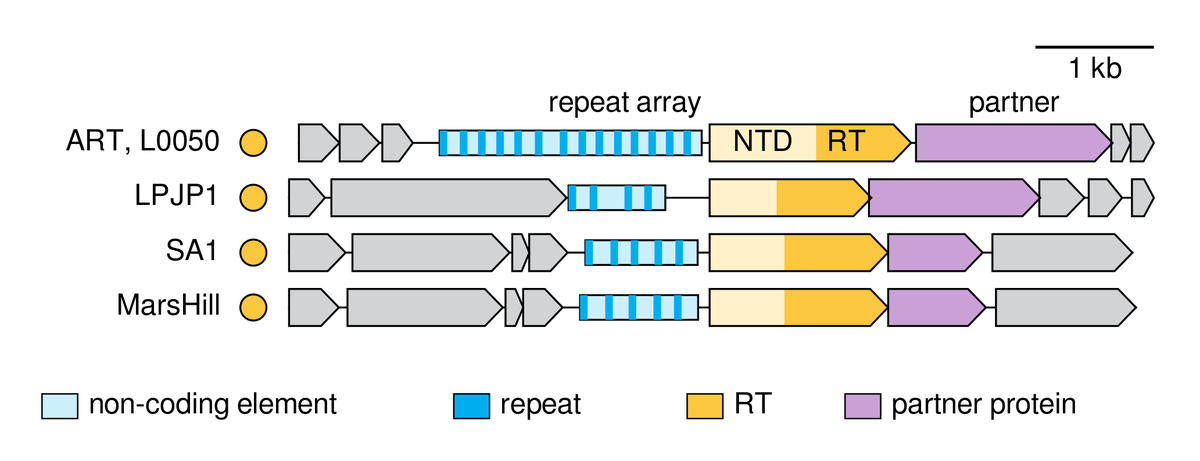
We were surprised by what came back. Claude turned up a strange CRISPR-like RT system we didn't ask for. It is an RT from jumbo phages with an array of repeats upstream and a dedicated partner gene. We call these array-associated RTs (ART).
ART systems are one of many unusual RTs that are being discovered. UG27 RTs were recently shown to co-occur with several copies of ncRNAs, a discovery made possible through a breakthrough in genomic language modeling that enables covariation analysis from @_David_Li and @garykbrixi.
https://t.co/ZSQon23eut
We're excited to see that Claude was able to make an analogous discovery by seeing DNA repeats by eye, and are curious to learn what other hidden messages we might be able to see through Claude!