Why have a single agent build your app when you can have a team of agents working in parallel right in your IDE?
I wrote a complete breakdown walking through the exact architectural blueprint, including a copy-and-paste Master Prompt you can drop into your workspace today.
https://t.co/H7dCenXQDM
@dev_maims A friend of mine managed to sell a startup for a crazy amount of money.
He warned me it was a rough ride and nearly went bankrupt getting it off the ground.
Another friend of mine wound up divorced getting theirs financially stable.
I'll pass on the startup path.
In QA/CI, stop blocking PRs on a single noisy eval run.
LLMs are non-deterministic. Run automated batch evaluations and track aggregate pass rates over time against golden production traces.
Ship on directional confidence, not coin flips.
How are you gating prompt and harness changes before they hit Prod?
Your agent's end-to-end benchmark score dropped 4% after a prompt tweak—and you have zero idea why.
End-to-end evals are a report card, not a debugger.
Here is how high-performing teams actually gate Dev, QA, and Prod agent deployments
Wire sensors into your loop using "Silent Success, Verbose Failure":
Checks pass → agent hears nothing (saves tokens + attention)
Checks fail → exact stack trace or diff is injected back into the loop for self-correction
Keep your repo rulebook (AGENTS.md) under 60 lines—a pilot's checklist, not a novel.
@dev_maims Funny enough, should be doing the same things now.
- Btc is off it's high
- AI has made building a business so much easier and more important
- software engineering still shows to have a very bright future
Bonus for agents with shell/file access: take an atomic workspace snapshot before risky runs or prompt rollouts.
Give your agent an undo button, not a prayer.
What's backing your agent checkpointers in prod right now—Postgres, Redis, or something custom?
State Management & Crash Recovery
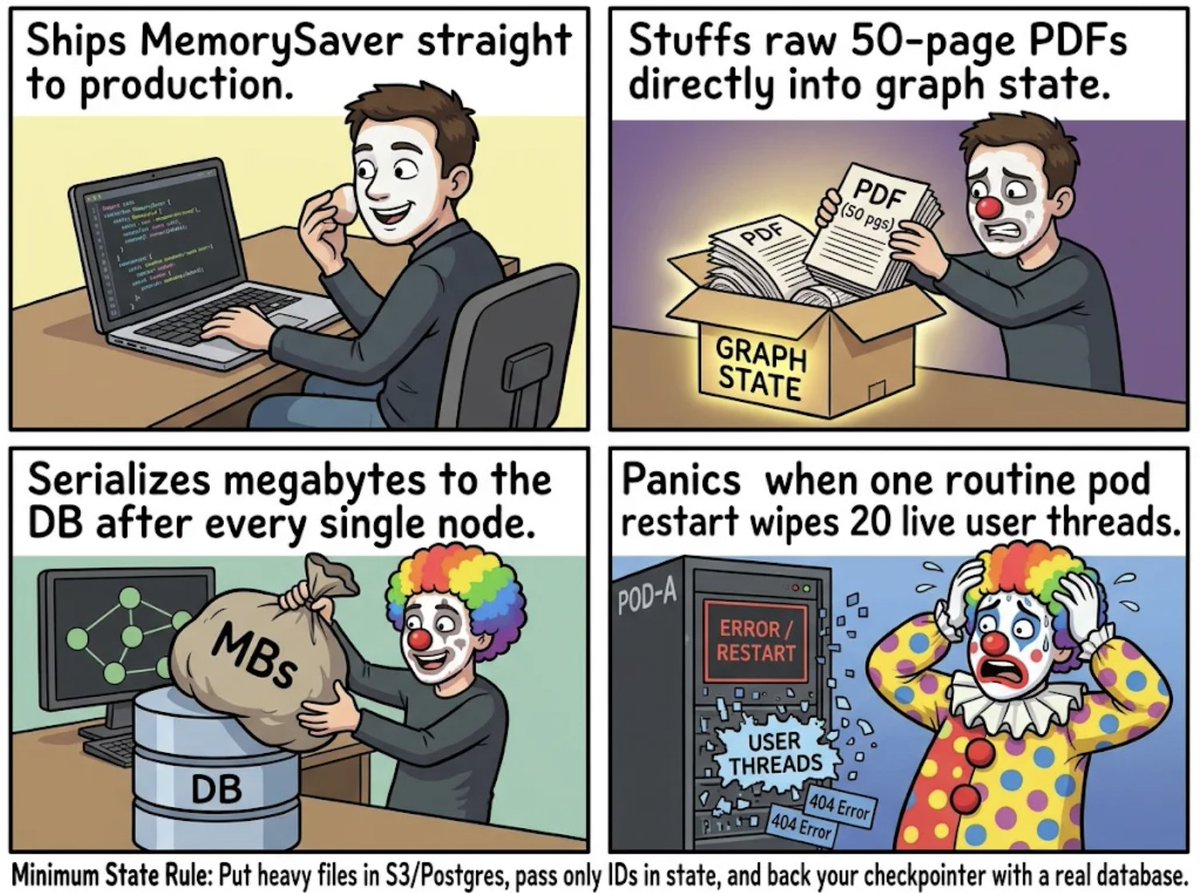
One pod restart just killed 20 in-flight AI agent threads.
If you're shipping MemorySaver to production—or stuffing raw documents into agent state—you're building a scaling time bomb.
Here's the persistence architecture that survives crashes and scales cleanly
Split your persistence into two distinct layers:
- Checkpointers (Postgres/Redis): Thread-scoped state snapshots for crash recovery, human-in-the-loop interrupts, and time-travel debugging.
- Stores: Cross-thread key-value memory for user preferences and long-term facts.
And always paginate aget_state_history()—a 500-step thread will OOM your worker if loaded at once.
When we run locally in replay mode, we read straight from that historical trace—there are zero live LLM or API calls.
If the agent tries to call an unexpected tool, the test suite instantly halts.
We can now run yesterday's production failures against today’s prompt updates with 100% fidelity. How are you tracing your agent runs today?
Observability & Debugging Non-Deterministic Agents
Last winter, my team spent three full days trying to reproduce a single production AI agent failure.
We had temperature=0 set. In theory, that meant deterministic output.
Yet every time we ran the same user prompt locally, the agent succeeded. In production, it randomly threw an error.
Here's why we were chasing ghosts, and how we finally fixed it
We finally fixed this by implementing a Deterministic Replay architecture:
We wrapped our LLM client and system tools with lightweight recording proxies.
Now, every production run logs a complete, serialized snapshot of the input, the exact model configuration, system clock timestamps, and verbatim tool responses. We store the heavy payloads once by their content-addressed hashes.
Last quarter, our AI agent’s cloud bill spiked by 400% after a minor traffic surge.
The problem was our actual user sessions hadn't grown nearly that fast. We were hemorrhage-spending because we were silently busting our prompt cache on turn 2 of almost every user session.
A cached input token is 10x cheaper than a base input token. But our production harness was accidentally invalidate-triggering the cache on almost every single loop.
Once I realized we were paying a massive "first-time processing" tax on 40-step threads, I overhauled our layout.
Here are the steps we used to cut our agent token spend in half:
1. Static First, Dynamic Last: We pushed our big system prompts and tool schemas to the absolute top of the request block. I had to force the team to stop injecting live timestamps and user metadata into the system prompt. Now, they're only appended in later messages.
2. Forced Static Tool Catalog: I found that when developers added or removed tools mid-session, the changes busted the cached prefix. We stopped swapping tool lists dynamically; instead, we load the full, stable catalog once and handle access via namespaced routing/client tool checks.
3. Eliminated Cross-Model Threading: Caches are model-specific. We used to swap models midway through a run to "save cost" on verification. It actually cost us more in busted cache history. Now, if we need a cheaper model, we use dedicated, isolated sub-agents.
4. Offloaded Heavy Tool Outputs: Passing raw, multi-thousand-line shell logs back to the LLM was destroying our cache bounds. Now, the agent writes big files directly to our object storage and only returns the file path alongside a small head/tail snippet.
Since locking this down, our cache hit rate went from single digits to over 85%.
Save this before your next big spike. What are your hit rates looking like in production?