Conservative estimates say that there are 40-100K Russian citizens who have come to live in Mariupol after occupation: including administration, private citizens who took mortgage or just bought real estate there.
Just imagine this:
- They killed around 100K civilians in Mariupol (estimates according to satellite imagery + morgue data – not possible to confirm while the city is occupied).
- Now they destroyed their graves (and previously just poured concrete over the bodies in the apartment buildings basements).
- They move in by THOUSANDS to live in the apartments of those dead people or those who cannot come back to confirm their property rights.
I just wish everyone could wrap their heads around these simple facts. Without any geopolitical points, grand ideas, and such. This is indeed THIS simple: people lived their lives, never attacked anyone, mostly spoke Russian, owned apartments and businesses and were generally happy with their lives. Russia took ALL of that away and either killed or virtually tortured the citizens into obedience, brainwashing their kids and substituting the Ukrainian population with Russians.
I have no freaking idea how anyone can support that. There is something deeply insect-like in it. Like a colony of ants moving into a neighboring ant house after killing its owners.
For all those who asked, here is a clip of @havivrettiggur responding to masked protesters interrupting his lecture at Haverford College on February 1, 2026. Enjoy and learn.
Of course there was no famine, just as there was no genocide, just as Jews have never used Christians' blood to make unleavened bread. These are all myths that we're now going to pretend no one ever believed.
https://t.co/O3rH04nkgC
I think @DavidDeutschOxf made the point that Popperian ideas are a high, thin mountain ridge between two evil, deep valleys.
One tiny misstep, and you tumble into either:
1. The fiery pit of authoritarian certainty
2. The poisonous swamp of relativism
Here, it’s relativism.
dear xxxxxxxx,
i read every word. i wish i had a more satisfying answer for you, but the truth is, i get messages like yours regularly—from people who've done everything they were told would matter, who show up, call, write, protest, and still feel like they're bailing out the ocean with a spoon. you're not wrong to feel that way. the foundations are shifting beneath us, and the tools we were told would protect democracy—engagement, institutions, information—are being undermined in real time.
here's what i know: you're already doing more than most. the calls, the protests in gaetz country, the refusal to look away—that matters. not because it guarantees any policy change, but because it keeps the muscle memory of citizenship alive. when people stop showing up, stop calling, stop caring, that's when the tidal wave actually wins.
but let’s be honest, you are swimming against the current. we're living through a transformation in how power works. grassroots civic engagement—the kind you're doing—is eroding not just because of political polarization, but because the systems that used to amplify individual voices are being replaced by algorithms that consolidate power in fewer hands. the social media business model is fundamentally incompatible with a healthy civil society—it welcomes bots, promotes extremism, and spreads disinformation precisely because those things maximize engagement. you're not just fighting bad policy; you're fighting a system designed to maximize division for profit. traditional information networks are collapsing. the "messy middle" of democratic institutions is under sustained attack. and younger americans especially are feeling a disenchantment that's hard to overstate.
so, what do you do when the infrastructure itself is compromised?
first, remember that erosion is uneven. not all american institutions are decaying at the same rate. some things still work extremely well: contract enforcement, capital markets, innovation. the judiciary remains independent in its decision-making. state and local governance remains mostly technocratic and independent of washington. the professional military is still firmly loyal to country over leader. your husband's service wasn't for nothing. that culture, that commitment to something bigger than partisan politics—it's one of the things that's holding. imperfectly, but holding.
second, stay local. national politics feels like screaming into the void because, increasingly, it is. but local politics—school boards, city councils, state races—still has leverage points where individual voices matter disproportionately. it's less glamorous, but it's where you can actually see cause and effect. and it's where the most consequential fights over voting access, education, and civil society are happening right now.
third, build real community. not just online networks, but face-to-face relationships with people who share your values—and people who don’t. the coming years are going to require resilience, and that comes from knowing your neighbors, organizing locally, and creating mutual support systems that don't depend on institutions you can't control.
fourth, focus on the 10%. not every outrage requires your energy. in an environment where everything is breaking news, where uncertainty itself has become the dominant condition, the most important skill is figuring out which fights matter for outcomes. don't let the noise exhaust you. pick your battles.
finally—and this is hardest—accept that you can't control outcomes, only your response. you stood by your husband for 24 years because you believed in something bigger than yourselves. that belief was real and justified. the question now isn't whether you can stop the tidal wave alone—you can't. the question is whether you're willing to keep standing for what you believe in even when the odds look terrible. because the alternative—cynicism, withdrawal, giving up—guarantees the outcome you're trying to prevent.
.@DavidDeutschOxf: "A rational approach to politics is to judge all political institutions as ways of facilitating conjecture and criticism, or as Popper says, does it make it easier to remove bad policies and bad rulers?
That's the only criterion that one should judge a political institution by, not how well does it choose rulers? Is it going to choose the best ruler? Are they going to be right? Are they going to be probably right? And those are all terribly bad questions, which are based on authority, based on seeking authority from someone.
We have to expect that our policies at any one time will be riddled with errors, most of which we're not aware of, and our institutions, the institutions that we use to select politicians and so on, like voting systems and parliamentary rules and that kind of thing, will also be riddled with errors.
And the people running them, that is the politicians, the civil servants, will also be riddled with errors.
So what are we to do in this situation?
Well, we have to, whenever possible, we have to adjust things so that attempts to locate and correct errors are as easy as possible."
“Say it loud. Say it clear. Jew-hate is not welcome here.”
The media may not want to show you this. So, we will.
This is what 70,000 people standing against antisemitism looks like.
Jews and their allies proudly waved the flag of this country as we called for an end to hate on Britain’s streets.
Beautiful, isn’t it?
In the name of Palestine, an elderly Jewish woman was stabbed in a kosher grocery store in Ottawa yesterday. She survived the assault.
Here are social media posts by the alleged attacker, Joseph Rooke of Cornwall, Ontario.
In Montreal in 1970, terrorists calling to make Québec a state took a British diplomat hostage for 60 days and murdered a cabinet minister. Canada invoked the War Measures Act and sent in troops. Now @MarkJCarney is sending the message that murder and kidnapping wins you a state.
As my late father used to say in the days of handwritten European cafe bills: "if they were just bad at math, you'd expect half the mistakes to be in my favor."
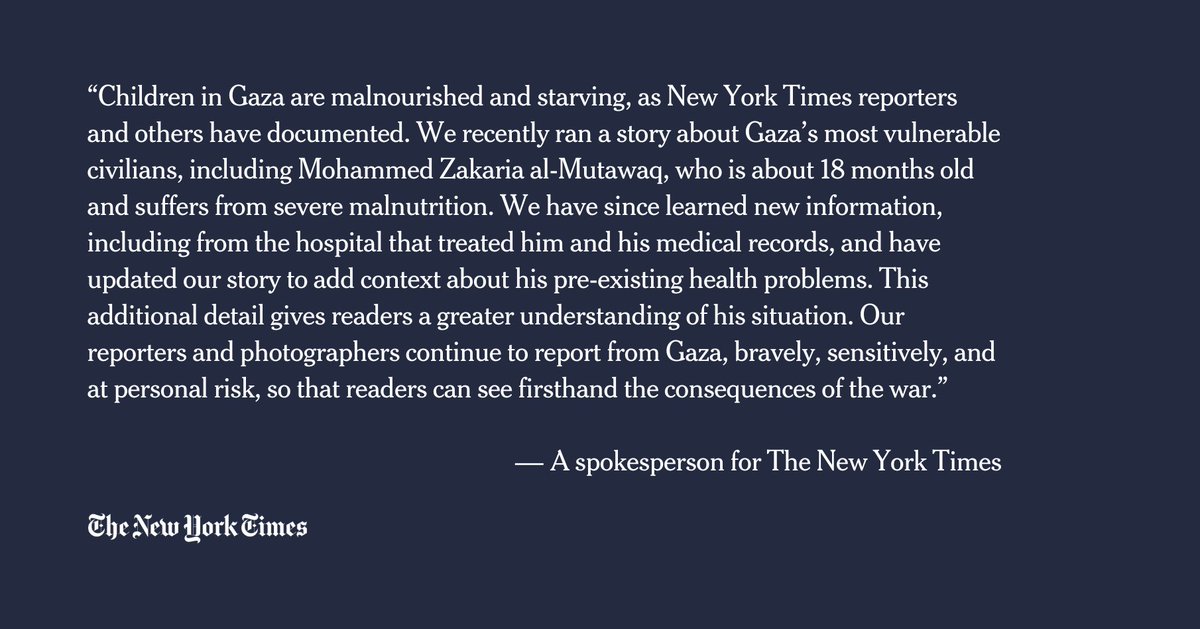
We have appended an Editors' Note to a story about Mohammed Zakaria al-Mutawaq, a child in Gaza who was diagnosed with severe malnutrition. After publication, The Times learned that he also had pre-existing health problems. Read more below.
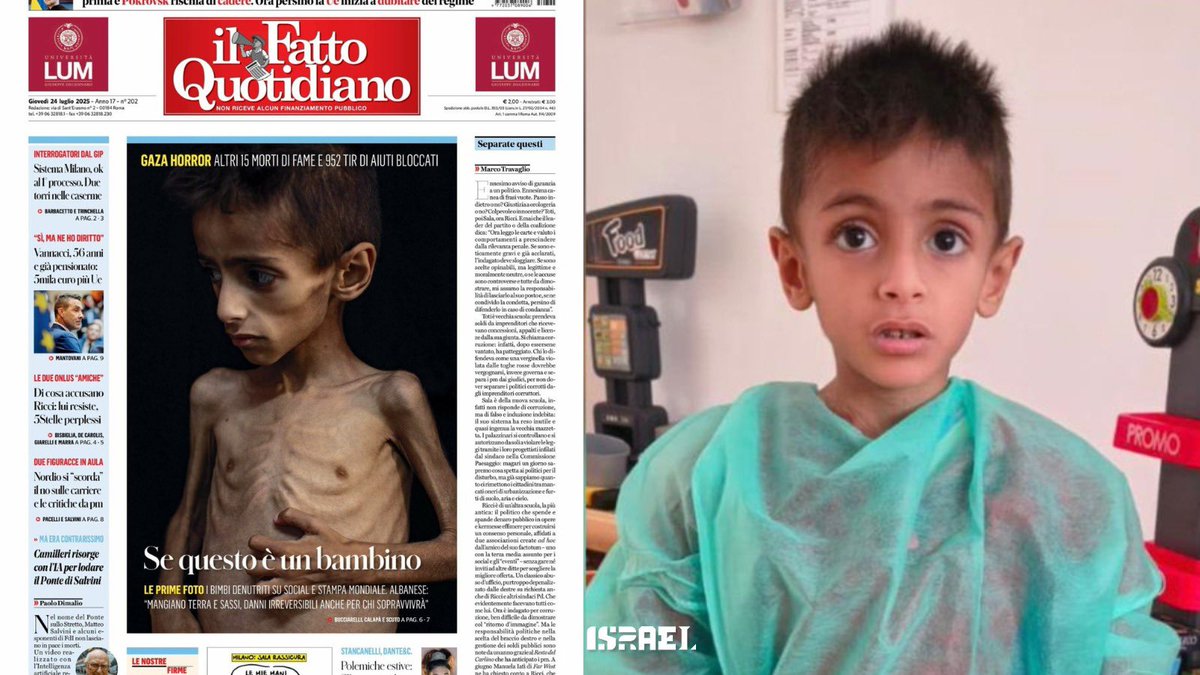
This is what a modern blood libel looks like:
A sick child. A hijacked photo. A lie that spreads faster than truth.
His name is Osama al-Raqab. He has cystic fibrosis, a serious genetic illness.
He’s been in Italy receiving treatment since June 12. Israel enabled his medical transfer from Gaza.
But that didn’t stop media outlets from weaponizing his image NOT to tell his story, but in order to smear Israel.
Because when it comes to Israel, facts are optional.
Hate always finds a headline.
Here he is again talking total sense as usual. @patcondell addresses the middle east and the Israel - Palestine situation.
Give him a follow, he is awesome.
We are outraged by reports that Hamas attacked a bus carrying GHF workers to a distribution center near Khan Younis last night. At least 8 people have been killed and the GHF has stated that some team members may have been taken hostage.
Hamas demands unrestricted aid and then turns around and openly threatens aid workers and any civilians who accept the aid.
Hamas is a terrorist organization with no interest in protecting the very people they rule. They care about power and bloodshed. That’s it.
This is yet another wake-up call for the international community. Countries must designate both the military and political wings of Hamas as terrorist organizations and take concrete steps to end its reign of terror. https://t.co/Pzoe6eiHXm
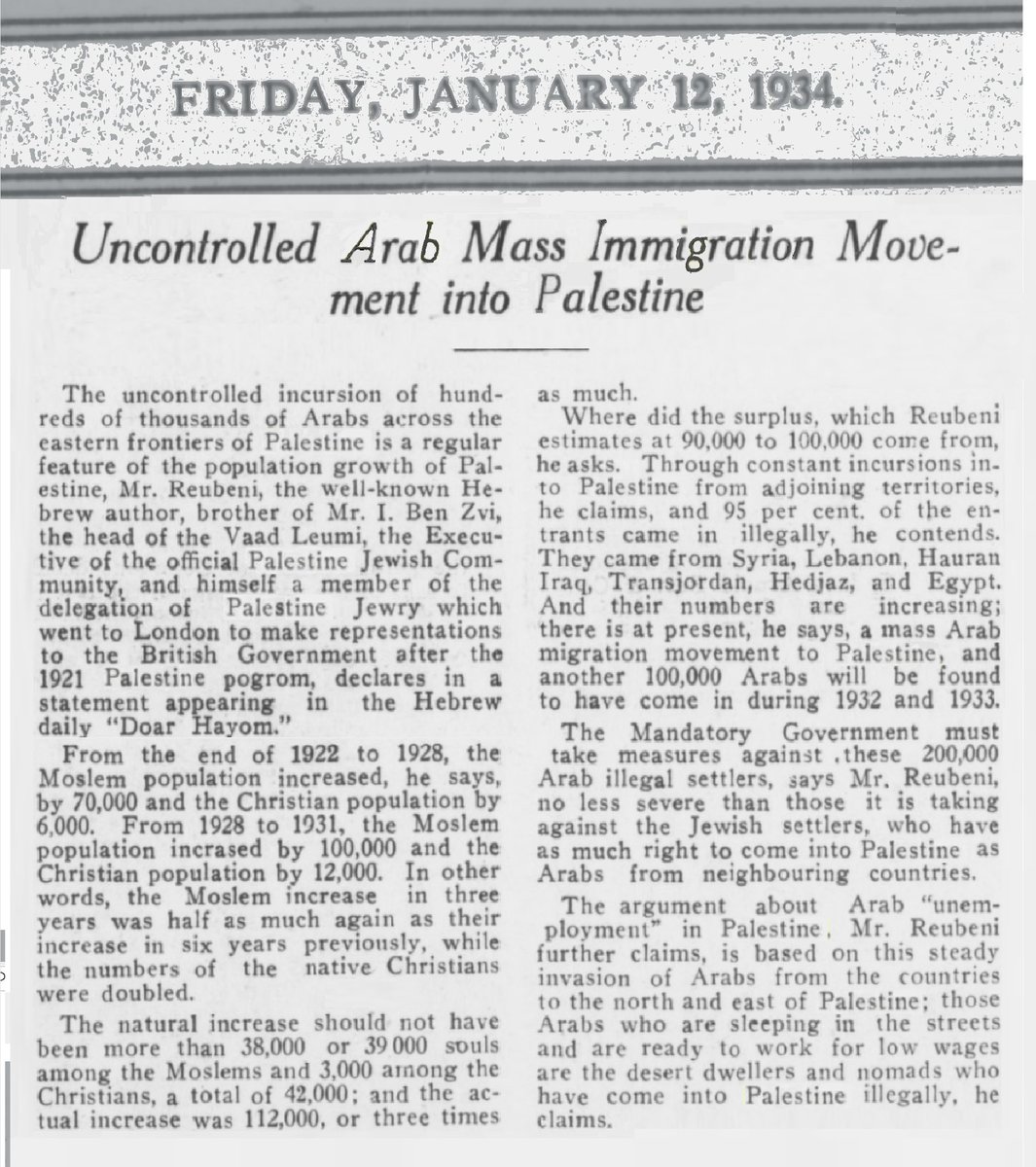
You’ve been told that Jews poured into the Land of Israel as colonial invaders.
That Zionism was foreign.
That Palestine was peacefully Arab—until the Jews arrived.
But the truth is more complicated.
Arabs came in huge numbers too. And here’s why that matters.
A thread 🧵
You know what the single most profound, far-reaching effect of Russia’s war against Ukraine is?
Ukraine has finally learned to truly respect itself.
We are no longer some godforsaken "Russia's backyard", where corrupt mafia clans don’t dare to make a sound without the Kremlin’s permission, and where everyone lines up to lick Moscow’s boots.
We are a nation that, in just a few years, built from scratch a capable army — the one that is now heroically fighting Russia, one of the largest military powers in modern history.
To stand up to such an adversary in the biggest war of our time, Ukraine has been sustaining World War I-scale mobilization and made revolutionary breakthroughs in military innovation.
Today, Ukraine possesses one of the most capable armies in the world, with cutting-edge, real-time experience in modern warfare—able to resist an enemy that is vastly superior in everything.
We have preserved a democracy and a brutally competitive political life like neither Russia nor any of its satellites country ever had.
Our president, once a populist comedian, has grown to be a leader of the free world—someone applauded by entire nations in the halls of St. Peter’s Basilica.
We are no longer the punchline of imperial Russian jokes. No longer “village bumpkins,” no longer “little brothers.” We have finally remembered who we are—descendants of the ancient Slavs, the Vikings, the Zaporizhian Cossacks.
Our capital is not a provincial town but a sacred, ancient Christian city—the beating heart of this part of civilization. And its holy sites belong to us. No one else.
We no longer feel ashamed of our language or our culture. No longer do we see them as “backward,” “provincial,” “second-rate,” as Moscow has insisted for centuries. We have long since broken out of Russia’s cultural orbit: there’s no more garbage Russian pop music on the radio, no endless cop shows from Moscow on TV, like we endured for decades.
Instead, in the midst of war, we’re witnessing a cultural renaissance unprecedented in our history—Ukrainian music, cinema, and literature are flourishing. In Kyiv, tickets to classic Ukrainian plays are sold out six months in advance.
We’re no longer a patchwork “post-Soviet country,” split between a “Russian-speaking southeast” and a “Ukrainian-speaking west.” We are a united nation. A person from Dnipro and a person from Lviv now share the same values, the same mission, the same grief, the same culture and history — and the same enemy.
People from Kharkiv fight the Russian invader just as fiercely as those from Ternopil.
No one laughs anymore at the idea of a Ukrainian navy— our naval drones have humiliated the Russian Black Sea Fleet. We shoot down enemy fighters. Our drones and missiles now strike oil depots, airfields, and ammunition bases across Russia nearly every night.
Ukraine is no longer a country you can show up to, toss some exploitative resource deal on the table, and sneer, “Sign this — you’ve got one hour.” No. Now you’ll be escorted out of the room with your hands shaking — and only after that will a balanced, civilized, mutually respectful agreement be negotiated. Yelling and threats no longer work here.
We are a country whose Chief Mufti has volunteered to become a combat medic at the front. Our Chief Rabbi works daily to advocate for Ukraine around the world. His son died in combat, defending Ukraine with a weapon in his hands.
Ukraine is now holding our ground — honorably —against a whole axis of evil: Russia, Iran, and North Korea. And Russia has suffered devastating defeats and drained its once-vast Soviet stockpiles of weapons and ammunition.
And along the way, we’ve shaken up global politics. We’ve earned the trust and support of dozens of nations. We’ve broken through walls of Western fear, hesitation, and passivity, the appeasement. Ukraine’s victory in the Battle of Kyiv in 2022 changed the course of European history when the best military minds were giving us 72 hours.
You can’t imagine how often we still find ourselves saying to each other, half in disbelief:
“Can you believe this? Who would’ve thought our poor Ukraine was capable of this?”
What more can I say?
Ukraine has already proven itself a great nation.
We have countless enormous problems—and they’ll require titanic effort to overcome.
But if we endure this war of annihilation, this country will have glorious future.