EQUITY GROUP, KCB AND NSE-LISTED KENYAN BANKS: As we wrote previously, last year was the last year we compared Equity Bank and KCB Group. From now on, it will be Equity, then KCB. This is about fundamental positioning and performance. With Quarter 3 Profit after tax of Ksh 71.5 Bn, Equity Bank will definitely make around Ksh 95 Bn to slightly over Ksh 100Bn in the full year. This gives the company a forward P/E ratio of around 3.7 years at today’s market Price. This means if you bought the entire Equity Group today, it would take you 3.7 years, or under 4 years, to recover your money on Profits alone. This would be a much shorter period if you factor in the inevitable increase in profit within that period. On the other hand, KCB Group Quarter 3 results came with a bottom line of Ksh 58.6Bn. This gives a full-year forecast of approximately Ksh 80 Bn with a forward PE ratio of around 3.5 years.
Technically, KCB seems more attractive, but Equity Bank is more grounded fundamentally. Technical analysis evaluates the share price trend. Fundamental analysis deals with the company’s performance.
42% of Equity Bank's profits came from subsidiaries outside Kenya, with DRC as a star performer. KCB’s subsidiaries from outside Kenya contributed 33.4%.
The comparative performance of the two local champions clearly shows that companies that base their strategy on market-driven dynamics become more solid in the long run. Even with KCB having the advantage of heavily participating in large Government transactions, including G-G, the sale of Safaricom's stake, and others, Equity Bank has usurped KCB on most parameters, including the Return on Capital. Dr Mwangi is sweating the assets and capital of Equity more than Mr Russo. Both men are doing great, though.
The strategy of consolidating the region is paying off for both. Operating in around 6 countries, Equity Bank is more profitable than Nigerian Access Bank, which operates in around 20 economies. Consolidation takes advantage of know-how that only comes with time.
Going forward, the financial giants must spread to West and Southern Africa and hunt for more money to bring back home.
Even with the stellar performance, neither features in the top 10 list of the largest banks in Africa. The two banks should consider acquisitions, mainly in Southern and Western Africa. Merging the two to create Equity KCB Group should not be far-fetched. It remains a viable idea. This would create a financial behemoth that can compete with the likes of Standard Bank, FirstRand, National Bank of Egypt, Nedbank, Attijariwafa Bank of Morocco, and others.
The listed Kenyan Banking sector is among the most undervalued in the world, with most domestic banks trading at below 1 to book value or at a discount and with PE ratio of below 5.
The only risk lies in how the country manages the public debt. A default would erode all the advantages. Spreading the risk geographically is an intelligent strategy.
We are African and Africa is our Business.
Co-op Bank just grew its profit by 27%. But look closer: the story isn’t the headline number, it’s where the growth came from.
For the nine months to September 2026, Co-op made KES 27.4B after tax, up from KES 21.6B. EPS rose from KES 3.68 to KES 4.68, and the interim dividend went up 50%, from KES 1.00 to KES 1.50.
Three things drove it:
1. Lending growth. Net loans grew 22% in a year, from KES 407B to KES 497B, at a time when many Kenyan banks are still cautious about lending. Deposits grew 15% to KES 633B.
2. Cheaper deposits. As CBK cut rates, Co-op’s interest bill on customer deposits fell 7%, even though deposits grew. Net interest income rose 12.7%.
3. Fewer bad loans. Loan loss provisions fell 34%, from KES 7.4B to KES 4.8B, and gross NPLs dropped from KES 78.9B to KES 71.7B. That alone added about KES 2.5B to pre-tax profit.
What to watch:
1. Costs are growing faster than income. Operating costs excluding provisions rose about 15%, while operating income rose about 12%.
2. The NPL ratio is improving, but it’s still around 13%. Asset quality is the risk that could reverse the provisioning tailwind.
Kenyans are being asked to buy shares in Dangote’s refinery. Meanwhile, Dangote just bought 25% of Kenya’s fuel pipeline.
He confirmed today that his group bought 4.5bn KPC shares in a block trade, about KES 42.5bn at KES 9.02–9.36 a share.
Three things stand out:
1) Strategy. A refiner now owns a quarter of the pipeline that moves fuel across Kenya and into Uganda, Rwanda and DRC. That’s vertical integration, and it fits his plans for a Kenyan refinery.
2) The sellers. KPC listed at KES 9.00 in March. Whoever sold has made almost nothing in seven months, apart from the dividend, which went to the buyer because the trade was cum-dividend.
3) Governance. 25% is the level at which Kenya’s takeover rules kick in. Minority shareholders deserve clarity: who sold, at what price, and does KPC keep open access for other fuel importers?
A strategic investor can be good for KPC. But for a national asset, the process matters as much as the price.
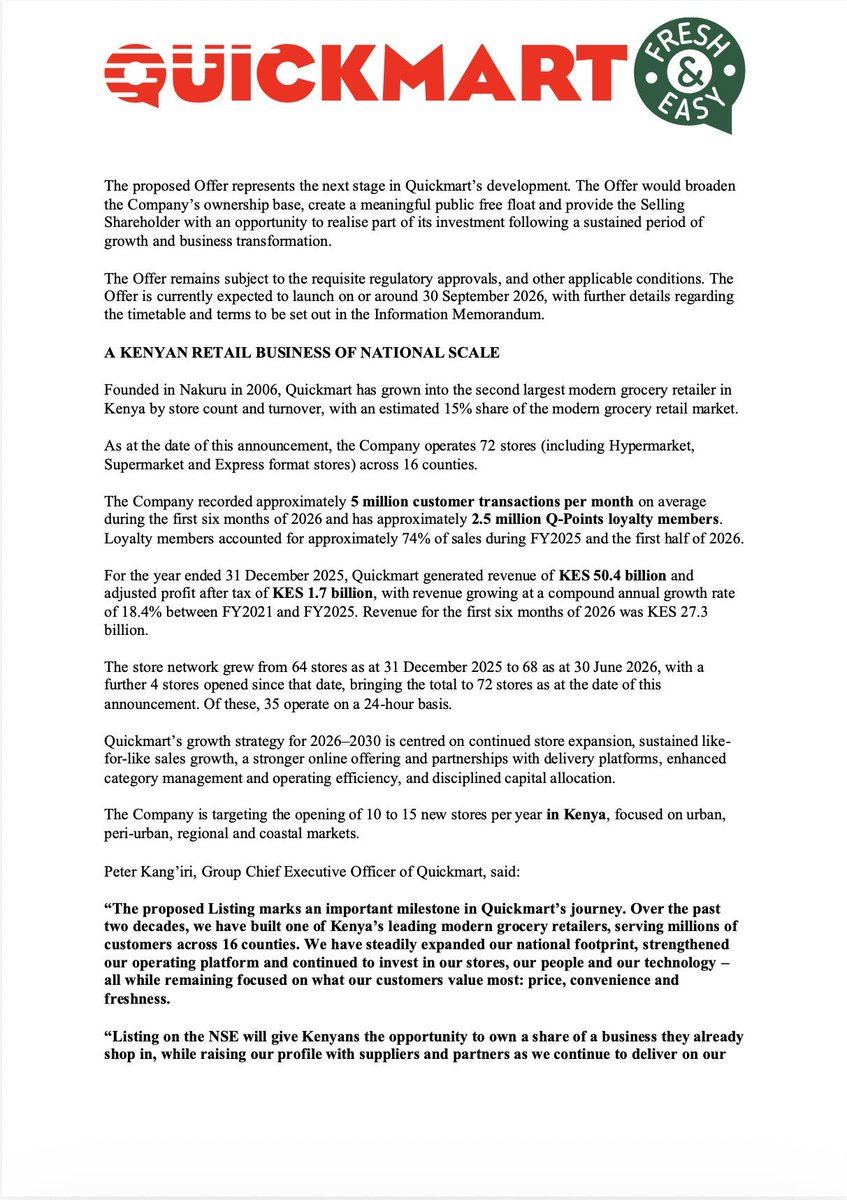
Quickmart is coming to the NSE Kenya.
Offering 50% of the company, 2 billion shares, to investors.
📍 72 stores | 16 counties
💰 FY25 revenue: KES 50.4bn
📈 Adjusted PAT: KES 1.7bn
💵 Target dividend payout: 80%+ of PAT
No new capital raise. This is an offer for sale and will be a major new consumer-sector listing on the NSE 👏🏾
YouTube Documentaries to Watch
1. How to Unlearn Hate: Stories of Courage, Hope & Reconciliation — DW Documentary
2. Eco Burial: Would You Consider to Being Composted? — DW Documentary
3. I Don’t Get Democracy — Johnny Harris
4. Everything You Own Came Through Them — Endevr
Before you sell your Equity Group shares, remember these words by Group CEO, Dr James Mwangi:
“When you invest in Equity you don’t invest for yourself.
This is a high growth stock, a high return stock.
This is not for selling in the market. Its not for trading, its for holding.
And the cash generated is enough to maintain your lifestyle. And you live the stock for your children.”
Today the NSE had one of its worst days in years.
The NSE All Share Index (NASI) fell 3.38%, wiping out KES 139.63Bn, more than the KES 125Bn lost in the worst Covid-era sell-off.
Why is this happening? Should you panic-sell? Is the bull run over? 🧵