Previously, we looked at the Health sector. This time we take a look at: Robotics and Drones.
Robotics and autonomous systems: onboard and workcell cameras record what a machine sees and does, and the footage gets reviewed when something needs explaining or improving.
Drones and aerial inspection: one flight over a pipeline, a roof or a power line can produce hours of video, and the part that matters is a few seconds that have to be found afterward.
Autonomous vehicles and ADAS: test fleets record every drive, and engineers go back through the footage to look at specific events.
Two more in Robotics and Drones:
Fleet and trucking telematics: dash and cab cameras
Manufacturing and quality inspection: lines, stations, inspection cameras
In robotics and drones, footage is data. It’s what the machine “sees”, acts upon, and it’s what people go back to for review, inspection and training. Vidaio compresses, tags, names, sorts, and files it.
Next up: Infrastructure.
@vidaio_
$TAO
🚨 Scam Alert 🚨
Bittensor is NOT complicated. You just don’t want to put in the work.
The same effort it took to understand Bitcoin and DeFi is the same effort you’ll need to understand Bittensor and its subnets.
It’s actually pretty damn simple once you get started.
Stop selling people shortcuts because they’re too lazy to learn.
$SWELL
We’ve built the tools...
We’ve got the tech...
We’re organized....
We’re well-dressed...
We’re polished....
We’re serious...
We’re meeting the biggest names in the industry...
We're turning heads...
We’re ready...
Vidaio for Media and Entertainment.
The video AI that upgrades itself!
@vidaio_ bittensor:native
Last time we looked at Security. Today: Public Safety.
Law enforcement: body-cams, dash-cams and interview rooms produce footage that has to be offloaded, labeled and stored, then pulled for reviews, records requests, training and court.
Transportation hubs: airports, rail, metro and ports run cameras across platforms, gates, terminals and docks. The footage settles incidents, and it also shows how people and vehicles actually move through a site.
Emergency services and fire: stations, vehicles and incident scenes generate footage that can be reviewed to see how a response went and what could be done faster.
Four more in Public Safety:
Smart cities and municipal CCTV: intersections, transit stops, public squares
Border and customs: crossings, inspection lanes, cargo
Government and court archives: hearings, records, evidence storage
Defense and ISR: surveillance and reconnaissance video
In public safety, footage is evidence. It’s also how agencies review a response, train their people and find ways to work faster. Either way it has to be kept, found and produced on demand. Vidaio compresses, tags, names, sorts, and files it.
Next up: Health.
@vidaio_ $TAO
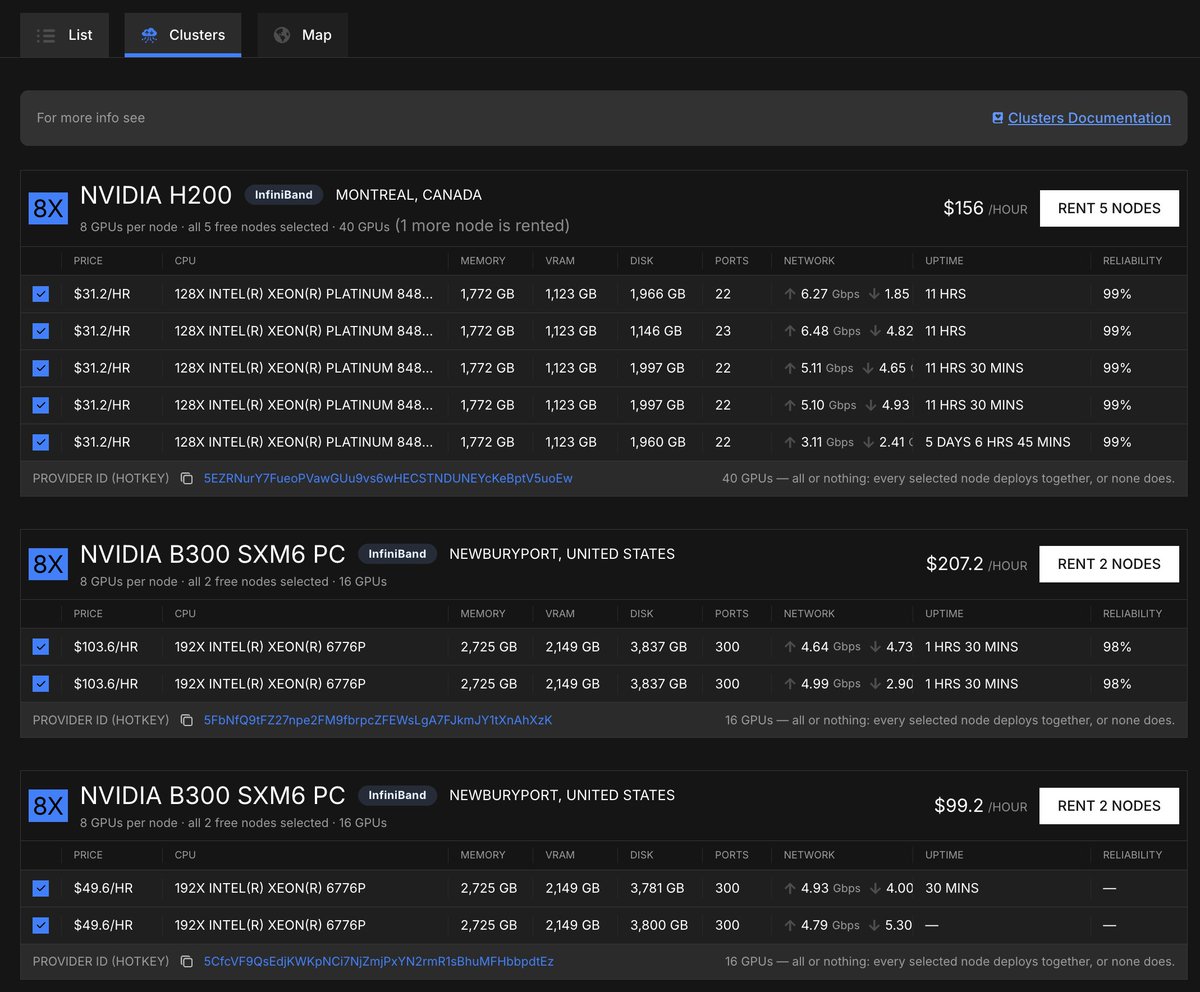
lium: the only place globally where you can rent h200 and b300 clusters on-demand and instantly.
We continue to revolutionize the GPU industry by shipping novel features optimized for agent productivity and efficiency.
$tao is the place for the future of AI markets. I Use https://t.co/Vnhtdh0Vzd and https://t.co/LJsuk7CqAg for research and follow @TAOTemplar@ShizzyUnchained and @AltcoinMillie as of now they have not been co-opted and are unbiased. Check out their YouTube too.
As I mentioned, anything outside of Bittensor will be extremely hard to compete with in the inference compute markets because of the engine, to put that into perspective.
A Bittensor subnet is now selling inference on an American enterprise exchange, at half the market's own price floor, funded by token emissions. $TAO
🚨 Every $TAO subnet has been forced to run the same business model. eTAO ends that.
It's one of the biggest changes to subnet economics since dTAO. Watch the 80-second explainer 🎬👇
How it worked until now
Every 12 seconds, each subnet mints new alpha tokens. Almost every subnet split them the exact same way:
• 18% to the owner (the team running it)
• 41% to validators and their stakers (checking the work)
• 41% to miners (doing the work)
A GPU farm, a research lab and a consumer app all lived by one rule.
What eTAO (Expressive TAO) changes
Each subnet owner can now set their own split, within limits:
• Miners: at least 33%
• Validators: up to 50%
• Owners: up to 33% (18% minimum for lease-created subnets)
• Changes about once a week
Total emissions don't change. eTAO only changes where they go.
Why that's a big deal
Different businesses need different budgets:
• A compute subnet short on GPUs pays miners more
• A research team funds its developers through the owner share
• A subnet with hard-to-check work spends more on validators
Targon (SN4) is the live example. In the Talking Targon episode with Const, the team said customers want more compute than it has, and most of it is rented.
Push miners from 41% to 80% and miners get about 95% more tokens. At the same token price, that nearly doubles the budget to bring on GPUs.
More compute → more revenue → bigger buybacks. That's Targon's plan, not a guarantee.
The twist
Lower yield can be bullish.
A high APY tells you how fast new tokens reach stakers. It doesn't tell you what customers pay.
Normal companies make this trade every day: reinvest in production instead of paying out. eTAO lets subnets make the same call.
The guardrails
• Root $TAO stakers are paid their baseline first, calculated from live chain state
• Owners can't set validators below that baseline
• Miners can never drop below a third
• The burn and recycle slots exist but are fixed at zero for now
Why? Const explained it: without a floor, a subnet could cut out its outside holders, fake its price signal and pull emissions it hasn't earned. The floor keeps every subnet paying the network that funds it.
Everything else that just changed
eTAO isn't alone. Bittensor is redesigning itself fast:
• Null Consensus: opt-in, up to 2,500 participant slots per subnet, up from 256
• Proof-of-work registration: miners can join with compute, no TAO upfront
• Subnet registration cost now halves every 8 days, down from 16
• New-subnet immunity drops from 120 days to 60
• Gamma (in development): subnets buy compute, storage and inference from each other with their emissions
Put it together: bigger competitions, easier entry, faster turnover, custom budgets, and soon an internal economy where subnets are each other's customers.
The take
• eTAO is on testnet now. Mainnet comes with the next runtime upgrade (v481)
• An owner can fund the wrong thing. A weak scoring system can pay miners who farm rewards instead of building the product
• Alpha staking yields aren't permanent. A subnet's split is now part of what you're investing in
• Emissions aren't revenue. The bull case only works if extra output gets paid for
Why it matters for AI
AI doesn't grow in straight lines. Agents make thousands of requests while a person reviews one dashboard. Workloads shift from compute to storage to verification in weeks.
A network funding that can't run on one fixed rule.
Now it doesn't have to. 🧠
Sources: Bittensor release notes (v481), Talking Targon Ep. 01 with Const, Novelty Search.
$TAO / Not financial advice, always DYOR.