Zee Entertainment’s ₹600 Crore Buyback: Questions on Capital Allocation and Corporate Governance
Zee Entertainment Enterprises Ltd’s proposed ₹600 crore share buyback has raised questions about its capital allocation strategy. The concerns come shortly after the company raised ₹735.55 crore through a preferential issue of convertible warrants to a promoter-group entity. With operating profitability under pressure, the decision to return capital to shareholders has prompted questions about the rationale behind the move and the utilization and monitoring of the funds raised.
As reported in @EconomicTimes, InGovern highlights the need for greater transparency and stronger board-level oversight in capital allocation decisions. Its assessment raises important questions about the timing of the buyback, the traceability of warrant proceeds, the company's financial performance, and the need to balance shareholder returns with long-term financial requirements.
Read the full article:
https://t.co/T6QsJyPW4U
https://t.co/U22w5FD85F
#InGovern #CorporateGovernance #ZeeEntertainment #CapitalAllocation #ShareholderValue #BoardGovernance #ProxyAdvisory #CorporateIndia
TVS Family Succession Dispute: Valuation Changes and the Governance Risks for Listed Companies
The ongoing succession dispute within the TVS family has raised concerns about family settlements, promoter ownership and corporate governance. The differences over asset division and business valuations have also brought the interests of minority shareholders in TVS Holdings and TVS Motor Company into focus.
In his analysis, Mr. @reachShriram Subramanian, Founder and Managing Director of InGovern Research Services, highlights that changes in business valuations should not, by themselves, become grounds for reopening an agreed family settlement. Any proposed changes must be evaluated against the documented terms and applicable legal provisions. The report also draws attention to the need for greater transparency around ownership arrangements, promoter disclosures and the potential impact on minority shareholders.
The governance implications of the dispute have also received coverage from @business_today, @EconomicTimes, @bsindia, @businessline and @RediffNews. These publications have highlighted concerns around promoter control, ownership changes and shareholder interests. The broader takeaway is that family succession arrangements involving listed companies require clear documentation, transparent disclosures and appropriate governance oversight to protect shareholder interests and maintain investor confidence.
Read the full article:
https://t.co/lnzX7fYn1Q
https://t.co/p6wXe6fyVM
https://t.co/bmsyWU0R58
https://t.co/LhV25aOzkg
https://t.co/viMbrpp7kF
https://t.co/req6D8XgWG
https://t.co/UsHIxGXz7w
#CorporateGovernance #TVSGroup #FamilyBusiness #BoardGovernance #MinorityShareholders #InGovern
The Supreme Court’s verdict on YES Bank’s ₹8,415-crore Additional Tier-1 (AT-1) bonds has brought renewed attention to the legal framework governing bank resolutions and the risks associated with these financial instruments. The ruling, which overturned the 2020 write-off of the bonds, could affect YES Bank’s capital adequacy and raise broader questions about regulatory authority in banking crises.
Speaking to @business_today, Mr. @reachShriram Subramanian, Founder and Managing Director of InGovern Research Services, said, “It was a totally surprising order to intrude into an instrument structure. The bonds pay out a higher interest rate and are subordinate bonds without any guarantees.” He further clarified, "The Supreme Court contends that the write-off in this particular case was not on proper legal grounds.”
Read the full article: https://t.co/XbWsciNXcM
#CorporateGovernance #YESBank #AT1Bonds #BankingRegulation #InGovern
Fairfax’s IDBI Bank Takeover Puts CSB Bank at a Crossroads: Stake Sale or Merger?
In an article published by @ETBFSI (The Economic Times BFSI), Fairfax’s acquisition of a 60.72% stake in IDBI Bank for ₹52,878 crore has raised questions about the future of CSB Bank, in which Fairfax already holds a 40% stake. The development brings into focus whether Fairfax will pursue a merger between the two banks or sell its stake in CSB Bank, considering regulatory requirements and strategic priorities.
Mr. @reachShriram Subramanian, Founder and Managing Director of InGovern Research Services, highlighted the potential business benefits of a merger, noting that CSB Bank’s strong presence in southern India could complement IDBI Bank’s operations. He also pointed out that a larger bank could benefit from greater pricing power on both the asset and liability sides, making a merger a possibility that cannot be ruled out.
He further explained that the new promoter would bring in a new board and management team and could potentially receive regulatory leeway for a few years to first stabilize IDBI Bank before deciding on its future structure. Following this period, Fairfax could consider a merger or explore selling its shareholding in CSB Bank.
Read the full article: https://t.co/AyN9bhuHKq
#CorporateGovernance #Banking #IDBIBank #CSBBank #Fairfax #InGovern
Tata Boardroom Feud Tests a Trusted Business Empire
A public disagreement between Tata Sons and its majority shareholder, Tata Trusts, has brought the group’s governance, leadership succession, and proposed public listing under scrutiny. The dispute over N. Chandrasekaran’s reappointment as chairman raises questions about the alignment of interests between the board and shareholders, as well as the potential impact on the Tata Group’s long-standing reputation for trust and good governance. The issue was reported by @BBC News.
“When we say this is a governance crisis, it’s a misalignment of interests between the board [of Tata Sons] and the shareholders [Tata Trusts],” says @reachShriram Subramanian, Founder and Managing Director of InGovern Research Services, in his comments to BBC News. He also observes that Ratan Tata’s larger-than-life image contributed to the current conflict, as the leadership transition took place after his death rather than under his direct supervision. A smoother succession process could have helped avoid the present challenges.
Read the full article: https://t.co/ZVQKLbjfug
#CorporateGovernance #TataGroup #BoardroomGovernance #LeadershipSuccession #InGovern
Why a Public Tata Sons Can Strengthen Its Legacy and Transparency
The proposed listing of Tata Sons has raised questions around whether becoming a public company could affect the Tata Group’s legacy, ownership structure, and long-standing governance approach.
In his article in @FortuneIndia, Mr. @reachShriram Subramanian, Founder and Managing Director of InGovern Research Services, explains that a public Tata Sons would still be Tata Sons. The Tata Trusts’ continued significant ownership can help preserve the Group’s long-term purpose and stewardship even with public shareholders.
He further highlights that a listing could bring greater transparency and accountability through enhanced disclosures and public scrutiny. This could provide stakeholders with better visibility into the governance of the group's parent company while maintaining the balance between public ownership and the trusts' role.
Read the full article: https://t.co/gmGMuWQ3P8
#TataSons #TataGroup #CorporateGovernance #Governance #Transparency #Accountability #InGovern
Tata Sons: How Far Can a Board Go Against Its Controlling Shareholder?
The ongoing battle at Tata Sons is raising important questions about the balance of power between a company’s board and its controlling shareholder. The decision to reappoint N. Chandrasekaran despite opposition from Tata Trusts, which holds a 66% stake, has brought shareholder rights, board authority and corporate governance into sharp focus.
Speaking to @business_today, Mr. @reachShriram Subramanian, Founder & MD, InGovern, highlighted that, “Corporate law requires the shareholders of Tata Sons to approve the reappointment at a shareholder meeting an annual general meeting (AGM) or extraordinary general meeting (EGM)- which means Tata Trusts will have a say in the approval.” This brings shareholder approval and the role of the controlling shareholder into focus in the ongoing governance debate.
Read the full article: https://t.co/miEfZkRmYB
#CorporateGovernance #TataSons #BoardGovernance #ShareholderRights #BoardIndependence #TataTrusts #InGovern
Tata Sons: Restructuring to Avoid Listing
Tata Trusts has proposed merging Tata Electronics Systems Solutions (TESS) and Tata Consulting Engineers (TCE) with Tata Sons as a way to restructure the holding company and potentially avoid the requirement to list Tata Sons. The proposed restructuring would bring operating businesses and revenues directly into Tata Sons, with the proposal requiring regulatory approval from the RBI.
Mr. @reachShriram Subramanian, Founder & MD, InGovern, noted that the key question is whether the RBI would accept the proposed restructuring, particularly since Tata Sons’ earlier application to deregister its Core Investment Company (CIC) status had been rejected. The proposal therefore raises important questions around regulatory compliance, corporate structure and whether the restructuring could change Tata Sons’ regulatory classification.
Watch the full discussion: https://t.co/wWo8xXlJVS
#CorporateGovernance #TataSons #TataTrusts #RegulatoryCompliance #CorporateRestructuring #BoardGovernance #InGovern
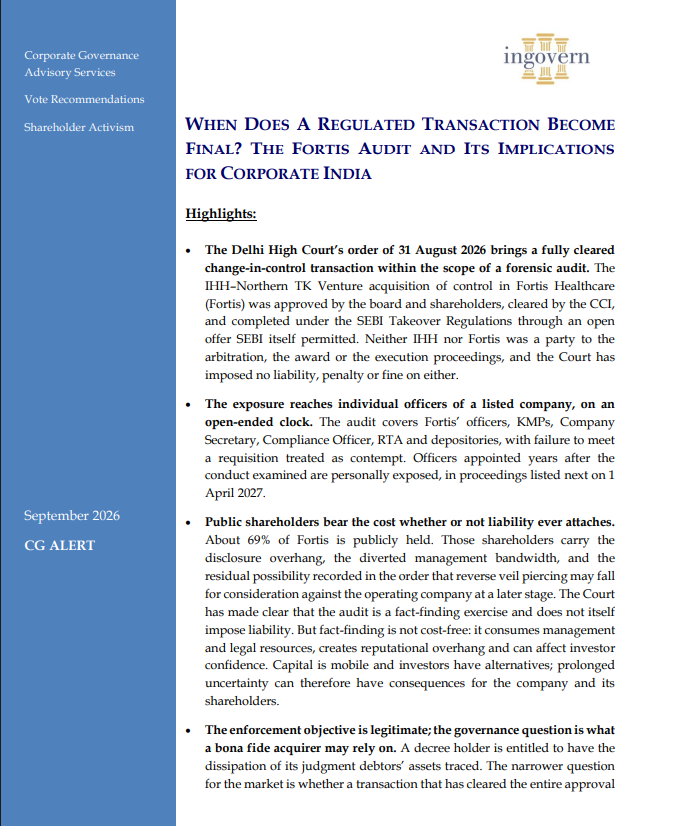
HC order weighs on confidence: Fortis investors
The Delhi High Court’s order directing a forensic audit of transactions involving Fortis Healthcare’s former promoters has raised concerns among investors about the impact of prolonged legal uncertainty on the company. The issue has been covered by @timesofindia, @businessline, @EconomicTimes and @FortuneIndia, with the coverage focusing on investor confidence, corporate-law principles and the implications for listed companies.
Mr. @reachShriram Subramanian, Founder & MD, InGovern Research Services, highlighted that the central issue is whether a transaction that had already gone through the required approval framework – including the board, shareholders, CCI and SEBI’s takeover regulations - can be reopened years later through a forensic audit. He noted that the 2018 acquisition of a controlling stake in Fortis by IHH Healthcare had received the relevant regulatory clearances, while neither IHH nor Fortis was a party to the original arbitration proceedings.
InGovern also highlighted a broader corporate-governance concern around whether a listed company can be drawn into enforcement proceedings arising from the personal liabilities of its current or former promoters. The distinction between a company and its shareholders or promoters is important, and weakening this separation without a clear finding of fraud or legal basis could create wider uncertainty for listed companies, boards, compliance teams and investors. At the same time, the forensic audit remains a fact-finding exercise and does not by itself establish liability.
Read the full articles:
https://t.co/7qSdApYSM0
https://t.co/ufvJeyutvv
https://t.co/BOjo5u4m1l
https://t.co/OzqJmFjEc5
https://t.co/n1fveoStPX
#CorporateGovernance #InGovern #ShriramSubramanian #FortisHealthcare #InvestorConfidence #BoardGovernance #CorporateLaw #ListedCompanies
Proxy Advisers Split 2-1 on Hikal’s CMD Appointment
A recent @CNBCTV18Live report highlights differing views among proxy advisers on the proposed appointment of Sameer Hiremath as Chairman and Managing Director of Hikal for a three-year term.
InGovern has raised concerns about combining the Chairperson and Managing Director roles within the promoter family without a clearly defined mechanism for independent board leadership, such as an independent Chair or Lead Independent Director. The analysis also highlights the lack of clarity in the proposed remuneration structure, including the absence of a disclosed maximum payout, detailed performance-linked parameters, peer benchmarking, and provisions such as malus and clawback.
These governance concerns also come in the context of Hikal’s recent financial performance and issues previously highlighted around audit, compliance and other governance matters. Stronger independent oversight and a more transparent, clearly defined performance-linked remuneration framework are important considerations when evaluating the proposed leadership appointment.
Read the full article: https://t.co/lXlgUEIVEN
#CorporateGovernance #BoardGovernance #ShareholderRights #ProxyAdvisory #Hikal #InvestorGovernance #InGovern
Tata Sons Succession Battle: Governance and Succession Questions Come to the Fore
The reappointment of N. Chandrasekaran as Chairman of Tata Sons for another five-year term, despite the dissent from Tata Trusts Chairman Noel Tata, has brought the differences between Tata Sons and Tata Trusts into the open. The 4–1 board vote has also raised questions around the Articles of Association, shareholder approval, and the succession process ahead.
Speaking on @ETNOWlive, Mr. @reachShriram Subramanian, Founder & MD, InGovern Research Services, highlighted that the developments reflect a deeper divide between Tata Trusts and Tata Sons, with the board itself divided on the succession issue. He noted that the matter could potentially move to the courts and that the board’s decision would ultimately have to go before shareholders at the AGM. He also highlighted the broader corporate governance concern, particularly the need for clearer alignment between Tata Trusts and Tata Sons on succession planning and governance matters.
Mr. Shriram Subramanian also noted that the immediate impact on Tata Group’s operating companies may remain limited, as they have their own boards, management teams, and capital. However, the ongoing dispute brings the importance of succession planning and the governance relationship between the Trusts and Tata Sons into sharper focus.
Watch the full discussion on ET NOW:
https://t.co/hA4OfGzPjg
#InGovern #ShriramSubramanian #TataSons #TataTrusts #CorporateGovernance #SuccessionPlanning #TataGroup #ETNOW
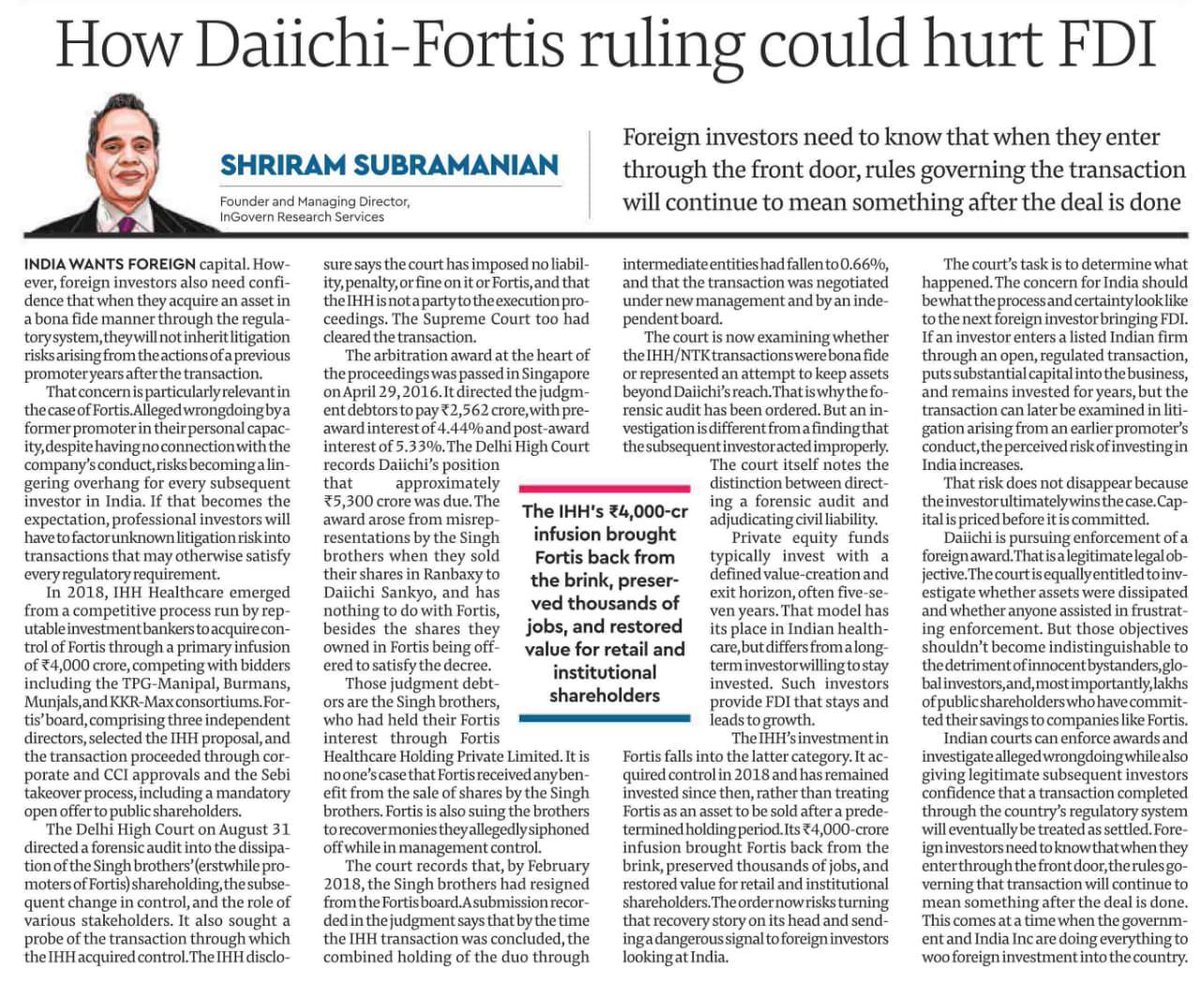
How Daiichi-Fortis ruling could hurt FDI
In his latest article published in @FinancialXpress, Mr. @reachShriram Subramanian, Founder & MD of InGovern Research Services, examines how the Daiichi-Fortis ruling could have wider implications for foreign investment and investor confidence in India.
The Daiichi-Fortis case brings attention to the importance of investor certainty, particularly when subsequent investors enter a company through a competitive and regulator-approved process. Mr. Shriram Subramanian highlights that IHH Healthcare entered Fortis through such a process, invested ₹4,000 crore and has remained invested since 2018. He raises an important consideration on whether an investor that has followed the established regulatory framework should also be impacted by matters associated with a previous promoter.
He further highlights the importance of distinguishing between examining concerns relating to past actions and determining responsibility for them. In his view, greater regulatory clarity can help provide confidence to foreign investors, particularly when matters involving previous promoters may have implications for subsequent investors and public shareholders. The case therefore brings forward the importance of maintaining a balance between accountability, investor protection and confidence in India’s regulatory framework.
Read the full article: https://t.co/s5CAo1K8zu
#InGovern #ShriramSubramanian #CorporateGovernance #FDI #ForeignInvestment #FortisHealthcare #DaiichiSankyo #InvestorProtection #Governance
Tata Sons Listing: What Does RBI’s Decision Mean for Shareholders?
The RBI’s rejection of Tata Sons’ request to avoid the mandatory listing requirement has brought the company’s listing and its implications for shareholders back into focus. The development could have wider implications for Tata Sons’ ownership structure, valuation and governance.
Speaking on @ETNOWlive , Mr. @reachShriram Subramanian, Founder & MD, InGovern, highlights that a Tata Sons listing could bring greater transparency and price discovery for the holding company while influencing the value and position of existing shareholders, including the Shapoorji Pallonji Group and Tata Trusts. He also points to the potential impact on Tata Trusts’ existing control and influence within Tata Sons.
He further notes that for listed Tata Group companies holding a stake in Tata Sons, a public listing could provide greater visibility into the underlying value of that investment. In his view, the larger consideration is therefore not simply the IPO itself, but how listing could shape transparency, accountability, shareholder value and governance at the centre of the Tata Group structure.
Watch the full discussion: https://t.co/o2ZEOlpoke
#TataSons #TataGroup #CorporateGovernance #ShareholderValue #RBI #InGovern #InvestorGovernance
Bahrain Court Rejects All 7 Cases On #HDFCBank
InGovern’s Shriram Subramanian To @CNBCTV18News
* Bahrain case win is a big positive
* Bank employees had been pulled up for this
On Coforge’s Internal Evaluation & Audit Findings
* OP Bhatt’s position on the board became untenable
#Watch: https://t.co/DXB3ntAPaS
@_prashantnair #CNBCTV18Market #Coforge #Governance @reachShriram@InGovern
Coforge Chairman’s Exit Brings Board-Shareholder Differences Into Focus
Coforge Chairman O.P. Bhatt’s resignation, following concerns around the board evaluation process and opposition to his reappointment by its largest shareholder, Advent International, has brought board oversight and shareholder alignment into focus. Reports from @EconomicTimes, @timesofindia and @livemint have highlighted the resignation, the internal audit concerns, and the shareholder opposition surrounding Bhatt’s reappointment.
Mr. @reachShriram Subramanian, Founder & MD, InGovern, points out that Bhatt’s exit does not appear to be linked to any financial discrepancy. He describes it as a rare instance where a disagreement between a chairman and the company’s largest shareholder has come clearly to the forefront.
According to him, the issue appears to extend beyond the board evaluation process, with differences over strategy and policy matters between Bhatt and Advent potentially contributing to the resignation. He also observes that the company appears to have presented the matter mainly as a board evaluation issue, rather than explicitly describing it as a disagreement between the chairman and Advent.
The voting pattern also makes the situation notable. Most public institutional investors supported Bhatt’s reappointment, while Advent’s opposition was enough to prevent the special resolution from reaching the required threshold. At the same time, Advent and other investors supported other resolutions, including the reappointment of CEO Sudhir Singh.
Read the full article:
https://t.co/vizKq5MHjp
https://t.co/8ViVq9pcxR
https://t.co/jpBow5Kxpc
#CorporateGovernance #BoardGovernance #Coforge #ShareholderActivism #BoardEvaluation #InvestorVoting #InGovern
CoForge Board Resignation Raises Governance Questions
The resignation of CoForge’s chairman, following concerns around the company’s board evaluation process, has raised important questions about board oversight and transparency.
Speaking to @ETNOWlive, Mr. @reachShriram Subramanian, Founder & MD, InGovern, explains that while the resignation itself may not necessarily signal a major red flag, the circumstances surrounding the board evaluation deserve attention.
A key concern is whether the findings of the board evaluation, particularly the chairman’s own evaluation, were fully presented to the board. The situation also highlights a broader governance principle: every director should have an independent voice, and no individual director’s profile or position should overpower the collective functioning of the board.
He also points out that the regulator could examine the findings of the board evaluation to determine whether they indicated a substantive governance concern or were primarily related to differences within the board.
Watch the full discussion: https://t.co/WGfFsrhSvF
#CorporateGovernance #BoardGovernance #CoForge #BoardEvaluation #IndependentDirectors #CorporateGovernanceIndia #InGovern #SEBI
PSU Board Appointments Face Pushback from Institutional Investors
A recent @moneycontrolcom report highlights growing institutional investor opposition to director appointments and reappointments at several listed PSUs. While the resolutions were approved with government support, the voting pattern raises important questions around board appointments and governance practices.
Mr. @reachShriram Subramanian, Founder of InGovern, explains that institutional investors could be voting against PSU director appointments for several reasons, including the proposed terms of engagement, the candidate’s profile, and past performance. He also notes that attendance at board meetings has become an important consideration for institutional shareholders.
He further points out that PSUs are subject to the same SEBI LODR requirements relating to board appointments as other listed companies. However, their compliance track record has historically not been perfect, with frequent delays in director appointments due to pending clearances from the relevant ministry. He also highlights instances where a PSU has functioned without a single woman director on its board, despite this being required under the rules.
These concerns underline the importance of timely board appointments, appropriate board composition, and stronger compliance with governance requirements.
Read the full article: https://t.co/562wMLMOk4
#CorporateGovernance #PSU #BoardGovernance #InstitutionalInvestors #SEBI #BoardAppointments #InGovern