For 300 years the English government in Ireland tried to make it illegal for an Irish family to spend the summer with its cows.
The practice was called booleying. Every May the household left the winter village and walked the herd up into the hills, to a cluster of huts on the summer pasture, and lived there until October. Grandparents, children, the lot. The men came and went. The women ran the booley, and the booley ran on milk: fresh, soured, curdled, buttered, and eaten as the day's meals. The grass was free because it was up a mountain, and a family that owned 8 cows and a mountain wanted for nothing until the frost.
The English could not stand it. A people that walked away every summer could not be counted, tithed or made to plough. The Statute of Kilkenny, 1366, forbade the Irish to booley their cattle on any land held by the English, and licensed the English to seize the herd if they did. By 1612 the King's attorney general in Dublin could report that it had been made penal for an Englishman even to allow it.
Edmund Spenser, who had been handed 3,000 acres of confiscated Cork, wrote a whole pamphlet on what was wrong with Ireland, and this was near the top of it. Living out with the herd, he said, taught the Irish to be wild and to feed themselves without a master.
That was the objection, in his own words. Booleying was outlawed because it worked.
The remedy, over the next century, was to take the hills, fence the grass, put the family on a rented acre in the valley, and hand it a potato.
The last booleys in Ireland were still walked up the hills of Achill in the 1940s, by people who had been told for 600 years that their summers were a crime.
Ken Griffin, founder of Citadel, one of the most successful hedge funds in history, publicly admitted that AI is making his PhD researchers redundant
This year on stage at Stanford he described exactly what scared him
His team built an AI system that takes an academic finance paper, reproduces it, and tests it out-of-sample
What used to take a junior quant 6-8 weeks, AI does in 2-3 hours
He said he went home depressed
When the man who's been winning this game for decades says the technology scared him, it's worth listening
The edge of these people was never brains. It was one cycle: take an idea, test it on history, kill it if it doesn't work, repeat. Faster and more ruthlessly than anyone
That cycle cost a fund $650,000 a year for a single analyst. So you traded blind, while they tested everything in advance
After reading Griffin, I got curious to reproduce the exact thing that made him feel bad
Took an academic strategy from 2012, described it in one sentence, and in 20 minutes had a full backtest on real data
+1,537% on Bitcoin, Sharpe 1.02
No code, no team, no New York office
And here's what most people still don't get. While they tell themselves AI trading is hype, they keep bleeding out on their own deposit, testing one idea for weeks, while machines test a thousand a night
The same cycle that haunts the head of Citadel now fits into one sentence in a text box
The difference is no longer money or a team. The difference is only whether you sit down and test your idea today
Describe any strategy in a sentence and in minutes you'll see if it works (after signing up there's a free trial period): https://t.co/ki213YmaOX
⚡️BREAKING: 🇪🇺 The DIGITAL EURO will be launched TODAY for Banks. — President of ECB, Christine Lagarde
The ERA of TOKENIZATION begins TODAY in EUROPE!🔥
“AI is more like grown rather than written.”
Computer scientist Connor Leahy (@NPCollapse) explains why even the people building AI struggle to understand what happens inside it:
I resigned from Anthropic today. I spent the last three years doing pretraining research at both OpenAI and Anthropic. Neither company is acting responsibly. They are racing straight to self-improving superintelligence and gambling with our lives. More thoughts below.
TURN OFF THE LED LIGHTS SAYS THIS NEW STUDY IN NEW SCIENTIST.
We knew lighting impacted physical and mental health in the 1960s.
Read the new research below and your mind will be blown.
There was extensive research on how indoor lighting impacts the learning environments and general health.
The research was published and noted decades ago.
Nothing was done at scale.
Today standard LED lights and standard fluorescent lights dominate learning environments.
Massive bombshell. Anthropic co-founder Chris Olah warns that AI will displace human labor on a catastrophic global scale. He confirms tech elites have absolutely no mechanism to share the wealth, leaving the global poor completely abandoned to suffer. He is 100% accurate.
Meta has formally informed the Irish government of its plans to lay people off here.
It wants company cuts of 10% and it employs 1,800 here (40% less than 3 years ago)
Comes just after record quarterly profits of $ 26bn -- almost $ 1bn every three days
https://t.co/rhvGLr4e7k
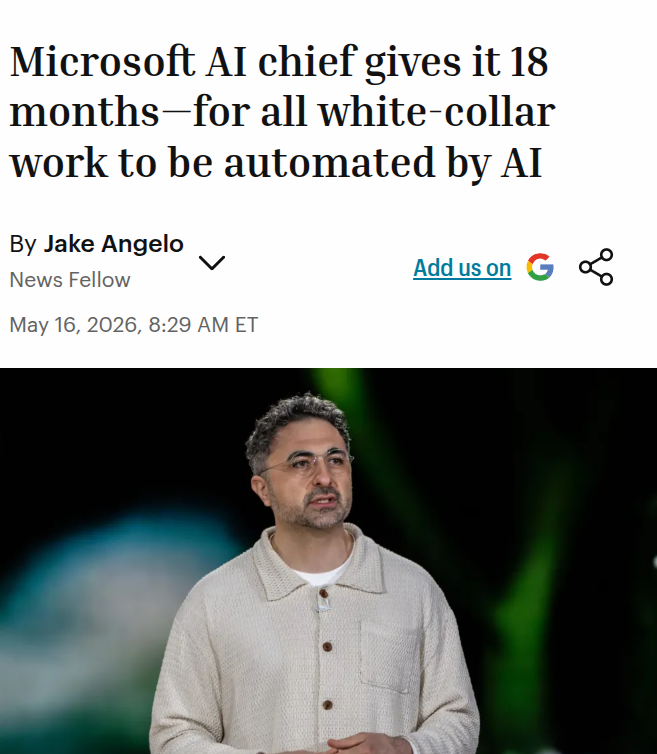
MICROSOFT'S AI CHIEF JUST SAID SOMETHING THAT SHOULD MAKE EVERY OFFICE WORKER STOP AND READ THIS TWICE.
AI will automate most computer-based professional tasks within 12 to 18 months.
Not entry-level tasks.
Not low-skill tasks.
The expensive ones.
Mustafa Suleyman is not talking about factory workers or delivery drivers.
He is talking about the people sitting at desks in front of screens doing work that earns $80,000 to $200,000 a year.
The jobs being targeted:
Reading and processing documents.
Writing and responding to emails.
Building and updating spreadsheets.
Writing and reviewing code.
Managing dashboards and tickets.
Drafting and analyzing contracts.
Running campaigns.
Updating project trackers.
If your job description involves reading, writing, comparing, filing, summarizing, searching, or deciding under known rules you are in the category Suleyman is describing.
Here is the uncomfortable truth buried in his statement.
These jobs are not at risk because they are low-skill.
They are at risk because they are repeatable patterns.
A $150,000 a year analyst who reads reports, extracts key data, compares it to historical benchmarks, and writes a summary recommendation is doing a repeatable pattern.
The intelligence required is real.
The pattern is still repeatable.
And repeatable patterns are exactly what AI agents are being built to execute.
The 12 to 18 month timeline is not a prediction about the distant future.
It is a statement about what is already in development at the companies building the tools.
The people who spend the next 12 months learning to direct AI agents rather than execute the patterns themselves will not be replaced.
They will be the ones replacing the patterns.
The people who wait to see what happens will find out the hard way.
Bookmark this.
Follow @cyrilXBT for every AI development that changes the employment equation the moment it surfaces.
🚨BREAKING: Anthropic just published a study mapping exactly which jobs its own AI is replacing right now.
The workers most at risk are not who anyone expected. They are older. They are more educated. They earn 47% more than average. And they are nearly four times more likely to hold a graduate degree than the workers AI is not touching.
The argument is straightforward. Anthropic built a new metric called "observed exposure." Not what AI could theoretically do. What it is actually doing right now in professional settings, measured against millions of real Claude conversations from enterprise users.
For computer and math workers, AI is theoretically capable of handling 94% of their tasks. It is currently handling 33% of them. For office and administrative roles, theoretical capability is 90%. Current observed usage is 40%. The gap between what AI can do and what it is already doing is enormous. The researchers are explicit about what comes next. As capabilities improve and adoption deepens, the red area grows to fill the blue.
The demographic finding is what makes the paper uncomfortable. The most AI-exposed workers earn 47% more on average than the least exposed group. They are more likely to be female. They are more likely to be college educated. This is not a story about warehouse workers or truck drivers. It is a story about lawyers, financial analysts, market researchers, and software developers. The exact group whose education was supposed to insulate them.
Computer programmers showed the highest observed AI exposure at 74.5%. Customer service representatives at 70.1%. Data entry keyers at 67.1%. Medical record specialists at 66.7%. Market research analysts and marketing specialists at 64.8%. These are not predictions. These are measurements of work that is already happening on AI platforms right now.
Then there is the pipeline finding nobody is talking about loudly enough.
Anthropic's researchers found a 14% decline in the job-finding rate for workers aged 22 to 25 in highly exposed occupations since ChatGPT launched. No comparable effect for workers over 25. Entry-level roles were never just jobs. They were the training ground where junior analysts became senior analysts, where junior lawyers learned how arguments hold together. If that layer disappears, nobody has answered the question of where the next generation of senior professionals comes from.
The detail buried in the paper that most coverage missed: 30% of American workers have zero AI exposure at all. Cooks. Mechanics. Bartenders. Dishwashers. The technology reshaping professional careers is completely irrelevant to roughly a third of the workforce. The divide is no longer between high skill and low skill. It is between presence and absence.
The company publishing this study is the same company selling the AI doing the replacing. Anthropic had every commercial incentive to soften these findings. They published them anyway.
If you spent four years and $200,000 on a degree to land a white collar career, the company that builds Claude just confirmed your job is more exposed than the bartender pouring drinks at your graduation party.
Source: Anthropic, "Labor market impacts of AI: A new measure and early evidence"
PDF: https://t.co/taYgsIfiTj
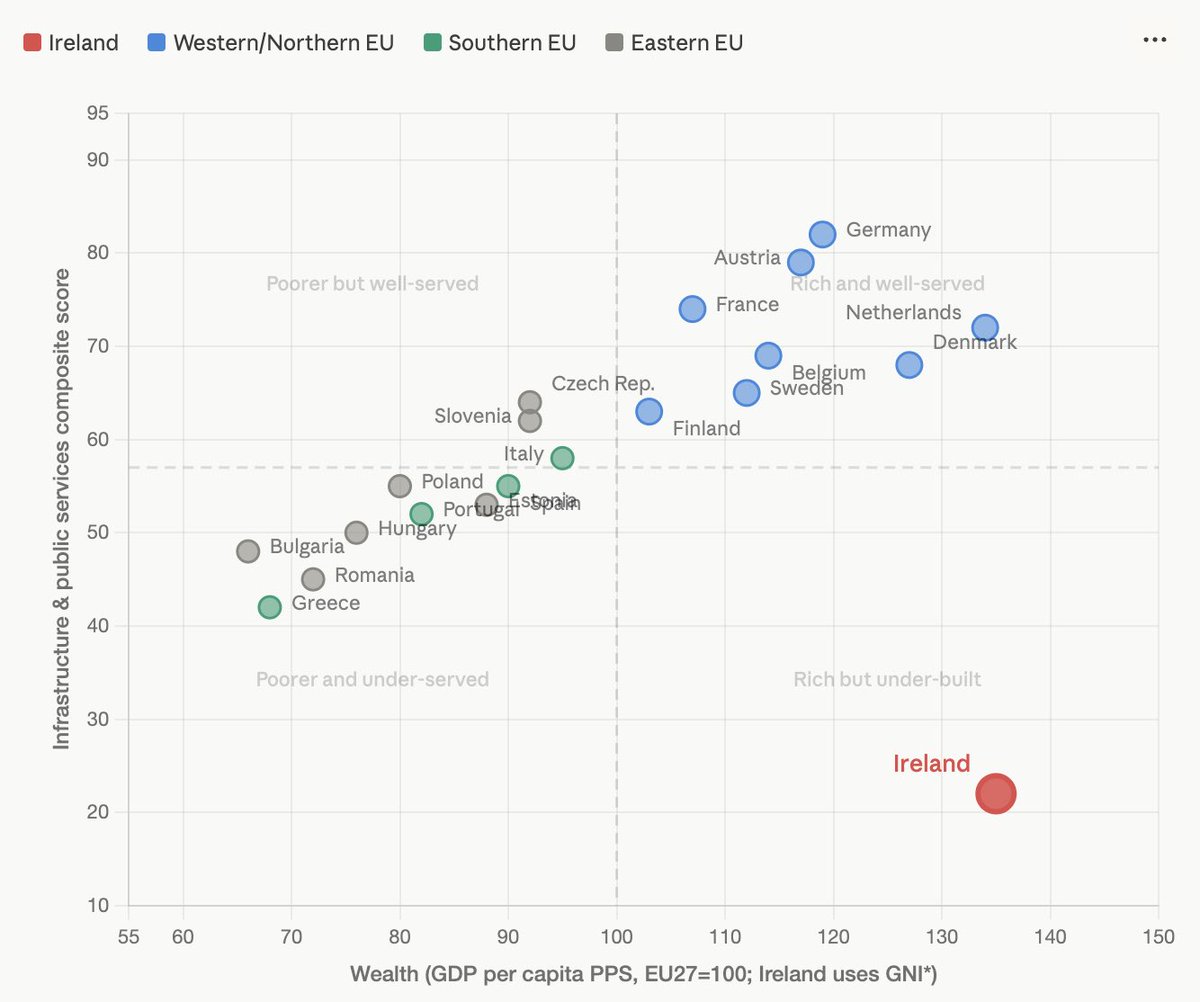
The protests in Ireland are not about just fuel! They are about the distance between Ireland on this graph and every other modern and developed economy. Ireland is second wealthiest but gets waaaaay less than any other country for that wealth. By a golden mile.
That visual gap in this graph? That’s what people are protesting. It’s a lack of infrastructure and the everyday enshittification of services, the economy, and the additional difficulty of trying to live, relative to peers in any other country. It also highlights why people don’t get uniformly listened to! - because there is no government architecture to engage meaningfully across this huge gap.
That gap is a three hour drive to work in traffic, a 14 month wait for an MRI, buses that don’t arrive, trains that don’t exist, schools that have no places for your kids, houses that are unaffordable, pubs that close before midnight, €12 sandwiches, expensive fuel.
People feel this gap, even if they can’t explain it precisely. And that builds into resentment, and ultimately protest. Fuel just happened to be the next thing that could be pointed to, today.
🚨 Do you understand what happened in the last 12 hours?
> Goldman Sachs said $450 billion in AI investment contributed "basically zero" to US economic growth.. the Chief Economist said it on record..
> Uber dropped $1.25 billion on Rivian to build 50,000 robotaxis.. the drivers who built the company are about to be replaced by the cars..
> Jeff Bezos started raising $100 billion to buy manufacturing companies and automate them with AI.. he's not building factories.. he's buying them to empty them..
> DoorDash launched an app that pays people to film themselves doing chores.. not for content.. for AI training data.. so robots can learn to replace them..
> OpenAI bought Astral.. the open source Python tools that millions of developers loved.. bolted it onto their coding agent.. the community is furious..
> Cursor dropped Composer 2.. their own AI model that beats Claude on coding benchmarks.. a 50-person startup outperformed a $30 billion lab..
> Hollywood resurrected Val Kilmer with AI to star in a new movie.. he died of cancer.. never filmed a single scene.. they built a digital version of him..
> HSBC is planning deep job cuts using AI to gut their middle and back offices..
> UK unemployment hit 5.2%.. AI hasn't even started firing people yet..
> Fortune 500 updated the AI price tag to $4.5 trillion.. 93% of US jobs vulnerable to disruption..
> Nvidia GTC is happening right now.. Jensen closed his keynote with singing robots and a digital clone of himself.. the man selling the shovels is also selling the future..
all of this happened in ONE day.. a single Thursday..
if you're not following me you're finding out about this 48 hours late from someone who read my post..
An NVIDIA powered farming machine uses Al vision and precision lasers to eliminate weeds in milliseconds without herbicides and without harming crops, a potential shift toward chemical free agriculture