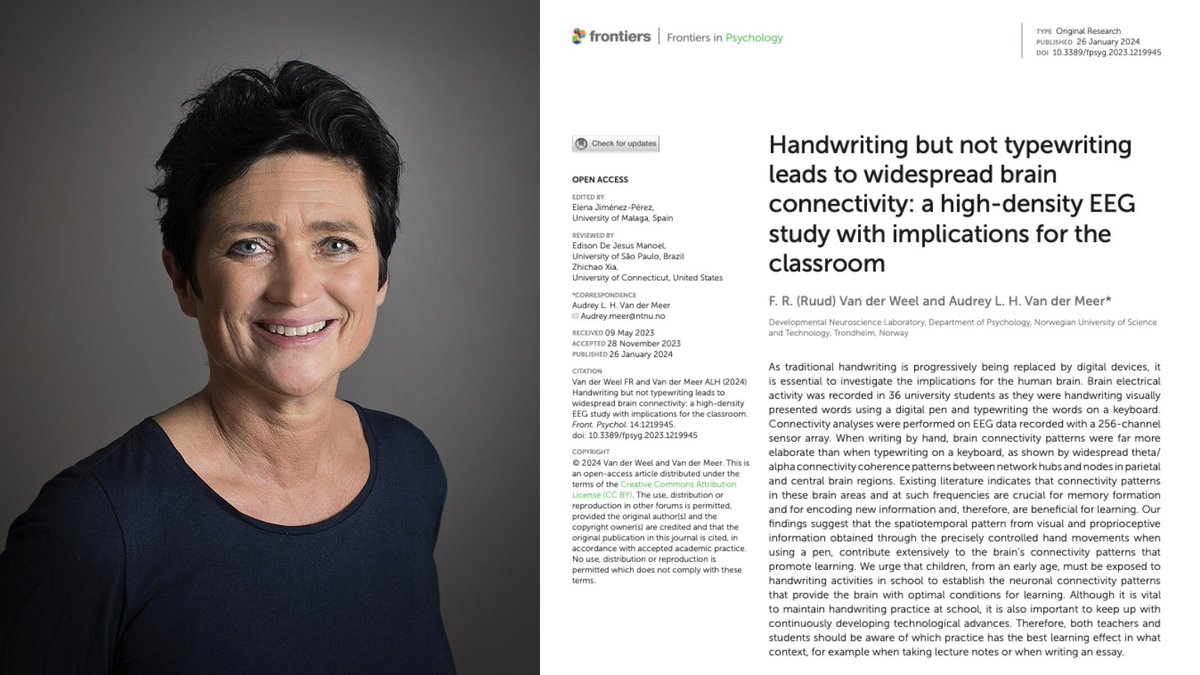
A Norwegian neuroscientist spent 20 years proving that the act of writing by hand changes the human brain in ways typing physically cannot, and almost nobody outside her field has read the paper.
Her name is Audrey van der Meer.
She runs a brain research lab in Trondheim, and the paper that closed the argument was published in 2024 in a journal called Frontiers in Psychology. The finding is brutal enough that it should have changed every classroom on Earth.
The experiment was simple. She recruited 36 university students and put each one in a cap with 256 sensors pressed against their scalp to record brain activity. Words flashed on a screen one at a time.
Sometimes the students wrote the word by hand on a touchscreen using a digital pen, and sometimes they typed the same word on a keyboard. Every neural response was recorded for the full five seconds the word stayed on screen.
Then her team looked at the part of the data most researchers had ignored for years, which is how different parts of the brain were communicating with each other during the task.
When the students wrote by hand, the brain lit up everywhere at once.
The regions responsible for memory, sensory integration, and the encoding of new information were all firing together in a coordinated pattern that spread across the entire cortex. The whole network was awake and connected.
When the same students typed the same word, that pattern collapsed almost completely.
Most of the brain went quiet, and the connections between regions that had been alive seconds earlier were nowhere to be found on the EEG.
Same word, same brain, same person, and two completely different neurological events.
The reason turned out to be something nobody had really paid attention to before her work. Writing by hand is not one motion but a sequence of thousands of tiny micro-movements coordinated with your eyes in real time, where each letter is a different shape that requires the brain to solve a slightly different spatial problem.
Your fingers, wrist, vision, and the parts of your brain that track position in space are all working together to produce one letter, then the next, then the next.
Typing throws all of that away. Every key on a keyboard requires the exact same finger motion regardless of which letter you are pressing, which means the brain has almost nothing to integrate and almost no problem to solve.
Van der Meer said it plainly in her interviews.
Pressing the same key with the same finger over and over does not stimulate the brain in any meaningful way, and she pointed out something that should scare every parent who handed their kid an iPad.
Children who learn to read and write on tablets often cannot tell letters like b and d apart, because they have never physically felt with their bodies what it takes to actually produce those letters on a page.
A decade before her, two researchers at Princeton ran the same fight using a completely different method and ended up at the same answer. Pam Mueller and Daniel Oppenheimer tested 327 students across three experiments, where half took notes on laptops with the internet disabled and half took notes by hand, before testing everyone on what they actually understood from the lectures they had watched.
The handwriting group won by a wide margin on every question that required real understanding rather than surface recall.
The reason was hiding in the transcripts of what the two groups had actually written down.
The laptop students typed almost word for word, capturing more total content but processing almost none of it as they went, while the handwriting students physically could not write fast enough to transcribe a lecture in real time, which forced them to listen carefully, decide what actually mattered, and put it in their own words on the page.
That single act of choosing what to keep was the learning itself, and the keyboard had quietly skipped the choosing and skipped the learning along with it.
Two studies. Two countries. Same answer.
Handwriting makes the brain work. Typing lets it coast.
Every note you have ever typed instead of written went into your brain through a thinner pipe. Every meeting, every book highlight, every idea you captured on your phone instead of on paper was processed at half depth.
You did not forget those things because your memory is bad. You forgot them because typing never woke the part of the brain that would have made them stick.
The fix is the thing your grandmother already knew.
Pick up a pen. Write the thing down. The slower road is the faster one.
Polen baut sein erstes AKW. Direkt an der Ostseeküste. Protest gibt es nur wenig. Das hat auch was mit Marie Curie zu tun (die eigentlich Maria Skłodowska-Curie hieß). Und viel mit Kohle, an der 🇵🇱 lange festgehalten hat.
12 Minuten Zeit? Dann hier lang:
https://t.co/vgnYvtpoNb
Polens Präsident will Referendum anstoßen, die Frage sehr neutral formuliert:
"Sind Sie für Umsetzung der EU-Klimapolitik, die zu einem Anstieg der Lebenshaltungskosten, der Energiepreise und der Kosten für Führung von Unternehmen und landwirtschaftlichen Betrieben geführt hat?"
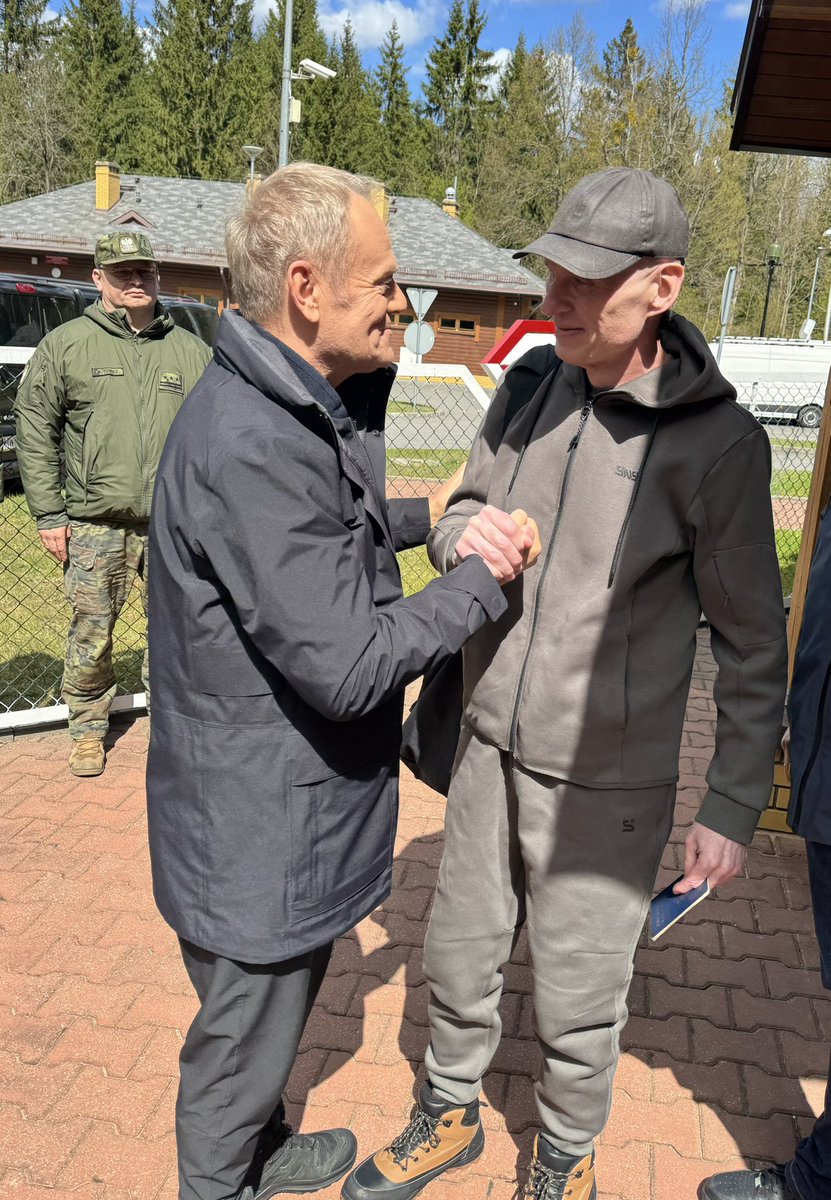
Poczobut war 2021 festgenommen worden, zu 8 J verurteilt. 2025 bekam er den Sacharow-Preis. Die Freilassung ist Teil eines Häftlingsaustauschs, den der US-Vermittler Coale ausgehandelt hat. Austausch gegen einen RU Archäologen, dem Ukraine illegale Grabungen auf der Krym vorwirft
Völlig überraschend: Der polnisch-belarusische Journalist Andrzej Poczobut von @gazeta_wyborcza ist aus belarusischer Haft entlassen. Polens Premier Tusk postet dieses Foto des einst kräftigen Mannes:
So sieht man nach fünf Jahren Gefängnis in Belarus aus
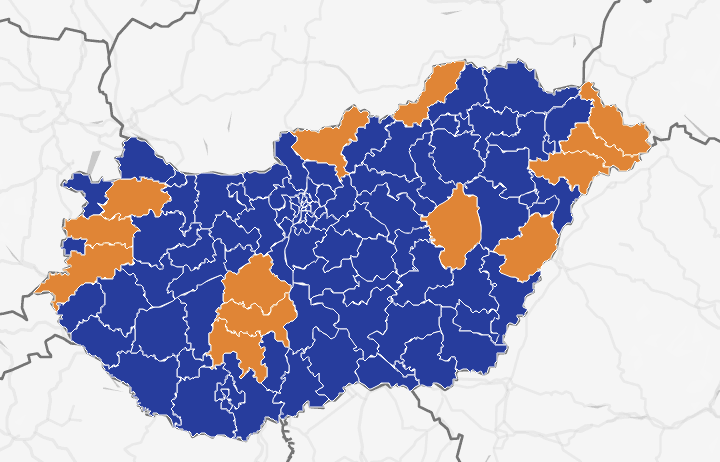
Okay ich hätte das nicht für möglich gehalten. Fidesz hat nur 13 von 106 Wahlkreisen geholt. Sogar der Wahlkreis Fejér-3, in dem Orbáns Heimatort Felcsút liegt, ging an Tisza - 2022 hatte Fidesz den noch klar gewonnen. Das von Orbán gebastelte gemischte Wahlsystem (106 Direktmandate, 93 über Liste), das die stärkste Partei bei Wahlen deutlich bevorteilt, hat sich nun gegen ihn gewendet und seine Herrschaft beendet. Von einer Zwei-Drittel-Mehrheit auf 55 Mandate - was für eine Niederlage.
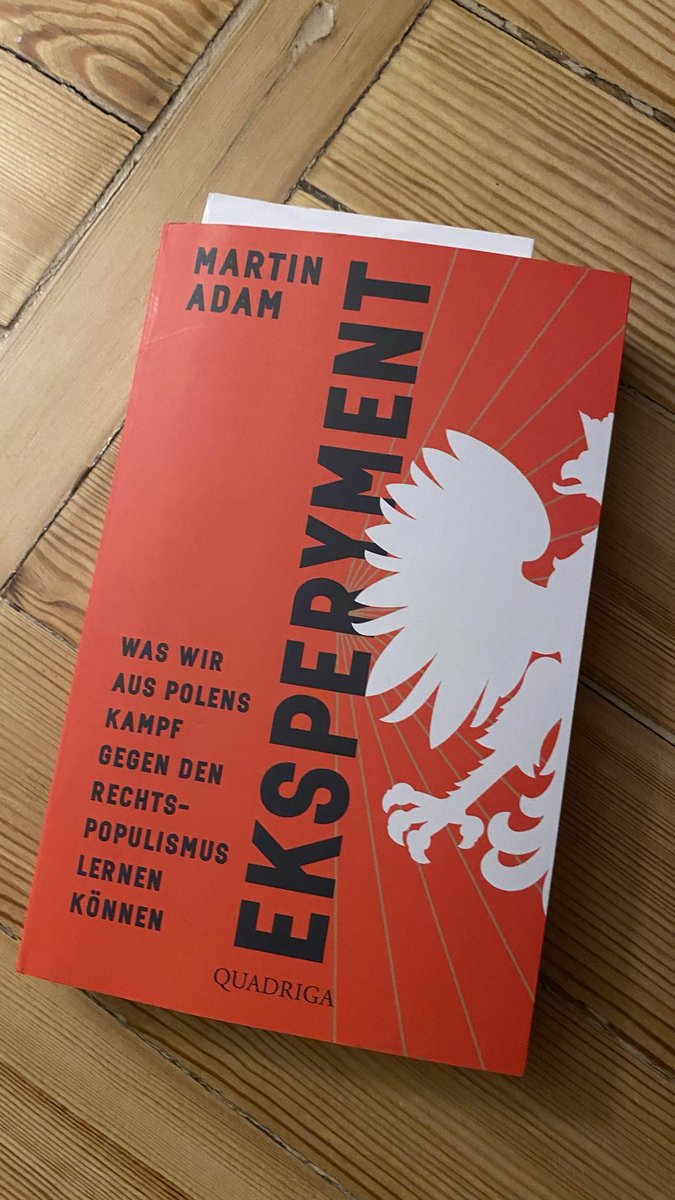
Dringender Lesetipp (und passend zur Ungarn-Wahl): Polens Beispiel zeigt, wie schwer es ist, Rechtspopulisten trotz Abwahl loszuwerden. Einmal an der Macht verändern sie Institutionen, besetzen Langzeitposten, erschweren Nachfolgern das Regieren. Tolles Buch von Kollege Martin 👇🏼
ja nicht vollzählig ist. Richter-Vereidigung durchStaatschef galt immer als Formsache, #Nawrocki nutzt sie nun als Machtmittel. Am Verfassungsgericht derweil Mini-Demo mit Plakat: „Karol, dies ist nicht das Grand Hotel!“ Anspielung auf Nawrockis früheren Job als Hotel-Türsteher
Machtkampf in #Polen 🇵🇱 immer absurder: Weil Präsident Karol Nawrocki mehrere vom Parlament gewählte Verfassungsrichter/innen nicht vereidigen will, haben die sich heute kurzerhand selbst vereidigt. Ob das verfassungswidrig ist, kann nicht festgestellt werden –weil das Gericht 1/
On 13 April 1990 - Good Friday - the USSR for the first time officially admitted responsibility for the Katyń massacre of Polish officers.
During a visit to Moscow, Mikhail Gorbachev handed Wojciech Jaruzelski copies of NKVD documents confirming Soviet responsibility for the crime. Among them was Beria’s 5 March 1940 “Katyń decision”, signed by Stalin and other Soviet leaders, ordering the execution of Polish prisoners of war and detainees without trial.
There's been a lot of anger today about Jens Stoltenberg's memoir which, some news sites have been implying, shows he was willing to agree to Russia's late 2021 demands for unilateral NATO withdrawal of all (non-local) forces from Eastern Europe. The memoir doesn't say this. 🧵
"Those now justifying their refusal to support [us]...because we didn’t 'consult' with them first are the very the reason we didn’t—if we had been stupid enough to 'consult' them, they would have prevented us from acting," says the US ambassador to Poland https://t.co/zrlTD5HRJs
If there is precisely one thing you watch today, make it this. French Senator Claude Malhuret. A microphone. And the most magnificently savage dismantling of the Trump administration ever delivered in a language they almost certainly don’t speak.
He covers Iran. He covers corruption. He covers the kind of staggering, industrial-scale incompetence that would get you fired from managing a car park. And he does it with the calm, unhurried certainty of a man who has read every page of the indictment and found it, if anything, worse than expected.
France has never pretended to like these people. But this is contempt elevated to an art form. The kind of refined, aristocratic disdain that takes centuries of civilization to produce and approximately ninety seconds to deploy.
Malhuret sounds like he is four seconds from the button. Not out of panic. Out of sheer, exhausted disgust.
Honestly? Understandable.
Watch it. Share it. The adults are speaking.
Gandalv / @Microinteracti1
Literatur in #Russland : nix für Zaghafte. Das Schreiben braucht ebenso viel Mut wie das Verlegen, das Verkaufen - und das Lesen. Toller Text von @SilkeBigalke heute in der @SZ
https://t.co/2i2Kp6kpFE