1/6 Every major DeFi protocol uses upgradeable contracts.
Everyone knows it. Nobody talks about it.
We worship immutability while secretly building workarounds because we know it doesn't work.
Time to admit the truth 🧵
The $40B Graveyard: Why Crypto Has No M&A Infrastructure by @IncentiveArch, Founder of @mergerprotocol
Traditional markets self-organize through M&A - 50% of companies undergo consolidation. Crypto has launched 36M tokens with zero exit infrastructure. This talk explores why crypto's financial system is half-built, the $40B in trapped value, and what the missing primitive looks like architecturally.
Full video below 👇🧵
Everyone's posting about AI. Nobody's showing the build.
Starting a build-in-public side project.
Raw unedited recordings of the entire process.
Day 0: the charter and product discovery workflow before a single line of code.
https://t.co/UExXjJQ6HI
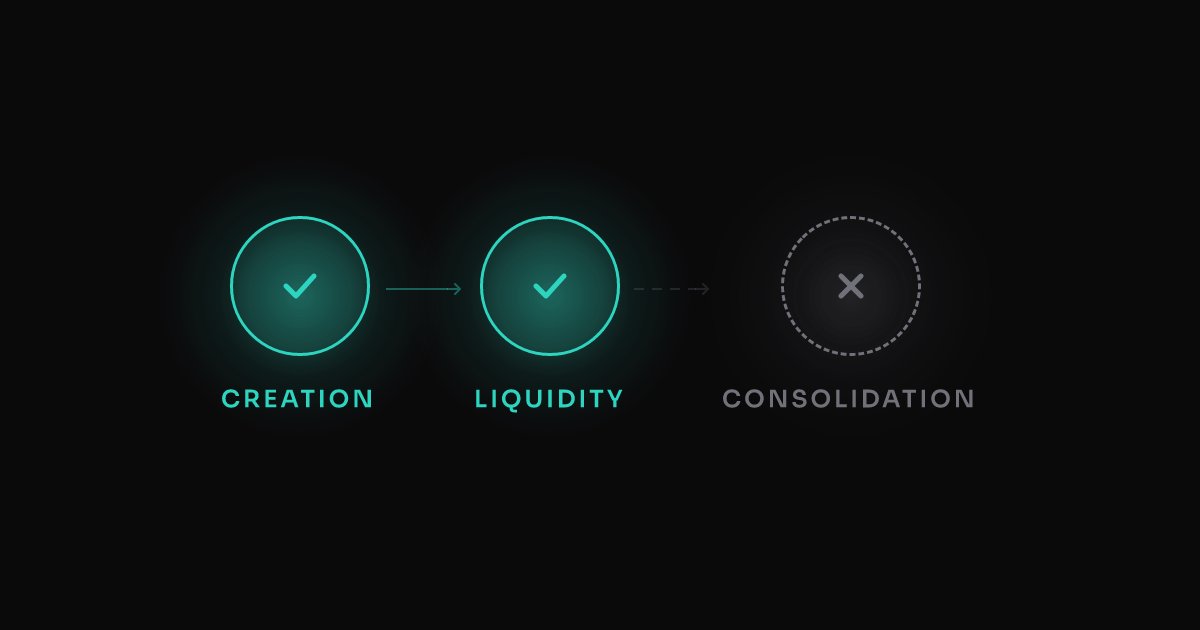
Crypto has primitives for creation (ERC-20) and liquidity (AMMs).
But there's no primitive for consolidation. That's not an oversight. It's a $40B design gap.
Here's why token mergers are inevitable infrastructure. 🧵
@donalt Token mergers. Allowing any two tokens to merge into one. Acquirers can hunt for strategic growth opportunities. Dying projects have an exit option.
Purely on chain.
For anyone actively building with @AnthropicAI's Claude Code and actively using subagents...make them collaborative with my communication protocol
You've probably realized subagents are stateless and have ZERO recall. This makes full agentic workflows a nightmare - repeated context construction, missing historical context, and no cross-collaboration.
You spend thousands of tokens reconstructing context on each new invocation. Subagents have no clue about other agent's work.
Check out my tool which is a Slack-like communication protocol where subagents can leave messages for other agents (and even themselves) to make context construction consistent across sessions and invocations.
https://t.co/Z2AWw7GlfY
@eros_protocol Native upgradeability is deterministic mutability in practice—love this! My piece explores why it's the future beyond dogma. Congrats on the reveal!
https://t.co/kt3v9nvpxV
1/6 Every major DeFi protocol uses upgradeable contracts.
Everyone knows it. Nobody talks about it.
We worship immutability while secretly building workarounds because we know it doesn't work.
Time to admit the truth 🧵
@101Blockchains Spot on—proxies show we're already subverting immutability for practicality. My article dives into deterministic mutability as the honest evolution.
https://t.co/FsYTq3mcU7
1/6 Every major DeFi protocol uses upgradeable contracts.
Everyone knows it. Nobody talks about it.
We worship immutability while secretly building workarounds because we know it doesn't work.
Time to admit the truth 🧵
@0xfrigg@anoma This ephemeral approach is deterministic mutability in action—rules for change without eternal rigidity. My piece on the immutability trap builds on this.
https://t.co/kt3v9nvpxV
1/6 Every major DeFi protocol uses upgradeable contracts.
Everyone knows it. Nobody talks about it.
We worship immutability while secretly building workarounds because we know it doesn't work.
Time to admit the truth 🧵
@gizmocloud_ark Love the stability angle, but what about the billions lost to unpatchable bugs? Deterministic mutability keeps the trust without the paralysis.
https://t.co/kt3v9nvpxV
1/6 Every major DeFi protocol uses upgradeable contracts.
Everyone knows it. Nobody talks about it.
We worship immutability while secretly building workarounds because we know it doesn't work.
Time to admit the truth 🧵
@RedbellyNetwork@bankless This debate nails why immutability at the logic layer is a trap—check my thread on deterministic mutability as the fix.
https://t.co/kt3v9nvpxV
1/6 Every major DeFi protocol uses upgradeable contracts.
Everyone knows it. Nobody talks about it.
We worship immutability while secretly building workarounds because we know it doesn't work.
Time to admit the truth 🧵
6/6 The future of blockchain isn't immutable.
But the rules for how it changes can be.
We're already living this (upgrades, governance, reorgs). Time to stop pretending otherwise.
Full breakdown: https://t.co/FsYTq3mcU7
1/6 Every major DeFi protocol uses upgradeable contracts.
Everyone knows it. Nobody talks about it.
We worship immutability while secretly building workarounds because we know it doesn't work.
Time to admit the truth 🧵
5/6 Example: Token mergers are impossible in crypto but happen daily in TradFi.
$5 trillion market. 50% of companies merge.
In blockchain? Dead tokens just die. No consolidation. No absorption. Value evaporates because immutability forbids becoming something else. Zombies.
This is the challenge that consumes me.
Not building faster blockchains or more complex financial products, but solving the fundamental economic game that determines who actually controls these systems.
Because without economic decentralization, technical decentralization is an illusion.
Crypto set out to decentralize control.
But a system is only as decentralized as its *most* centralized component.
We've obsessed over decentralizing technology while ignoring the centralization of economic power.
This oversight threatens everything we're building.
🧵
The solution exists in game theory, not governance rules.
We need distribution mechanisms where:
- More tokens = exponentially higher costs
- Large positions = longer commitment periods
- Influence scales sub-linearly with capital
Making fairness the equilibrium state.