The new and updated 2026 guide to monitoring SaaS and Cloud vendors' status is out.
A status page aggregator remains the go-to solution for staying on top of SaaS and Cloud outages in an easy and scalable way.
https://t.co/rGWu0lM9gI
IncidentHub can now ingest Microsoft Azure health data directly from your Azure subscription.
This is different from the public Azure status page - which surfaces mostly global issues.
IncidentHub can now ingest Microsoft 365 incident data directly from your MS 365 tenant.
Business tier customers can now connect their MS 365 tenant and get live service health data - incidents, advisories - directly from Microsoft's own API into their IncidentHub dashboard.
What we have shipped recently at IncidentHub:
The new Business plan with Teams support -20 Teams, unlimited users, 300 services, private status page ingestion, white-labeled public status page, and support for all our integrations.
IncidentHub now integrates with 4 ticketing and ITSM systems to send outage notifications:
- BoldDesk
- Zendesk
- Freshdesk
- Atlassian Jira Service Management
These integrations are meant to help your IT and support teams stay on top of third-party vendor issues.
You can try them out at no risk with a free 14-day trial of the IncidentHub Business Plan.
IncidentHub tracked 48000 SaaS and Cloud outages in 2025. The average organization depends on 100+ SaaS apps, making third-party vendor monitoring a crucial aspect of risk management and business continuity for almost all modern organizations.
Better SaaS outage alerting is about monitoring the right parts of your third-party services, and routing alerts to the right people at the right time.
IncidentHub can help you do both. Read more in our latest article on why IncidentHub is better than other status page aggregators when it comes to alerting.
https://t.co/oogf4t2gVd
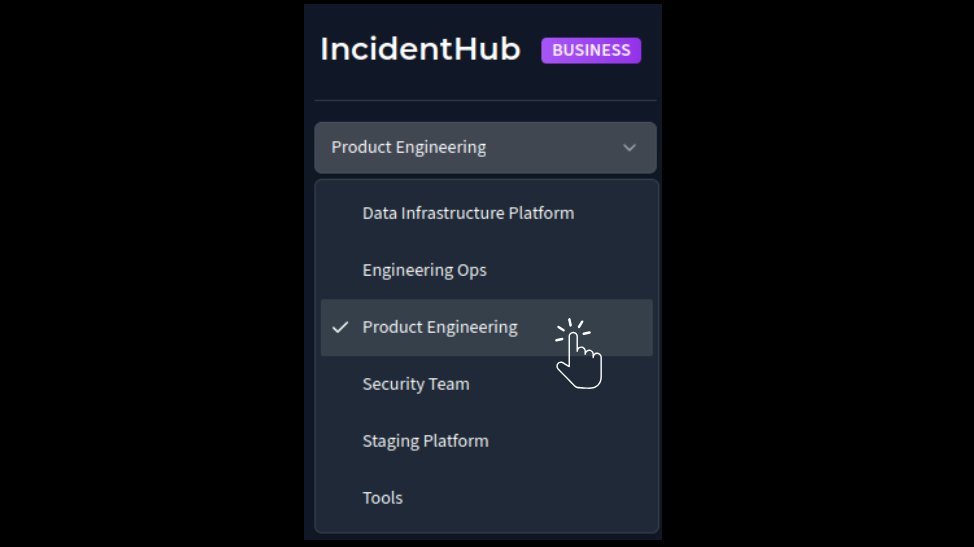
Manage vendor alerts across different teams in your org using IncidentHub Teams.
Teams are independent sub-accounts within your IncidentHub account - like teams within an org.
You can
- Route different vendor alerts to different teams in your org.
- Configure different component and alert filters for the same vendor across teams - think the Infra team monitoring AWS EC2 and the Platform team monitoring AWS CodeBuild.
- Have completely independent public status pages - one for each team's services.
- Independent incident timelines per team.
- And all within the admin boundaries of a single IncidentHub account.
Available on the Business Tier and above.
A few things we've shipped recently at IncidentHub:
- Maintenance widget on public status pages - upcoming maintenance events now surface at the top of your status page.
- Private status page ingestion - you can now pull in status data from SSO-protected pages. First supported provider: Infor CloudSuite, more to follow.
- Ticketing integrations - BoldDesk and Freshdesk join Zendesk as supported channels. Outage triggers go straight to your support queue without the noise.
- Smarter notifications - your selected components now surface at the top of alerts, so what matters to you doesn't get buried under other affected services.
- Webhook debugging - error messages are now visible in your dashboard when a webhook has been erroring in the background.
Plus expanded coverage across telecom, utilities, crypto exchanges, and MSP tools.
Much of this came directly from customers. Thank you to everyone who took the time to share feedback and requests
Full write-up: https://t.co/Ei6l6HuzV5
On October 20th 2025, your monitoring tools were down. So were your on-call alerts. So were many online classrooms, developer tooling, cybersecurity platforms. Here's what we found when we tracked hundreds of SaaS providers through the AWS outage.
AWS in 2025
- Had 38 outages across services and regions
- Saw its average monthly MTTR go up in Q3 compared to Q1 and Q2
- Saw its us-east-1 region face the highest number of outages
- Triggered outages across thousands of SaaS providers with the Oct 20th outage (~15 hours), with some of them lasting longer than a day.
Read the complete AWS Outage Report 2025 on the IncidentHub blog.
This was caused by a failure in Render's underlying infrastructure. Re-attaching the database storage took a while - resulting in some downtime in the incident processing. Post db recovery older incidents got processed but we didn't send out delayed alerts to avoid confusion.
We're seeing recovery. Public status pages are available and so is the IncidentHub dashboard. We'll post a post-mortem once we determine the root cause and if any notifications were affected.