IncluNorm is a tech platform that teaches inclusive behaviour, supports people with disabilities, and embeds disability inclusion into everyday digital systems
THE INCLUNORM QUIZ IS NOW LIVE 🚨
Nobody taught most of us disability inclusion. Not in school. Not at work. Or even at home. So we built something to help.
If you’re willing to learn and unlearn, this quiz is for you. Take the quiz:
https://t.co/m0KnO6hAMZ
#IncluNorm
Most people think they’re more inclusive than they actually are. 🤔
That’s not an insult. It’s a reflection of how little disability inclusion education most of us received growing up.
Take the IncluNorm Inclusion Quiz to find out how well you know 👇🏽 https://t.co/m0KnO6hAMZ
I feel incredibly honoured when I get tagged in conversations about albinism, disability, visible difference, accessibility, and inclusion. A few days ago, someone tagged me and said, “Misty, come and see your people.”
And that honestly made me happy. Because yes, those are my people. People with disabilities, people with albinism, people with chronic illnesses, people with visible differences. And most importantly, people whose experiences have been ignored, misunderstood, or spoken about without them in the room.
The tags are a reminder that people are seeing all the advocacy work, but at the same time, they also remind me how much work is still left to do. There are amazing organisations championing disability rights, providing support, assistive technology, funding, healthcare, and community services. But when it comes to disability education, language, perception change, and helping everyday people understand disability better, we still need more voices. 😢
We need more educators, more advocates and more people willing to challenge assumptions and start difficult conversations. That’s why I’ve made a commitment to spend the next few years creating free disability education resources that help people learn, unlearn, and do better.
Last month, I launched Before You Say That, a free dictionary of disability-inclusive language that helps people understand the impact words can have on disabled communities. It’s available for download here: https://t.co/QLxkWaCECP
I also launched the @IncluNorm inclusion quiz this month, an interactive disability inclusion quiz that helps people test their knowledge, challenge assumptions, and learn more about disability in a practical and engaging way. You should check it out: https://t.co/7AopULkpue
My team and I are creating these resources because we believe that understanding is an important step in disability inclusion. But that won’t happen by accident, only through education.
So, if you’re reading this and you’ve been looking for a cause to care about, let disability inclusion be one of them. The world is changing. More people are openly identifying as disabled. More people are asking questions. More organisations are trying to become inclusive. What we need now are people willing to learn because every more accessible future starts with someone deciding that disability inclusion is everyone’s responsibility, not just disabled people’s.
Let’s keep building that future together. 💚
Most people think they’re more inclusive than they actually are. 🤔
That’s not an insult. It’s a reflection of how little disability inclusion education most of us received growing up.
Take the IncluNorm Inclusion Quiz to find out how well you know 👇🏽 https://t.co/m0KnO6hAMZ
If you’re looking for something interesting to learn from this week, take the IncluNorm Inclusion Quiz.
35 questions.
7 levels.
A few assumptions you may need to unlearn. 👀
And when you’re done, challenge your friends too.
🔗 https://t.co/m0KnO6hAMZ
#DisabilityInclusion
I completely agree. In fact, over the last five years, my team and I have been working on exactly this problem from the awareness and education angle.
One thing we’ve learnt is that accessibility goes beyond about ramps, elevators, accessible transport, or infrastructure. Those things matter, but accessibility also starts with knowledge. People cannot build inclusive environments if they don’t understand disability in the first place. And many of us in this part of the world were not taught disability inclusion in school, at home or anywhere else.
That’s why I created Before You Say That, a free dictionary of disability-inclusive language that breaks down over 150 words and phrases commonly used in disability conversations. The goal is to help people communicate more respectfully and understand how language shapes perceptions of disability. It’s free for download here: https://t.co/QLxkWaCECP
We’ve also built @IncluNorm, an interactive disability inclusion quiz designed to help people test their knowledge of disability inclusion, challenge assumptions, and learn practical disability-inclusive concepts in a simple, engaging way. You can take the test via https://t.co/7AopULkpue.
We’re trying to fill an important gap that gets overlooked: disability education. We believe that before people can create accessible schools, workplaces, products, policies, and communities, they first need to understand the people those systems are meant to serve.
If you’re interested in disability inclusion, I’d love for you to check out both resources and share your thoughts. 💚💚
We’ve seen a lot of conversations on social media over the last few days about children with disabilities. As I read through the posts, comments, debates, and arguments, the LANGUAGE stood out to me. Sadly, many of us still use outdated and offensive language to describe disability.
I saw words like DOWNIES being used to describe children with Down syndrome. Some people even said DOWN SYNDROME BABY. A lot of people clearly don’t know that using SPECIAL NEEDS to describe children with disabilities is now considered outdated. I believe a lot of people genuinely do not mean to be “offensive” and that’s exactly why I wrote my book, Before You Say That, a practical dictionary of disability-inclusive language.
This book breaks down more than 150 words, phrases, and expressions commonly used in conversations about disability. For each entry, I explain what people usually mean when they say it, why it can be problematic, and how we can communicate more thoughtfully and respectfully.
Please note that this is not a book about political correctness. I wrote it to create awareness. It is for teachers, parents, employers, content creators, marketers, healthcare professionals, students, community leaders, and everyday people who genuinely want to do better. It is for anyone who has ever stopped mid-sentence and wondered:
“Is this the right word to use to talk about disability?”
The book is designed to be simple, practical, and accessible. You don’t have to read it from beginning to end. Open any page, read one entry a day, and come back whenever you’re unsure. Some entries will surprise you, and some will challenge you. This book was tested across disability communities and well researched inclusion advocacy models.
I wrote this book because I believe that when we communicate more thoughtfully, we create more room for dignity, inclusion, understanding, and belonging. Before You Say That is completely free because I believe these conversations should be accessible to everyone. The world does not become more inclusive by accident, only when people are willing to learn, unlearn, and rethink the assumptions they carry about disability inclusion.
My vision is bigger than a book. I hope to print and distribute copies to schools across Nigeria, translate future editions into local and international languages, and continue expanding this work through new volumes and conversations.
So before you say that… read this first. Download your free copy and join 317 people who have already downloaded the book and are rethinking the language of disability: https://t.co/QLxkWaCECP
If you’re looking for something interesting to learn from this week, take the IncluNorm Inclusion Quiz.
35 questions.
7 levels.
A few assumptions you may need to unlearn. 👀
And when you’re done, challenge your friends too.
🔗 https://t.co/m0KnO6hAMZ
#DisabilityInclusion
The most common response we’ve seen so far about the IncluNorm Inclusion quiz is “ I thought I knew this already.” 😭
Take the quiz here and find out if you know enough about disability inclusion: https://t.co/m0KnO6hAMZ
#DisabilityInclusion#DisabilityEducation
The most common response we’ve seen so far about the IncluNorm Inclusion quiz is “ I thought I knew this already.” 😭
Take the quiz here and find out if you know enough about disability inclusion: https://t.co/m0KnO6hAMZ
#DisabilityInclusion#DisabilityEducation
Let me tell you guys about what my team and I are building with @IncluNorm.
A lot of people say nobody taught them disability-inclusive behaviour. Nobody taught them accessibility or how to create workplaces, events, content, products, and systems that genuinely include people with disabilities. And often times, it’s true. A lot of people are not intentionally exclusionary.
To address this gap, we are building a digital platform where people and organizations can access practical tools, resources and short courses to improve their understanding of disability inclusion and how to apply it. Through education, real-life scenarios, community, and technology, we're helping people move from good intentions to meaningful action. Our mission is to make inclusion the norm and the IncluNorm Inclusion Quiz is our first step.
35 questions. 7 levels. Real-life scenarios. Detailed explanations for every answer.
This quiz might challenge a lot of things you already believe but we are hoping that you can discover what you know, what you don’t know, and what society probably should have taught us a long time ago about disability inclusion.
Inclusion starts with awareness, and we believe it grows through learning, unlearning, and action. Please join us, take the quiz:
https://t.co/7AopULkpue
The people who need the IncluNorm quiz most are usually the people who think they know everything about disability inclusion.
If you’re willing to learn, unlearn, and challenge a few assumptions, we’d love to have you.
Take the quiz:
https://t.co/m0KnO6hAMZ
The people who need the IncluNorm quiz most are usually the people who think they know everything about disability inclusion.
If you’re willing to learn, unlearn, and challenge a few assumptions, we’d love to have you.
Take the quiz:
https://t.co/m0KnO6hAMZ
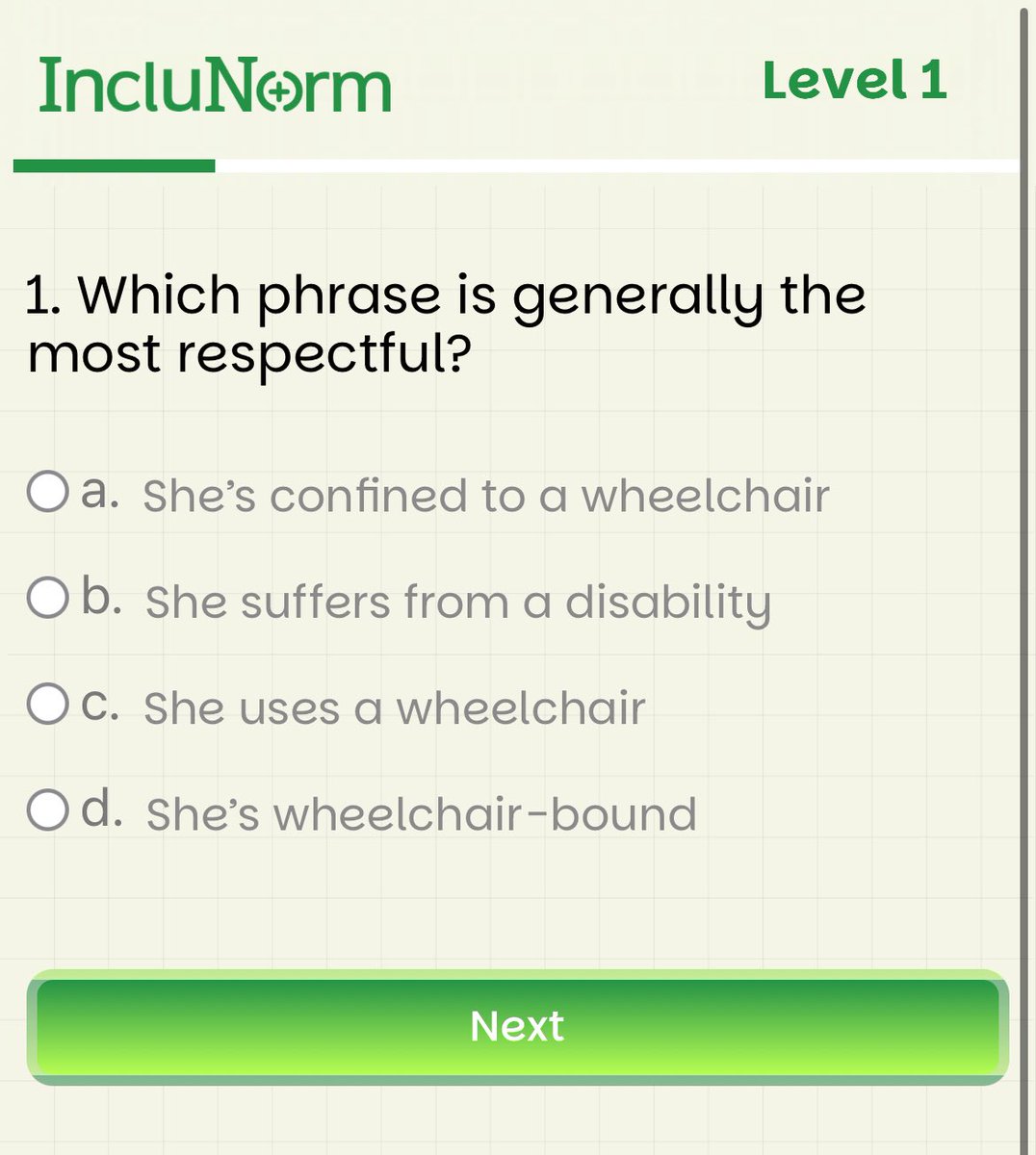
We started with an easy one. Or so people think. 😭
The first question of the IncluNorm Quiz has already humbled a few people.
Ready to test your knowledge? Take the IncluNorm Inclusion quiz here: https://t.co/m0KnO6hAMZ
Which answer would you pick? 👀
If you’re not 100% sure, you’re exactly who we built this quiz for.
35 questions.
7 levels.
Countless opportunities to learn something new.
Take the IncluNorm inclusion quiz here: https://t.co/7AopULkpue
#IncluNorm#DisabilityEducation #DisabilityAwareness
We started with an easy one. Or so people think. 😭
The first question of the IncluNorm Quiz has already humbled a few people.
Ready to test your knowledge? Take the IncluNorm Inclusion quiz here: https://t.co/m0KnO6hAMZ
Thank you for taking the IncluNorm quiz, well done 🙌🏽🎉🎉
Most people will never stop to question their assumptions. You did. Now don’t keep the knowledge to yourself.
Share your result and challenge at least three people to take the quiz. 😃💚💚
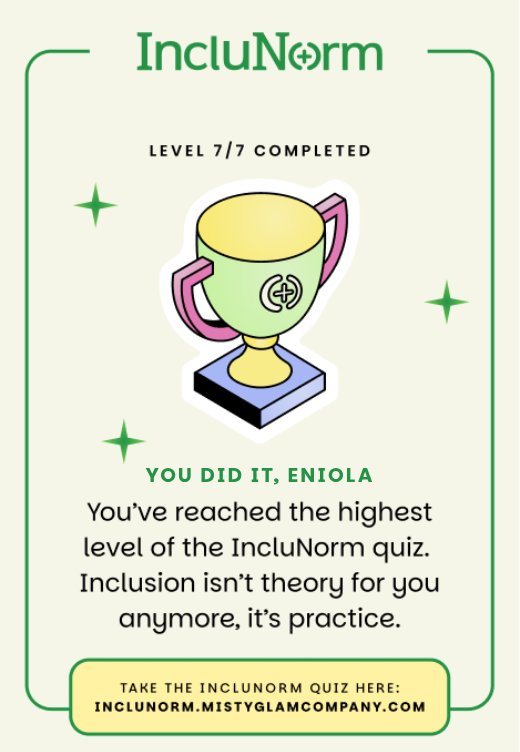
I finally reached Level 7 on the IncluNorm quiz. 🎉
This quiz challenged the way I think about disability, accessibility, language, and inclusion in everyday life. Think you can reach the highest level too?
Take the quiz here: https://t.co/OXFtJtoojr
I finally reached Level 7 on the IncluNorm quiz. 🎉
This quiz challenged the way I think about disability, accessibility, language, and inclusion in everyday life. Think you can reach the highest level too?
Take the quiz here: https://t.co/OXFtJtoojr
I finally reached Level 7 on the IncluNorm quiz. 🎉
This quiz challenged the way I think about disability, accessibility, language, and inclusion in everyday life. Think you can reach the highest level too?
Take the quiz here: https://t.co/HHG1CHpLOH