I was encouraged this week to see the leaders of the frontier labs agree on the need for them to slow down the pace of AI development. Given the stakes, it’s a good and necessary first step.
But I’m even more encouraged by the growing recognition that how this powerful new technology develops should be at the center of our public debate.
I’ve been watching the progress on AI for over a decade now, and one thing that’s clear to me is that the potential impact of this technology is not overhyped. It’s also moving at lightning speed – and even faster than those who are engineering it can keep up with.
I’m not an AI accelerationist who believes it will lead to some techno-utopia, and I’m not a doomer who thinks it will inevitably lead to humanity’s destruction.
But whether this technology results in amazing breakthroughs in medicine, energy and education or unleashes huge economic disruptions, greater inequality, and potential catastrophe will depend on the choices that we make right now – choices that should be made not just by the companies involved, but by all of us.
Harvard's 75-year study on what makes children successful found it wasn't grades, test scores, or extracurriculars.
It was one specific thing most parents stopped making their kids do by age 10:
Check out the latest article in my newsletter: The Biggest Threat to This Economy Isn't AI: It's Our Tolerance for Friction. https://t.co/cCmp1gBzL8 via @LinkedIn
Check out the latest article in my newsletter: The Biggest Threat to This Economy Isn't AI: It's Our Tolerance for Friction. https://t.co/cCmp1gBzL8 via @LinkedIn
Check out the latest article in my newsletter: The Nonprofit Sector Is No Longer a Fringe Social Service Provider. https://t.co/3E78P0G7gI via @LinkedIn
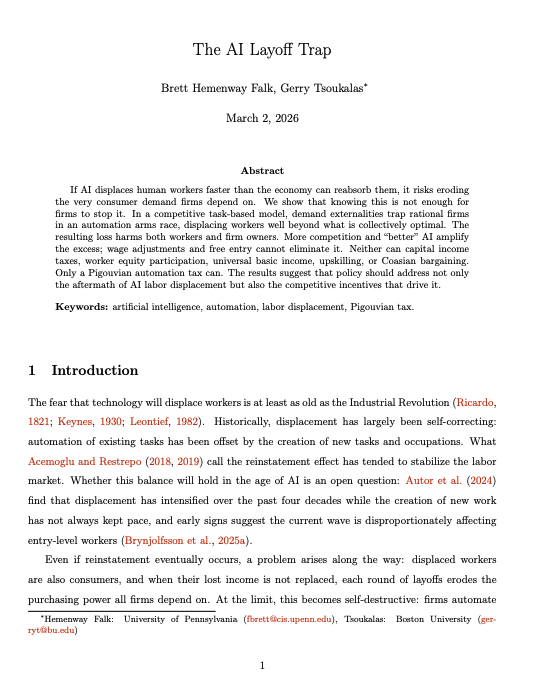
🚨BREAKING: Two researchers from UPenn and Boston University just published a paper that should be uncomfortable reading for every CEO automating their workforce right now.
The argument is straightforward. Every company replacing workers with AI is also eliminating its own future customers. Laid off workers stop spending. Enough of them stop spending and nobody can afford to buy anything. The companies that fired everyone end up selling into an economy with no purchasing power left.
Every executive can see this. The math is not complicated. But here is why nobody stops.
If you do not automate, your competitor does. They cut costs, lower prices, take your market share, and you collapse anyway. So every company automates knowing it is collectively destructive because the alternative is dying alone while everyone else survives. The researchers proved this is a Prisoner's Dilemma playing out in real time.
The numbers are already moving. Block cut nearly half its 10,000 employees this year. Jack Dorsey said AI made those roles unnecessary and that within the next year the majority of companies will reach the same conclusion. Salesforce replaced 4,000 customer support agents with AI. Goldman Sachs deployed a coding tool that lets one engineer do the work of five. Over 100,000 tech workers were laid off in 2025 and AI was cited as the primary driver in more than half those cases. 80% of US workers hold jobs with tasks susceptible to AI automation.
The researchers tested every proposed solution. Universal basic income does not change a single company's incentive to automate. Capital income taxes adjust profit levels but not the per-task decision to replace a human. Collective bargaining cannot hold because automating is always the dominant strategy.
They also identified what they call a Red Queen effect. Better AI does not solve the problem, it accelerates it. Every company chases faster automation to gain market share over rivals but at the end everyone has automated equally, the gains cancel out, and the only thing left is more destroyed demand.
The one thing the math says could work is a Pigouvian automation tax. A per-task charge that forces companies to account for the demand they destroy each time they replace a worker.
The conclusion is that this is not a transfer of wealth from workers to owners. Both sides lose. Workers lose income. Companies lose customers. It is a deadweight loss with no market mechanism to stop it on its own.
Elon Musk thinks the entire education system is built on a broken assumption.
That every student should learn the same thing. At the same speed. In the same order. At the same time.
Musk: “Everyone goes through from like 5th grade to 6th grade to 7th grade like it’s an assembly line. But people are not objects on an assembly line.”
The model was designed for a factory economy. Standardized inputs. Predictable outputs.
That economy is gone. The assembly line is gone.
But the education system still runs on its logic.
A student who masters algebra in two weeks sits through eight more weeks because the calendar says so. A student who struggles gets dragged forward because the schedule doesn’t wait.
Neither is being served. Both are being processed.
Musk: “Allow people to progress at the fastest pace that they can or are interested in, in each subject.”
AI doesn’t teach a classroom. It teaches a student.
One at a time. Every time.
It skips what a student already knows. It finds where they’re stuck and approaches it from a different angle.
It adjusts in real time. Not at the end of a semester when the damage is already done.
A student obsessed with basketball learns fractions through shooting percentages. A student who builds in Minecraft learns geometry through architecture.
The subject doesn’t change. The entry point does.
No teacher with thirty students can do this. Not because they lack skill.
Because the math doesn’t work.
AI doesn’t have that constraint.
Musk: “You do not need to tell your kid to play video games. They will play video games on autopilot all day. So if you can make it interactive and engaging, then you can make education far more compelling.”
The brain isn’t broken. The format is.
Kids learn complex systems and strategic thinking for hours voluntarily. Then walk into a classroom and can’t focus for twenty minutes.
That’s not a discipline problem. That’s a design problem.
Musk: “A university education is often unnecessary. You probably learn the vast majority of what you’re going to learn there in the first two years. And most of it is from your classmates.”
Four years. Six figures of debt.
And the real value comes from the people sitting next to you. Not the institution charging you.
The degree doesn’t certify knowledge. It certifies endurance.
Musk: “If the goal is to start a company, I would say no point in finishing college.”
The system was built to train employees. If you’re not trying to be one, it has nothing left to offer you.
Every lecture. Every textbook. Every curriculum. Now available instantly. Personalized to any learner. Adapted to any pace.
The question isn’t whether the old model survives.
It’s how long we keep forcing students through it while the replacement already exists.
Most nonprofits lose major donors before they ever ask for the gift.
Not because donors are no longer interested in the work.
Because cultivation is treated like a sales pipeline instead of a relationship.
Major donors aren’t ATMs. https://t.co/fZlq3247fx
Check out the latest article in my newsletter: The Strongest Nonprofits Are Not Run by Their Boards. They Are Guided by Them. https://t.co/5E258qBaE7 via @LinkedIn
Check out the latest article in my newsletter: New? This Has Been Reality Since 2010: 3+ Year Strategic Plans Fail 99% of the Sector https://t.co/n6xl5Pa5Mv via @LinkedIn