Highly relevant!
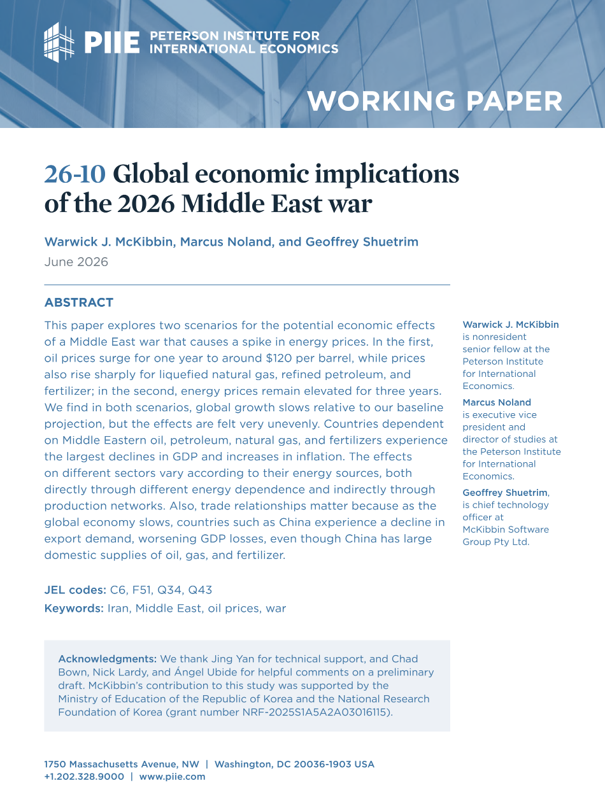
"Global economic implications of the 2026 Middle East war" by Warwick J. McKibbin, Marcus Noland, and Geoffrey Shuetrim.
"This paper explores two scenarios for the potential economic effects of a Middle East war that causes a spike in energy prices. In the first, oil prices surge for one year to around $120 per barrel, while prices also rise sharply for liquefied natural gas, refined petroleum, and fertilizer; in the second, energy prices remain elevated for three years. We find in both scenarios, global growth slows relative to our baseline projection, but the effects are felt very unevenly. Countries dependent on Middle Eastern oil, petroleum, natural gas, and fertilizers experience the largest declines in GDP and increases in inflation. The effects on different sectors vary according to their energy sources, both directly through different energy dependence and indirectly through production networks. Also, trade relationships matter because as the global economy slows, countries such as China experience a decline in export demand, worsening GDP losses, even though China has large domestic supplies of oil, gas, and fertilizer."
https://t.co/iqOXhaYdM4
🙏Grateful and excited that our paper 🏆
“Unbalanced Financial Globalization”
(with @DamienCapelle) was selected as one of the inaugural recipients of the AFA Future of Finance Award. We look forward to present our paper at the AFA'27 special session (🔗in bio)
#econtwitter #fintwitter
"Crowded Anomalies over the Business Cycle": "Anomaly returns vary systematically over the business cycle... Excess centrality... evaluates how an anomaly’s importance shifts when the covariance structure is conditioned on macroeconomic states... Macroeconomic exposure manifests as a state-dependent premium realized through systematic rotation across anomalies." https://t.co/OcOWlE4QZJ
Highly relevant!
"Asset price bubbles and systemic risk in money market funds" by Matteo Aquilina, Peter Cincinelli, and Giovanni Urga.
"We investigate the systemic risk contribution of 3,500 Money Market Funds (MMFs) in normal periods and during asset price bubbles in the US from January 2004 to December 2022. Using state-of-the-art statistical techniques for bubble detection and granular fund-level data, we show that MMF characteristics significantly influence systemic risk. Large MMFs and government MMFs, which invest exclusively in US Treasury securities, are associated with reduced systemic risk, while prime MMFs contribute to higher systemic risk. MMFs denominated in US dollars but domiciled offshore exhibit no significant differences from their US-domiciled counterparts."
https://t.co/IANGtukFKX
In Memoriam LES PAUL!
(June 9, 1915 - August 12, 2009)
We honor the legacy of Les Paul. An innovator, creator, and musician who inspired many to experiment with sound
#LesPaul