In Order to truly understand #bitcoin , you need to first understand Inflation.
Here's my 3-point summary:
1. The Fiat Monetary System that we currently live in with free floating abundant currencies (i.e. not pegged to any base Money like Gold) forces you to mis-price Capital.
Hayek wrote dense philosophical prose.
Dense. Academic. Written for other economists.
That person scrolling at 11pm after a 10-hour workday —
wondering why their salary keeps rising
but their life keeps getting harder —
never got to read him.
That person is in Delhi. Mumbai. Bangalore. Chennai.
This series was written for them.
— @IndiaBitcoinMan
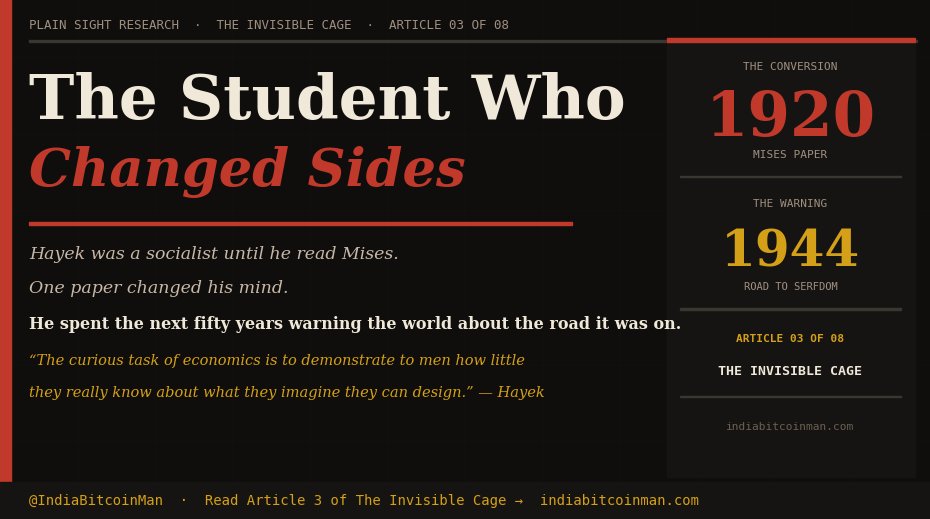
In the 1920s, a young economist in Vienna believed socialism was the answer.
He was brilliant. He was sincere. He was wrong.
Then he read one paper by his colleague Mises.
He changed his mind completely.
He spent the next fifty years warning the world about where it was headed.
The world did not listen.
This is Article 3 of The Invisible Cage — Plain Sight Research.
Hayek received the Nobel Prize in 1974.
In his lecture, he said the source of most economic damage in the twentieth century was not malice. Not corruption.
It was the pretence of knowledge.
The assumption that governments understand the economy well enough to manage it.
He died in 1992.
Sri Lanka proved him right in 2022.
Delhi proves him right every budget season.
Article 3 of The Invisible Cage. 👇
https://t.co/hQCJ1s0bME
Agree on the mechanics.
I also request you to checkout these Research Papers:
The Forced Checkmate | Paper 9 | IndiaBitcoinMan https://t.co/vtrI9x8HDV
It also covers at the end the Japan mechanism (Appendix A) together with the FED's nightmare.
The Honest Money Audit | Paper 16 | Plain Sight Research https://t.co/CfTY5jUII0
We are definitely at the beginning stages of the Global Sovereign Debt crisis.
If you look at the world from the Ray Dalio lens: "END of the Long Term Debt Cycle", these papers will make perfect sense.
@TheDeshBhakt — the satire lands because the silence is real.
These anchors have the platform, the reach, the prime time slots.
What they don't have — or won't use — is the forensic depth to explain what's actually happening to ordinary Indians.
So let me try.
The rupee joke isn't a joke. Sudhir's satire about salaries in petrol contains a real number: the rupee has gone from ₹3.30 in 1947 to ₹96.96 today. Under the current government alone — 60.32% depreciation. The middle class isn't imagining the squeeze. They're living the mathematics of a currency in structural decline.
Palki's fictional question — what CAN this government do? — deserves a real answer. Not much, and here's why. The RBI cannot cut rates when inflation is heading toward 6-7% by August–September. It cannot hike into a decelerating GDP. It cannot defend the rupee, control inflation, and support growth simultaneously. Three levers. All contradictory. That's not incompetence. That's a structural trap decades in the making.
Anjana's warning about the rupee making household budgets go haywire? She's right — but she's early. The Hormuz oil shock happened months ago. The CPI transmission — oil to refinery to freight to food — takes 90-120 days to arrive in your kitchen. August–September 2026 is when ordinary Indians feel it. The rupee at ₹96 is the pre-shock number.
And here's what none of the three fictional tweets mention: @Subhashgarg1960 — Modi's own previous Finance Secretary, the man who built the fiscal architecture — just called it "deforms not reforms."
When the architect reads his own blueprint and uses that word, it isn't opposition noise. It's a verdict.
The questions these anchors won't ask have answers. I've spent four months building them across fifteen papers.
The forensics: https://t.co/lqHyL7PMIL
The structural root: https://t.co/EMgDLE2WS5
.@Subhashgarg1960 didn't just use the word "deforms." He chose it deliberately.
He knows the difference. He spent 36 years inside the machine — as Finance Secretary, as Economic Affairs Secretary, as the man who defended fiscal consolidation when it was politically inconvenient. He knows what a reform looks like from the inside.
When that man reaches for "deforms" — it isn't rhetoric. It's a forensic verdict from someone who read the blueprint, watched the construction, and is now documenting the structural damage.
So let me add the measurements.
The governance deform: Lateral entry — 45 posts advertised to bring outside talent into the IAS. Cancelled in 3 days. Before a single interview was held. The system Garg served for 36 years rejected the one mechanism that could have modernised it — in 72 hours.
The capital deform: Net FDI collapsed from $ 28bn to $ 1bn in two years. Not because foreign investors stopped coming — gross inflows hit a record $ 74bn. But $ 44.6bn walked straight back out. Repatriation. Disinvestment. Capital that came, made its money, looked at the structural conditions for reinvestment, and quietly left.
The savings deform: Gold loans growing at 50.4% year on year. Consumer durables on EMI. Sole proprietors borrowing to survive, not expand. India's household savings buffer — the last line of defence — is being pledged to banks at a record pace just to maintain last year's standard of living.
The currency deform: ₹3.30 in 1947. ₹96.96 today. The rupee has lost more ground under the current government than under any predecessor. The RBI is now selling $ 1bn daily just to slow the fall.
The timing deform — and this is the one that makes everything else worse: the Hormuz CPI transmission hasn't landed yet. The oil shock happened. The price suppression administered the lie. The real inflation — in petrol, freight, food — arrives in August–September 2026.
Garg says "unhappy days ahead."
The data says: the unhappy days haven't started yet.
The structural forensics of how we got here — and what arrives next:
https://t.co/EMgDLE3uHD
https://t.co/lqHyL7Qkyj
India’s economy under Modi led BJP has gone worse from ‘fragile five’ to ‘vulnerable one’. No economy today is as vulnerable to growth, inflation, investment, exports, fiscal deficit shocks as India. Unhappy days ahead. Modi deforms have cost India badly. https://t.co/3sB1OwQLDu
And now the internal fracture surfaces.
Trump pushing Netanyahu for restraint — not because the US opposes Israel's Lebanon operations ideologically, but because Israeli escalation is actively destroying Washington's Iran diplomatic track.
The negotiation has no closing mechanism. Now it has a second saboteur.
For India: none of this changes the supply chain clock. The CPI transmission doesn't pause for Washington-Tel Aviv disagreements.
August–September is still on schedule.
Assertions. Denials. Rinse. Repeat.
Brent fell to $94 on the draft framework headline. Back to $98 on the denial. Then to $93 on the Axios Report.
The market is trying to price a negotiation that has no closing mechanism.
Every headline moves the price. None of them move the ships. And that's been Iran's plan all along. This is exactly China's optimal strategic geometry too: the exit visible, the walk endless, the arrival permanently deferred — not because anyone is sabotaging the talks, but because time itself is doing the work. Sun Tzu's supreme victory: the enemy's position becoming untenable without a single shot fired in that direction.
Unfortunately, the CPI transmission from this doesn't care about the negotiations. It left port months ago. It's already travelling through every country's supply chain.
August–September 2026 is when ordinary Americans/Indians feel the pain in their kitchens.
BREAKING: Iran rejects today's Axios report claiming a US-Iran deal or MOU has been reached, saying "Axios is fake news" and Iran "will not sign any agreement that does not align with our interests," explicitly rejecting the current deal terms. Iran also does not accept the proposed 60 day ceasefire extension due to continued violations of it and will "respond to any further violation of the ceasefire," per two members inside the negotiations.
Iran's Supreme Leader Mojtaba Khamenei has also not approved or agreed to the proposed agreement and terms.
Update — 4 days later.
Iran has suspended negotiations. Full Hormuz closure threatened again. Bab al-Mandab activation threatened.
The headline moved the price. The ships didn't move.
August–September is still on schedule.
.@TheEconomist 's Banyan column just named the detonator that most Indian market commentary is celebrating as proof of depth.
Jio + NSE listings = $ 75-85bn of foreign-held stock becoming freely exitworthy simultaneously.
Neither raises a single rupee of fresh capital. Both are pure offer-for-sale. The sellers — Meta, Google, KKR, Gulf sovereign wealth funds — are not portfolio tourists. They are direct investors who arrived in 2020 and are now being handed a liquid exit ramp.
The domestic retail investor buying into these listings believes they are buying India's future. What they are actually doing is funding foreign capital's departure — exactly as they have been doing for two years, absorbing $ 78bn of foreign equity selling through SIP flows.
The Economist calls it the exit mechanism. I've been calling it the administered lie.
Now layer what arrives simultaneously:
Net FDI already collapsed from $ 28bn to $ 1bn in two years. Reserves drawing down at $ 1bn daily. Rupee at ₹96. And the Hormuz CPI transmission — oil → freight → food — still travelling toward household budgets.
The SIP investor is being asked to absorb all of it. The IPO conversions. The FII exits. The currency depreciation. The incoming inflation shock.
The Economist concludes: the government could sequence this differently. Spread the listings. Let the domestic bid replenish. Instead —
"It is reaching for the match."
The forensics of the transmission mechanics and what this means for India's household savings:
https://t.co/lqHyL7Qkyj
The structural root that makes this sequencing politically possible — and economically catastrophic:
https://t.co/EMgDLE3uHD
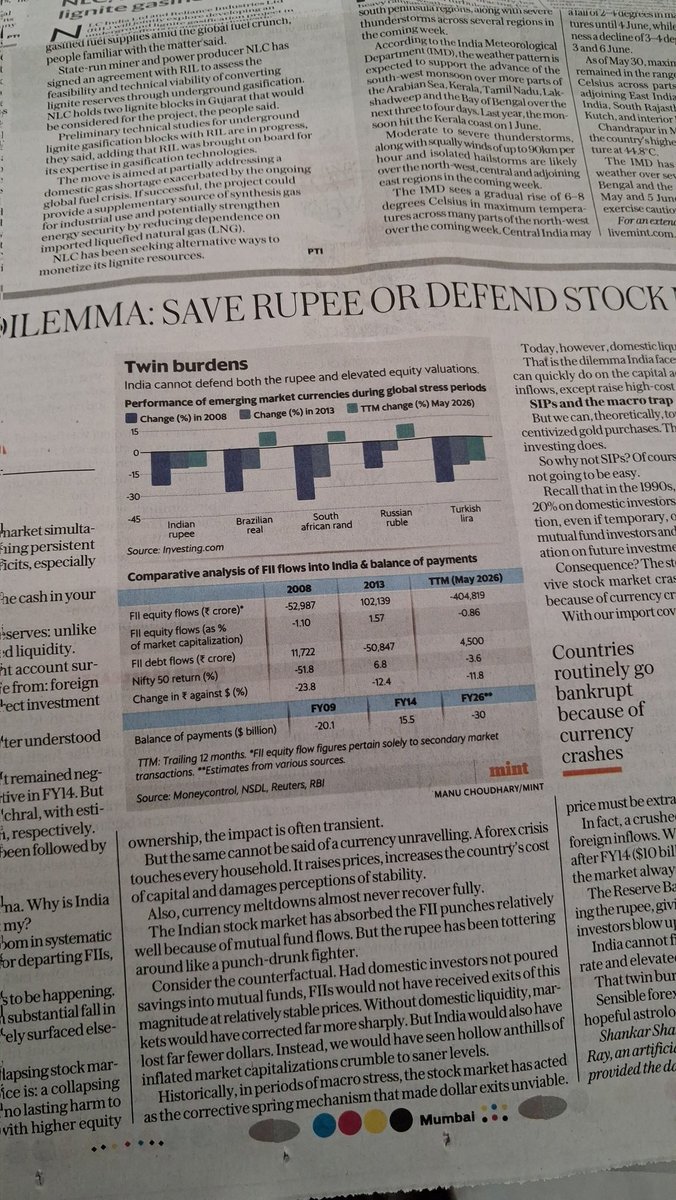
.@1shankarsharma 's macro dilemma as flagged by @livemint deserves a deeper look. Shankar names the twin burden precisely — save the rupee or defend the stock market. The data table alone should end the "don't panic" commentary.
But the twin burden is actually five. Two are visible. Three are still arriving.
Here are all five — falling on the same soldier simultaneously.
The SIP investor — India's last line of defence — is being asked to:
— Provide the liquidity that absorbs FII exits and prevents a market crash
— Fund the consumption that drives 60% of India's GDP — if they stop spending, growth stalls
— Service EMIs and maintenance debt just to sustain last year's living standard
— Watch rupee-denominated savings depreciate in real terms at ₹96 and falling
— And now absorb an incoming CPI shock from a supply chain that is still travelling
The first two Sharma has mapped. The last three are arriving on a different clock.
The Hormuz CPI transmission — oil → freight → food — hasn't landed yet. August–September 2026 is when ordinary Indians feel it in their kitchens.
That is not a twin burden. That is a five-front war fought by the same soldier.
The RBI cannot cut when the transmission is still travelling toward household budgets. It cannot hike into a decelerating GDP. It cannot defend the rupee, support equity valuations, and protect household purchasing power simultaneously.
Sharma asks: save the rupee or defend the stock market?
The honest answer is: at some point, neither. When three levers — rupee defence, inflation control, growth support — all pull in opposite directions simultaneously, the system doesn't choose. It breaks.
How this sequence unfolds — the transmission mechanics, the governance failures that make structural remedies politically impossible, and why the trilemma has no clean exit — is mapped across two papers.
The forensics: https://t.co/lqHyL7Qkyj
The structural root: https://t.co/EMgDLE3uHD
Mises wrote 1,000-page books. Dense. Academic. Unreadable to most.
That person scrolling at 11pm after a 10-hour workday — wondering why their salary keeps rising but their life keeps getting harder — never got to read them.
That person is in Delhi. San Francisco. Mumbai. Tokyo. This series was written for them. Plain Sight Research.
@IndiaBitcoinMan
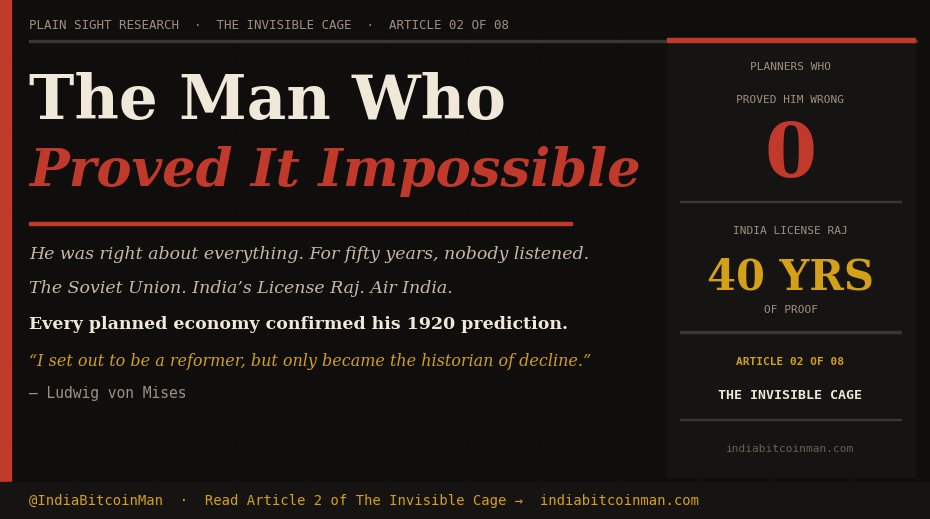
In 1920, a 38-year-old economist in Vienna wrote a 36-page paper.
It proved that central planning is not just inefficient.
It is mathematically impossible.
Every government on earth has spent 104 years trying to prove him wrong.
None have succeeded.
"I set out to be a reformer, but only became the historian of decline."
— Ludwig von Mises Written in exile. 1940.
He died in 1973. Still unpaid. Still ignored. Still right.
Article 2 of The Invisible Cage. The man who proved it impossible. 👇
https://t.co/d5jwPWMdTz