🚨ISRO’S NEXT LAUNCH COULD BE A CRUCIAL CONFIDENCE TEST
ISRO is preparing to return to the launchpad with GISAT-1A, with liftoff currently reported for September 4, 2026. The mission would be ISRO’s first launch since the PSLV-C62/EOS-N1 setback on January 12.
The upcoming mission comes after a series of important lessons for India’s launch programme.
• PSLV-C61 / EOS-09 — May 2025
The PSLV performed normally through its second stage, but an anomaly during the third stage prevented the mission from being accomplished.
• GSLV-F15 / NVS-02 — January 2025
This was not a launch-vehicle failure. GSLV-F15 successfully injected NVS-02 into its intended Geosynchronous Transfer Orbit, but the satellite subsequently could not perform its planned orbit-raising manoeuvres. ISRO’s investigation later identified a likely connector-contact issue that prevented the required drive signal from reaching the oxidizer-line pyro valve.
• PSLV-C62 / EOS-N1 — January 2026
ISRO reported an anomaly near the end of the PS3 stage, and the mission did not achieve its objectives.
Despite these setbacks, 2025 also saw major successes, including the GSLV-F16/NISAR and LVM3 missions. ISRO’s own 2025 space-situational report records five launches from Sriharikota, with PSLV-C61 being the only unsuccessful launch of that year.
The upcoming GISAT-1A mission will therefore be another important milestone as ISRO continues to strengthen launch reliability, apply lessons from previous missions and expand India’s capabilities in space.
#ISRO #Space #India #GSLV #GISAT1A
🚨Mission accomplished! 🇮🇳
GSLV-F17 has successfully placed EOS-05 into its intended orbit, marking another successful mission for ISRO.
A powerful launch, a precise orbital insertion, and another milestone for India’s space programme.
#ISRO#GSLVF17#EOS05#IndiaInSpace
🚨Vodafone Idea is changing — and Shah Rukh Khan is the new face.
Vodafone Idea has unveiled a refreshed Vi logo, with its signature yellow element redesigned into a 3D sphere above the “i”.
Alongside the rebrand, Shah Rukh Khan has been announced as the face of Vi’s upcoming campaign, “Vi badal raha hai… tayaar rahiye.”
But this is more than a logo makeover.
Vi says the new identity marks the beginning of a broader transformation focused on network strength, smarter experiences and technology-led offerings.
The company is also targeting ₹45,000 crore in capital expenditure over the next three years to strengthen its network.
New identity. New face. Now Vi has to turn the rebrand into a real turnaround.
#VodafoneIdea #Vi #Telecom
🚨17 bidders line up for Odisha’s ₹8,300 crore coastal highway.
NHAI has received 17 bids for the 160-km Rameshwar–Paradeep Coastal Highway, estimated to cost around ₹8,300 crore.
The project will strengthen coastal connectivity in Odisha and improve access to the Paradeep port and regional economic hubs.
#Odisha #Infrastructure #Highways #IndiaGrowth
🚨 ₹1.8 lakh crore highway pipeline for India. 🇮🇳
NHAI plans to bid out 54 highway projects covering 2,442 km in FY27, with an estimated capital cost of ₹1,80,017 crore.
The projects span 13 states/UTs, adding another major pipeline to India’s infrastructure expansion.
#Infrastructure #Highways #IndiaGrowth
🚨 Modi tells Putin: Ukraine war must end
At the SCO summit in Bishkek, PM Modi told Vladimir Putin that the Ukraine war should end “for humanity’s sake” and reiterated India’s support for peace efforts. onded positively.
🚨 Tata + Javelin: American missile production is moving closer to India.
Tata Advanced Systems Limited has been selected as the prime Indian partner by the Javelin Joint Venture — Lockheed Martin and Raytheon, an RTX business — for future in-country co-production efforts.
Under a new MoU, the companies will explore establishing a Javelin All Up Round (AUR) final assembly and integration facility in India, along with capabilities to produce selected components locally.
The model is not a complete shift of Javelin production from the US to India.
Key inputs would continue to come from the American supply chain:
🇺🇸 Lockheed Martin’s Troy, Alabama facility would produce sub-assembly kits.
🇺🇸 Raytheon’s Tucson, Arizona facility would produce guidance electronics units.
🇮🇳 These would then be shipped to India for final assembly and integration.
The Javelin Joint Venture has already produced more than 55,000 Javelin missiles and over 12,000 reusable Command Launch Units.
The significance is bigger than one missile.
If the proposed facility moves ahead, India would gain a role in the production and integration of one of the world’s most established anti-tank missile systems — while becoming more deeply integrated into the Javelin global supply chain.
The MoU comes just days after India finalized an agreement with the US to acquire Javelin systems for the Indian Army.
#Javelin #MakeInIndia #IndianDefence #DefenceManufacturing #IndiaUS
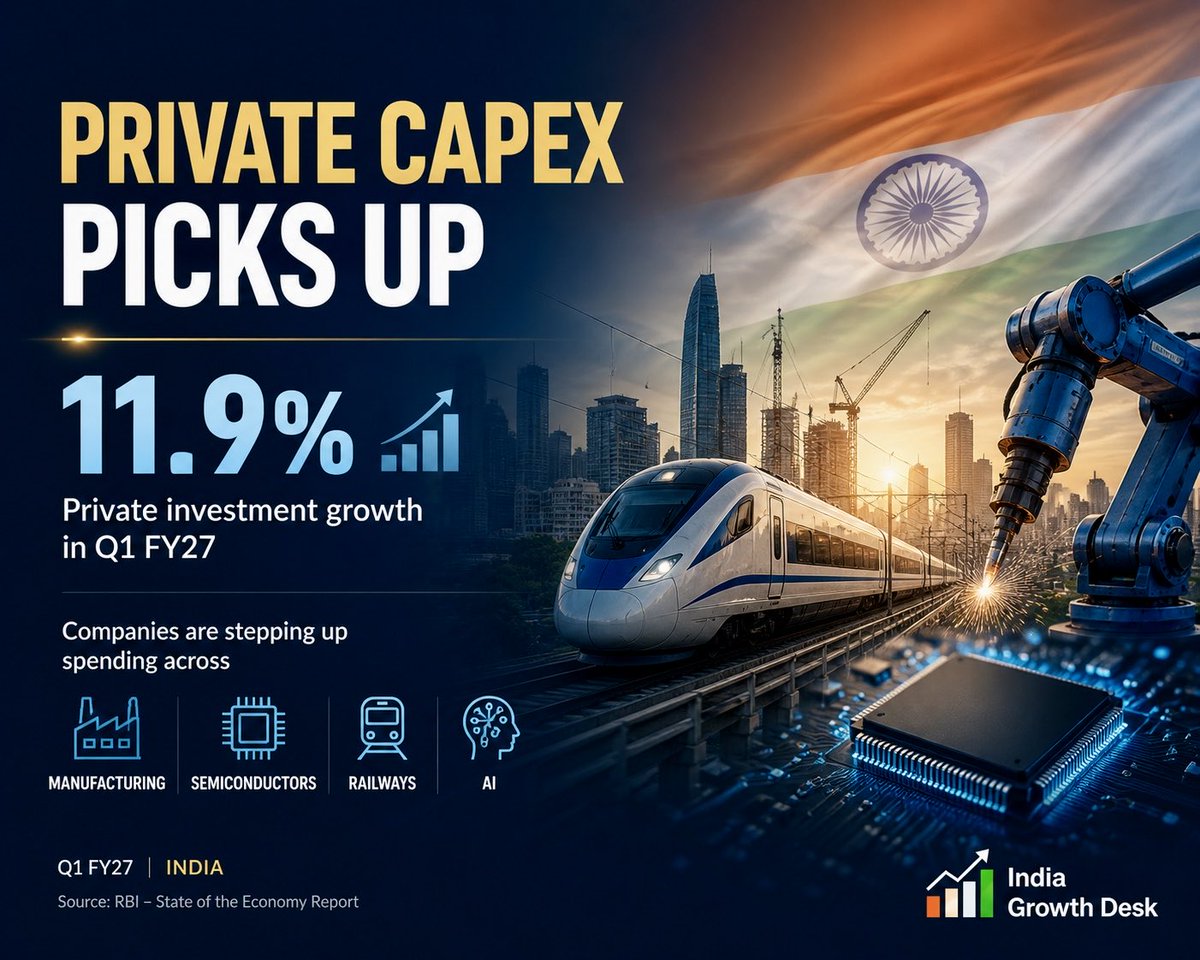
🚨India’s next growth engine may be private capex.
Private-sector investment rose 11.9% in Q1 FY27 as companies step up spending across railways, AI, semiconductors and manufacturing.
🇮🇳 India’s economy just delivered a stronger-than-expected start to FY27.
Let’s decode the numbers with India Growth Desk.
India’s real GDP grew 7.8% year-on-year in Q1 FY27, covering April–June 2026.
That was significantly higher than the 7.1% market expectation and the 7% growth forecast by the RBI. It also marks the 12th consecutive quarter in which India’s growth has beaten expectations, according to Reuters. (Reuters)
But the headline 7.8% is not the most interesting part.
The composition of growth is.
🏭 Manufacturing is accelerating.
Manufacturing GVA grew 9.2%, up from 8.3% a year earlier.
And some of the underlying numbers are even more striking:
• Electrical equipment: +27%
• Other transport equipment: +19.5%
• Computer, electronic & optical products: +12.4%
• Machinery & equipment: +9.1%
• Capital goods production: +15.2%
That points towards a broader expansion in industrial and capital-goods activity rather than growth being driven purely by consumption. (DD News)
📈 Investment is becoming a bigger part of the story.
Real Gross Fixed Capital Formation — the broad measure of investment in fixed assets — grew 11.9% in Q1 FY27, more than double its 5.8% growth a year earlier.
GFCF also rose to around 34.3% of GDP, compared with 31.4% a year earlier. (Reuters)
And Reuters sees signs that the private sector is increasingly joining the investment cycle.
Private-sector capital investment rose by more than ₹5 trillion ($52.7 billion) year-on-year in Q1, while corporate capex had already increased around 11% in FY26.
Investment is increasingly moving into manufacturing, railways, semiconductors, AI and data-centre infrastructure. Google and Amazon alone have announced more than $40 billion in Indian data-centre commitments, according to Reuters. (Reuters)
🛍️ Then there is consumption.
Household consumption expenditure grew 7.1%, slightly faster than the 6.8% recorded a year earlier.
That matters because India is seeing investment and domestic demand grow together — rather than relying on only one engine. (DD News)
💼 Services are still doing the heavy lifting.
The services/tertiary sector grew around 10%, with financial, real estate, IT and professional services recording 12.1% growth. (IndiaVerve)
There is, however, another side to the data.
India’s Q4 FY26 GDP growth was revised up to 8.6%, meaning Q1’s 7.8% represents a sequential moderation.
Agriculture grew 3.6%, while mining contracted 2.4%, showing that growth is not equally strong across every sector. (EcoNiti)
And the external environment remains challenging.
Geopolitical tensions, elevated energy prices, trade uncertainty and a weaker rupee could all put pressure on growth and inflation in the months ahead. Reuters also highlighted high oil prices and geopolitical risks as key challenges to the investment outlook. (Reuters)
So what does 7.8% really tell us?
India is not simply growing fast.
The growth engine appears to be broadening.
Manufacturing is expanding.
Capital investment is accelerating.
Private-sector capex is showing signs of revival.
Services remain strong.
And household consumption continues to grow.
That combination is important because investment in factories, machinery, infrastructure, electronics, semiconductors and digital infrastructure can expand India’s productive capacity for years to come.
7.8% is the headline.
The bigger story may be what is happening underneath it. 🇮🇳
#IndiaEconomy #GDP #IndiaGrowth #Manufacturing #Investment
🇦🇷 AN ERA HAS COME TO AN END
Lionel Messi has announced his retirement from international football, bringing the curtain down on a remarkable 21-year journey with Argentina.
207 matches. 125 goals. 2 Copa América titles. 1 World Cup.
From the heartbreak of multiple final defeats to lifting the World Cup in Qatar in 2022, Messi leaves as Argentina’s most-capped player and all-time leading scorer.
“The decision hurts, but I understand that the time has come.”
Thank you for everything, Leo. 🐐🇦🇷
#Messi #LionelMessi #Argentina #Football
🚨 Russia has submitted a detailed proposal to supply India with 5 additional S-400 Sudarshan long-range air defence squadrons in response to an Indian tender.
The proposed acquisition is estimated at over ₹50,000 crore and is currently being processed by the Defence Ministry.
India signed its first S-400 contract with Russia in 2018 for 5 squadrons. So far, 4 have been delivered, while the final squadron is expected by November 2026.
The system gained major attention during Operation Sindoor. Western Air Command chief Air Marshal Jeetendra Mishra recently said an S-400 achieved a 314 km engagement against a Pakistani surveillance aircraft, which he described as possibly the longest surface-to-air missile kill on record.
If the new deal is finalised, India could eventually operate 10 S-400 squadrons, significantly expanding its long-range air-defence coverage across the eastern and western fronts.
A key question now will be the delivery timeline. According to defence sources, supplies under a new contract could begin around 3 years after the deal is signed.
#S400 #IndianAirForce #IndiaRussia #IndianDefence
🚨 The Tim Cook era at Apple is coming to an end.
After 15 years as CEO, Cook will step down on September 1 and move into the role of Executive Chairman.
When he took charge in 2011, Apple was valued at around $350 billion. Today, it is worth nearly $4.5 trillion.
Under Cook, Apple also made a major bet on India — from opening its first stores in 2023 to turning India into a key global iPhone manufacturing hub. India now accounts for roughly 1 in every 4 iPhones assembled globally.
John Ternus will take over as Apple’s next CEO.
#TimCook #Apple #MakeInIndia
🚨The Diplomat claims that India expanding BrahMos deployment across its naval fleet could have “destabilising implications for the region.”
That argument turns deterrence on its head. India does not need anyone’s permission to strengthen its Navy, secure its coastline, protect vital sea lanes or defend its sovereignty.
In an increasingly militarised Indian Ocean, expecting India to remain under-armed for the sake of someone else’s “strategic comfort” is absurd. A strong Indian Navy is not destabilisation it is deterrence.
🚨ONGC explores buying deepwater drillships or forming joint ventures to boost India’s offshore oil and gas exploration.
The move is part of the ₹84,084 crore Samudra Manthan mission aimed at strengthening India’s energy security and reducing import dependence.
🚨GST Council may consider cutting the 18% tax on mobile phones as smartphone demand slows in India.
Smartphone shipments in India fell around 10–11% year-on-year during the April–June quarter, marking the steepest June-quarter decline in six years. Meanwhile, India produced mobile phones worth around ₹6.27 lakh crore in FY26.
The government has also recently notified a ₹62,500 crore Mobile Phone Manufacturing Scheme, aimed at increasing domestic production and value addition.
So how much cheaper could premium smartphones become?
If GST is reduced from 18% to 12% and the entire benefit is passed on to consumers, the effective reduction in the final tax-inclusive price would be around 5.1%.
• A ₹80,000 smartphone could theoretically fall to around ₹75,900
• A ₹1 lakh smartphone could fall to around ₹94,900
• A ₹1.5 lakh premium phone could fall to around ₹1.42 lakh
That means popular premium smartphones — including iPhones and flagship Android devices — could potentially become ₹4,000–₹8,000 cheaper, depending on their price.
However, there are two important caveats: the GST cut has not been finalised, and companies would need to pass the tax benefit on to consumers.
The proposal could therefore be a double boost for India: more affordable smartphones for consumers and additional support for the country’s mobile manufacturing ambitions.
#GST #iPhone #Samsung #Smartphones #MakeInIndia #Electronics
🚨 Modi and Putin expected to visit major India–Russia tech and industry expo ahead of BRICS Summit
The first INNOPROM.India industrial trade fair will be held in New Delhi from September 9–11, showcasing advanced technologies and industrial collaboration between the two countries.