Using "think" to describe what an LLM does reminds me of the 16th century, when astronomers didn't really believe in the heliocentric model, but used it for calculations anyway because the math was simpler. We'll start by calling it thinking, then gradually acknowledge it is.
Today we announced the Claude-led discovery of a molecular machine that we suspect could represent a new gene editing mechanism. Its precise function, biotechnological utility (if any), or level of significance is not yet clear, but at minimum it is work I would have been proud to do as a PhD student. The work was done mostly, though not entirely, by Claude: our life sciences team suggested a broad area of research, Claude read through the literature and a bunch of genome data and discovered something interesting, then Claude proposed experiments to verify the discovery and our team carried them out.
It’s easy to dismiss this as a one-off or curiosity, but we’ve repeatedly seen a pattern where AI performance in new intellectual domains goes from weak to superhuman in a matter of a few years. In 2023 models struggled to do math at the level of an average high-school student. In 2024 they started to do well on math competitions for the best high-schoolers in the country, in 2025 they started to solve minor open problems, in early 2026 more significant open problems, and in late 2026 they are beginning to solve the top few open problems in all of mathematics. We believe AI for biology is on a similar exponential trend.
The main difference between biology and mathematics, of course, is that math can be done purely theoretically, while biology requires experimentation. Some have used this to draw the conclusion that AI’s utility in biology will be limited. We think this is wrong. As we’ve demonstrated today, humans can collaborate with AI to perform the experiments, validate key results in a few weeks and, if necessary, work with the AI to iterate on what they find. Eventually it may even be possible for Claude itself to safely perform the experiments by autonomously controlling lab equipment, with appropriate safeguards in place, but we aren’t doing that today (our lab is also a BSL1/BSL2 facility that doesn't handle materials dangerous to humans).
More broadly, biomedical advancement has many stages — from fundamental biology discoveries, to translational research, to drug discovery, clinical trials, and finally the actual delivery of medicines and health care to patients. We are also interested in these later stages, but even simply accelerating the first stage of fundamental biological discoveries has the potential to speed up and broaden the entire pipeline. Improving our understanding of biology and sharpening biologists’ tools can drive forward all of the later stages, for example by identifying new drug targets, finding new therapeutic modalities, allowing for more precise measurement, and speeding up the experimental loop which itself further accelerates our understanding of biology. This will not in itself speed up clinical trial times, but if it succeeds it could greatly increase the number of promising candidates that go into the pipeline — an increase in throughput even though latency remains.
In Machines of Loving Grace, I wrote about AI’s potential to “cure most diseases in 5-10 years” — a goal that sounds impossible, but one I believe is just barely possible if AI is applied to every stage of the pipeline. The first step is showing that AI can first help with, and then drive, biological discoveries.
Claude’s discovery is the latest in a line of related prior work that goes back decades, beginning with systems like CRISPR, and continuing with discoveries like the bridge recombinase and VIPR in the past few years. Recently, there has been heightened interest in systems based on reverse transcriptase (RT) enzymes, the enzyme underlying the system Claude identified. And most recently, a Stanford team working independently described a novel RT system with an associated non-coding array that is in some ways similar to the one Claude found, though they are distinct systems that evolved independently from each other. I believe that we’re at the very beginning of finding such systems and developing them into powerful tools for biotechnology.
I’m proud of the resources Anthropic has invested in accelerating the public benefits of AI through the life sciences, and we’re aiming both to grow our life sciences team and to work with other scientists to extend this approach to a broad range of problems. If you have a proposal for a research collaboration or are interested in joining our life sciences team, please reach out.
To put it simply, an object and the system around it are not the same thing. A work or work(s) can be still sincere even if the system around it is not. The layer that funds, selects and circulates it can still have reasons of its own.
That is the part of the CIA/modern-art story worth keeping. The Agency paid for a cultural network (e.g. funding the Congress for Cultural Freedom), and still does! There is no memo ordering abstract expressionism, and you do not need one, people already do that out of their own accord willingly. However, Shared assumptions plus a filter that decides what gets amplified will suffice, in their eyes. People must know this is not a conspiracy, but an ecology!
people do this after basically every major AI model release
> “This changes everything”
followed by
> “You all say this every time. It is hype, nothing new.”
sure, comparing a new model to the previous generation, or to competing models, is interesting, useful, and often engaging
but i think there is another level that is more important to keep in view
not just individual releases, but how AI capabilities are moving across the ecosystem as a whole
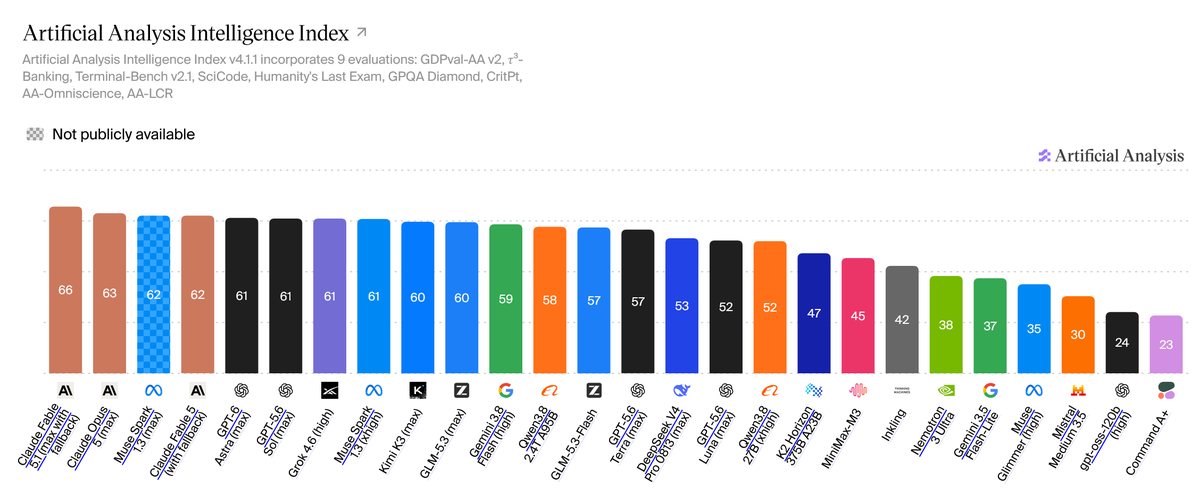
for example, models that were expensive frontier models not that long ago are already being caught or passed by open-weight models you can run yourself
i do not think we take observations like this seriously enough, regardless of what your personal view on AI is
take a chart like this
a month, a year, or more from now, the names and order could look completely different, or surprisingly similar to what we see today
either way, the capability level represented by the whole chart will probably have moved drastically
there will be more breakthroughs, shifts, and other developments worth paying attention to
and these movements will probably accelerate
through it all, people will still be arguing about whether the latest model is “actually” a big deal
if we keep looking at each of these changes in isolation, i do not think we are giving ourselves much chance to properly understand, let alone prepare for where everything might lead
the question of who is #1 this month, as well as every other month before, feels much less important than where AI as a whole is heading, and what that trajectory ends up meaning for the rest of society.
people have to keep drawing lines in the 'sand'
without contributive effort, the goal that which will benefit humanity in the highest will be slowed down
helping to cause, produce, or bring about a result. [1]