Underrated life advice: Make peace with being unimpressive to the outside world. Drive the normal car. Wear the simple clothes. Live below your means. Stay in the committed relationship. The ability to look ordinary while building an extraordinary life is wildly underrated.
Good Morning from Latvia, where public debt has jumped from just 9% of GDP in 2007 to 46.9% today. Yet Latvia remains comfortably below Maastricht’s 60% debt limit, something only 10 of the Eurozone's 21 members currently manage. Even more striking: defense spending is rising to ~5% of GDP, but Moody’s still expects debt to stay below 60%, at ~53% over the coming years. Latvia is rated A3/stable.
@ZephirousKarn Отказалась от любимой работы из-за сильных головных болей, нашла другую работу. Чувство глубокого удовлетворения сделанным за многие годы в душе осталось, немного страшно пр��бовать себя в новой сфере, но как же хорошо...
South Africa is the only country that built nuclear weapons and then deliberately destroyed them before a new demographic majority took power.
By 1989, they had 6 assembled warheads and a working intermediate range missile that also launched satellites, all developed alone under total embargo.
>1990: de Klerk ordered the arsenal dismantled
>1991: every gram of enriched uranium was melted down
1994: the missile program was cancelled
It was all finished before the ANC inherited the state.
France and the UK will sooner or later have to face similar difficult decisions.
The illegal migration crisis in Spain is all over the news
To put it in perspective, the foreign-born population in Spain rose from 2.1% in 1996 to 21% in 2026, a 10x increase.
Is there unlimited ability of a state to absorb migrants, or does it become a stretch at some point?
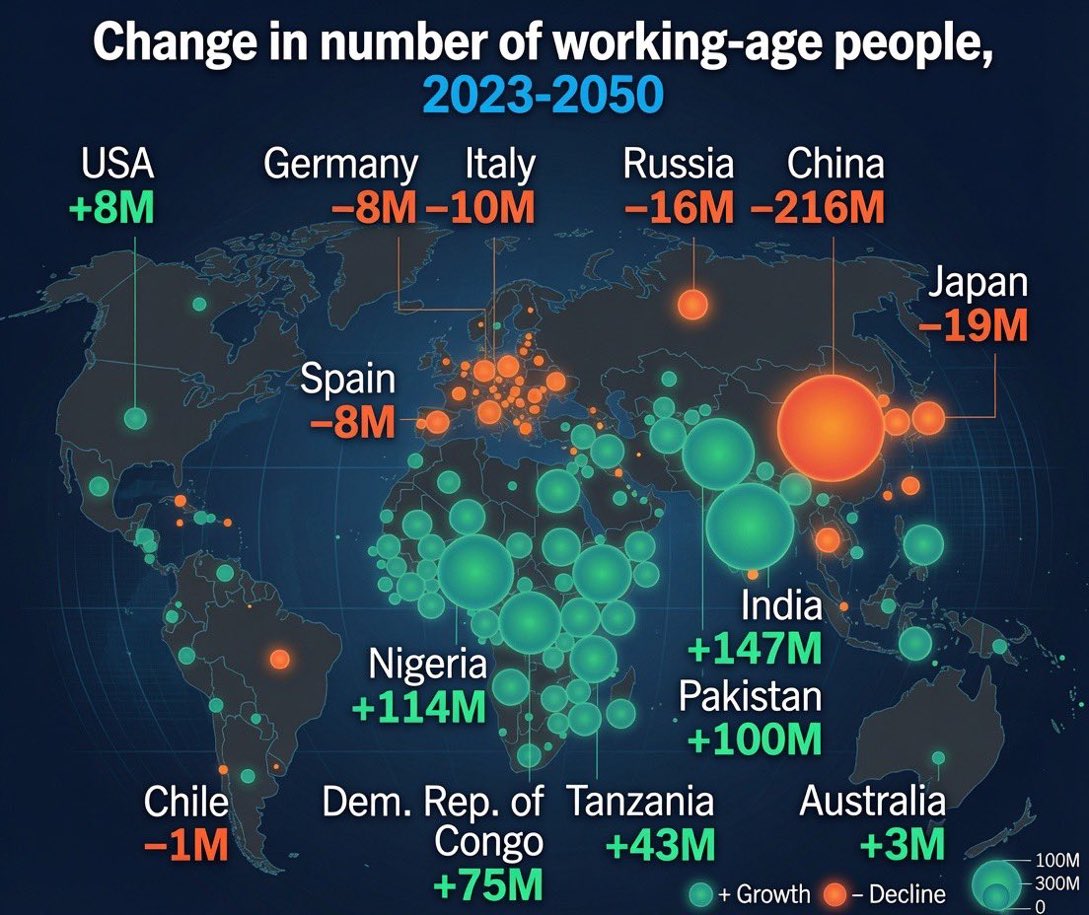
Demographics is not only an issue in Asia.
Italy, Spain, Poland and Germany are sleepwalking into a crisis as well.
Don’t count on a pension sufficient for a decent retirement there, and many properties will turn from assets to worthless liabilities. Plan accordingly.
Germans prefer „working“ for the government over starting a business and seriously assume they will keep their prosperity.
A nation with such a mindset won’t stay prosperous. They cover the steady decline with more debt for now
Entrepreneurs build prosperity, not the government
Tā vietā, lai piespiestu 50 gadus vecu profesionāli konkurēt ar „digitālajiem aborigēniem” koda rakstīšanā, mums jāmeklē veidi, kā pielietot viņa unikālās, gadu gaitā uzkrātās prasmes jaunajos apstākļos. Mums jāprot novērtēt uzkrāto cilvēcisko pieredzi.
Jeff Bezos: "We don't have a revenue problem in this country. We already have the most progressive tax system in the world.”
“The Top 1% of taxpayers pay 40% of all taxes.”
“The bottom 50% pay just 3%. We have a spending problem."
Money supply is significantly outpacing economic growth across major economies:
Canada's M2 money supply has grown +368% since January 2004, the largest increase among G7 economies.
By comparison, the Canadian economy has expanded +159% over the same period.
The US follows, with M2 growth of +279% versus a +171% increase in nominal GDP.
Meanwhile, M2 in France has surged +258% and +211% in the Euro Area, both outpacing nominal GDP growth of +84% and +102%, respectively.
In Japan, M2 has grown +90% since 2004, while its economy expanded just +25%, the slowest pace among G7 economies.
The gap between money creation and economic growth is widening.
All it takes to not be a poor nation in the western hemisphere is to stunt on the socialists.
Chile ran the most radical free market experiment on the continent and became the richest country in Latin America while its neighbors stayed poor.
In the 1950s a group of Chilean students trained under Milton Friedman at the University of Chicago and came home as the Chicago Boys.
Starting in 1975 they ripped the economy open, slashed tariffs, privatized state industries, and crushed runaway inflation.
In 1981 José Piñera replaced the broken state pension system with private retirement accounts, and dozens of countries later copied that model.
After Chile returned to democracy in 1990 growth hit 7% a year and poverty collapsed from over 60% to under 9%.
Same free market blueprint sustained for decades turned one of Latin America’s poorest countries into one of its richest.