Welcome 👋: https://t.co/v8K0215NAv
Join Discord: 💬 https://t.co/5hH4lnRbD1
Explore Projects: 🔍 https://t.co/kqeo5QVJon
Active Inference Ecosystem: 🌐 https://t.co/aPlu82ryqI
Videos: 🎥 https://t.co/UkBhZeTD7Z
Volunteer: 🌱 https://t.co/e92piLqvxO
Intern: 🎓 https://t.co/JZWitC1w2V
Newsletter: 📰 https://t.co/fYP5BNGUMc
Fellows Program: 📖 https://t.co/0Pc0lisYdK
Partnerships: 🤝 https://t.co/KUVBFncdcY
Support the Institute: 💖 https://t.co/IRsq0yhRdK
Join us in advancing the field of Active Inference and be part of our growing community!
GNN-based active inference for Battleship: Finite-catalog inference, interpretable decisions, and reproducible software
Paper: https://t.co/zLnp6CeV6U
Code: https://t.co/BG8eYPnNAt
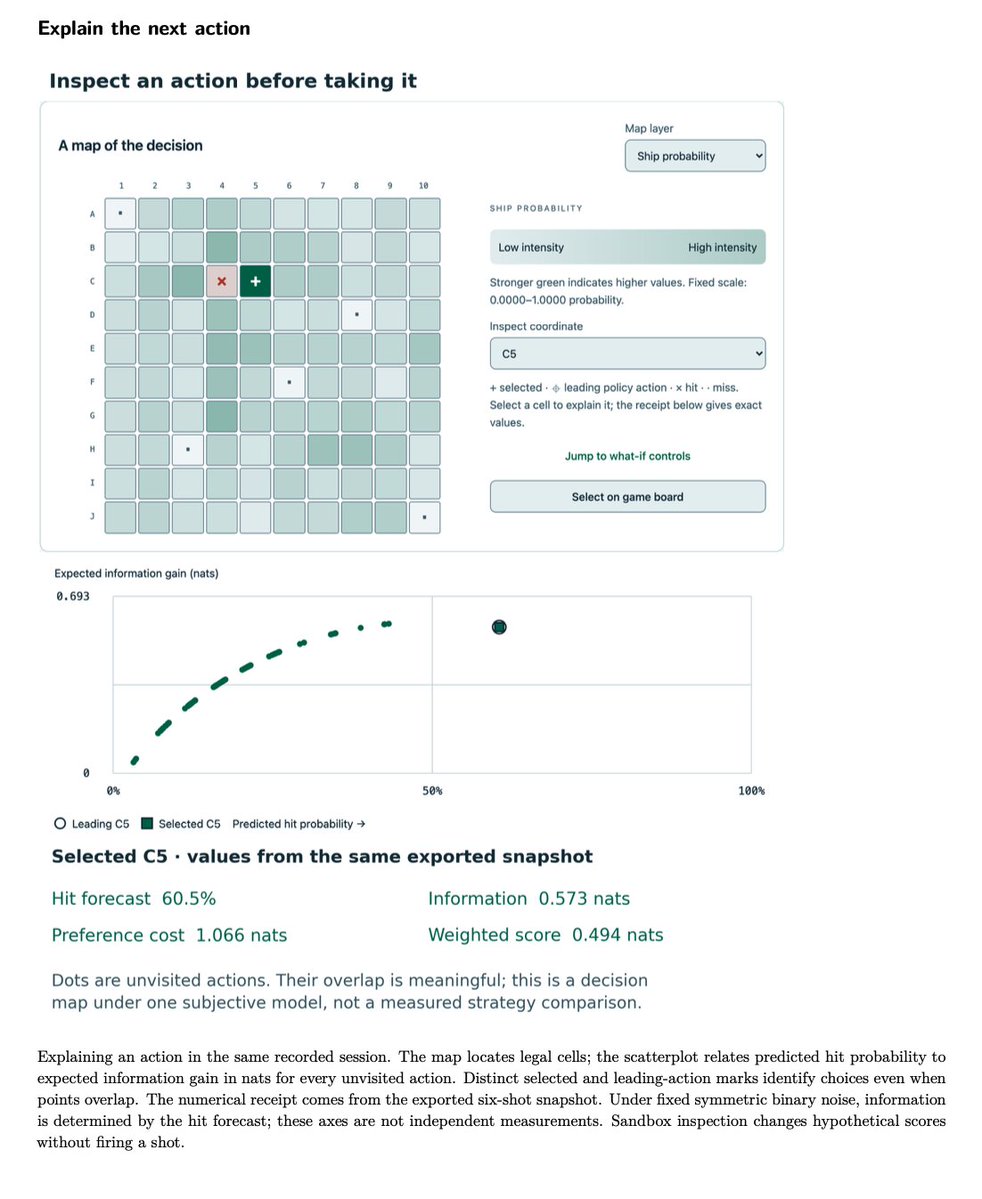
Active inference models connect beliefs, preferred outcomes, and information-seeking actions, but an implementation can obscure the assumptions behind its displayed quantities. We present a browser-based Battleship dashboard whose executable contract begins with a Generalized Notation Notation (GNN) specification. The assistant performs exact categorical Bayesian inference conditional on a reproducibly sampled finite catalog of legal fleets, and evaluates a one- step preference-and-information objective. An interactive decision explorer exposes occupancy, observation forecasts, information gain, preference cost, action probabilities, hypothetical posteriors, and parameter sensitivity for either actor. The selected fleet remains outside the assistant’s information boundary. We derive the implemented quantities, distinguish expected from realized information, and connect the model to active learning, active search, partially observable planning, and prior Battleship research. A two-fleet example isolates the preference–information trade- off. A retained descriptive demonstration motivates a prospectively specified 1,280-search follow-up across 256 fresh paired catalog/truth units and five strategies. Completion shots, five-shot hits, and normalized label entropy receive 24 planned Holm-adjusted paired sign tests, alongside descriptive paired mean-effect intervals. Standard greedy EFE and pragmatic completion counts tie in every pair. Pure epistemic selection has less favorable completion sign balance in both size strata.
Active Inference Across California: Graphical Models & Geospatial Decisions
https://t.co/2luQ4PocVk
Explore Active Inference through a statewide example spanning fire, seismic activity, and drought. Animated graphical models connect hidden conditions, observations, belief updates, and sensing decisions to a practical question: what should we observe next?
Very cool, also we can do this with multiple languages, converting codebases into state space models you can do inference with:
https://t.co/LLfGL1Qrwf
https://t.co/asg1xkCpuf "COGANT: Deterministic Codebase-to-GNN Translation"
My dear friends, I’d like to show you my latest toy project
Introducing Handwired: turn your regular JavaScript code into a neural net!
- no training
- exact outputs vs the JS program
- fully differentiable
All runnable in a browser, without GPU
@jpschroeder@0xBOYD Also this can be done with State Space models, see:
https://t.co/sTYnMaF0Ap
https://t.co/asg1xkCpuf
COGANT: Deterministic Codebase-to-GNN Translation
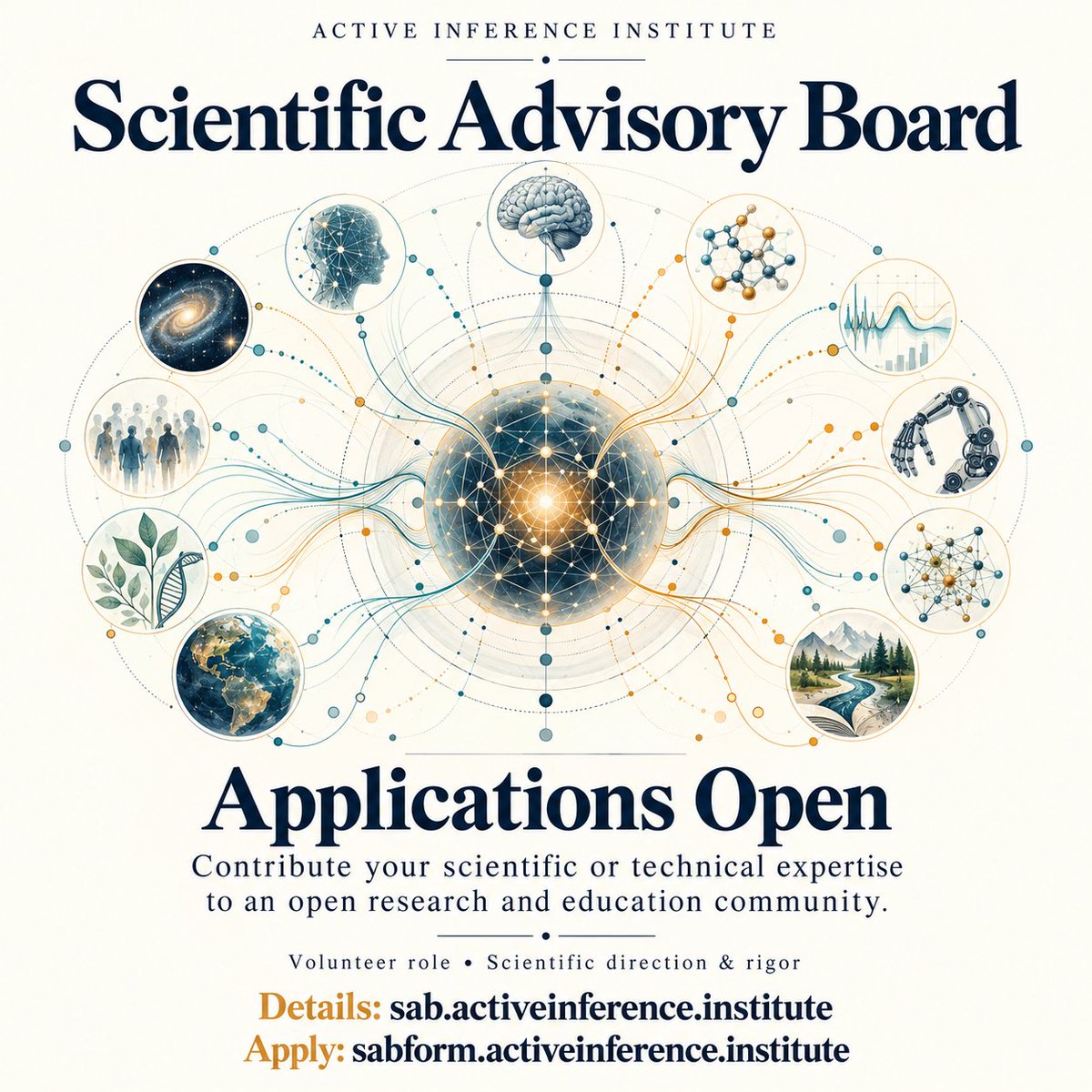
Do you have scientific or technical expertise you'd like to contribute to an open research and education community? The Active Inference Institute is accepting applications for its Scientific Advisory Board, a volunteer role that works alongside the Board of Directors and Officers and focuses on scientific direction and rigor. We welcome applicants from across the fields that Active Inference touches.
Details are at https://t.co/XLqUt6ulQK and the application is at https://t.co/9YDv1Htab0
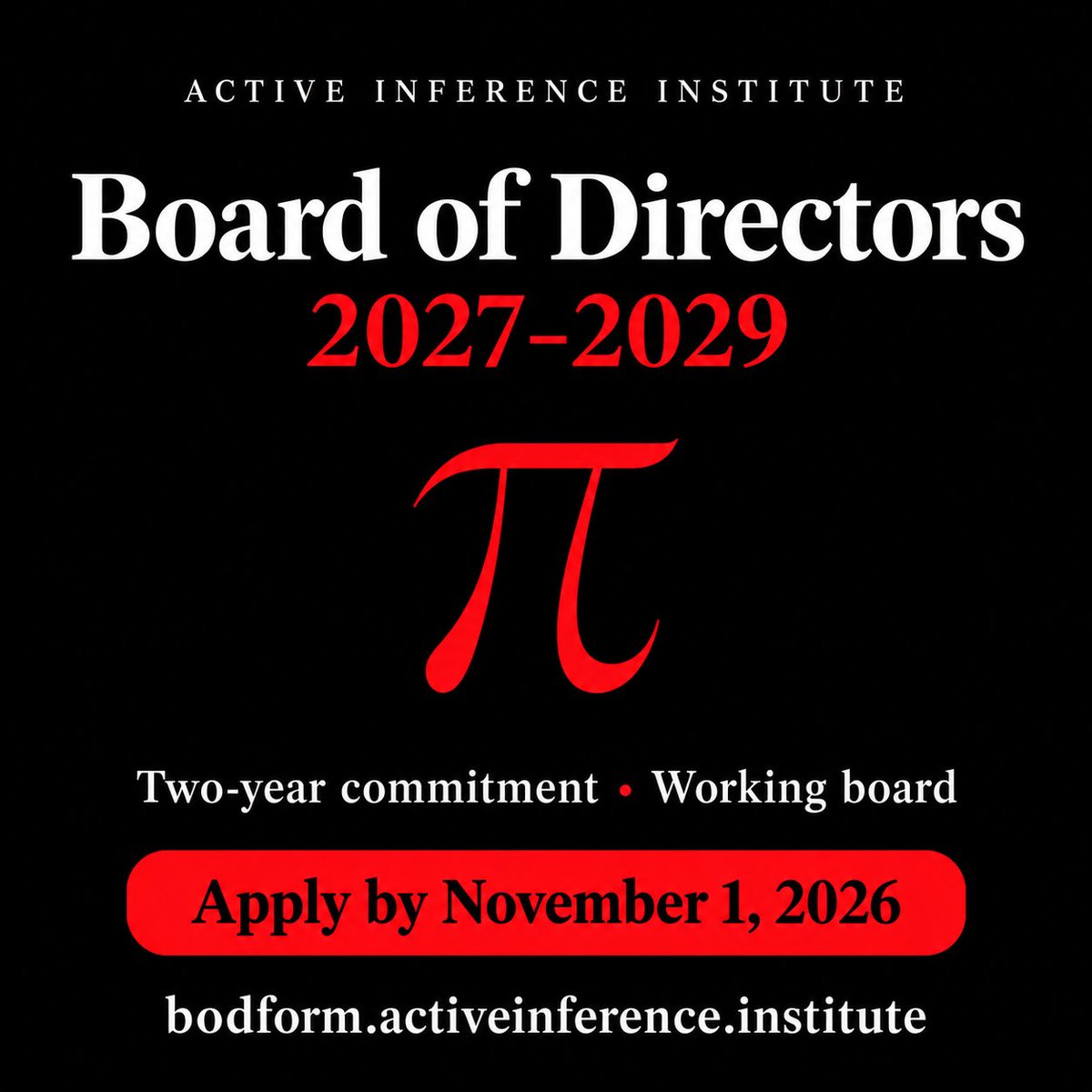
The Active Inference Institute is currently seeking applicants for the 2027/28 Board of Directors! Our board provides formal governance and oversight for the Institute as a non-profit organization, and in doing so serves the accessibility and applicability of Active Inference. In addition, we are a working board for a (mostly) volunteer organization, and require each board member to serve on a committee dedicated to institute development. If you would like to be considered, please complete this form before November 1st, 2026. Additionally, if you know someone who would be perfect for this role, feel free to pass this opportunity along to them.
More information: https://t.co/4I2qgmSr9R . Application form: https://t.co/sSQHKfh8mi .
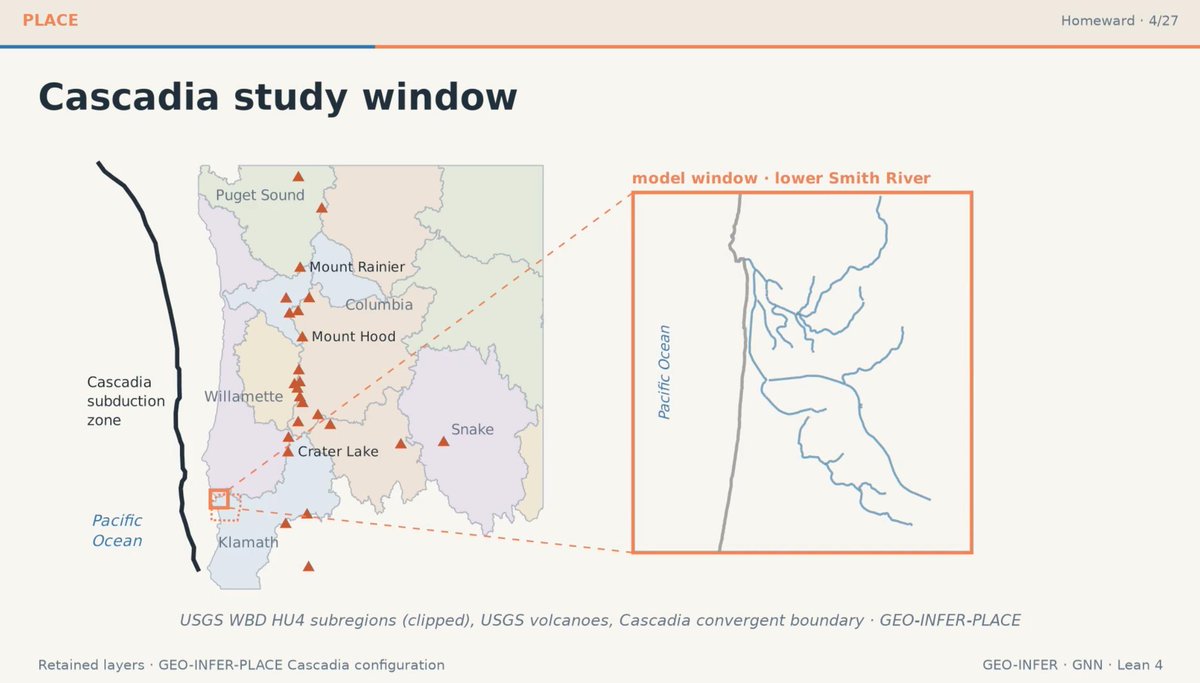
Homeward: Typed Geospatial Active Inference in Cascadia | GEO-INFER, GNN & Lean 4
https://t.co/JCx0gNTw1K
How can one geospatial active-inference model connect executable simulation, a precise model specification, and machine-checked mathematics?
The 6th Applied Active Inference Symposium is Nov 12–13, online and free.
Keynote by Karl Friston, plus Mike Levin @drmichaellevin, workshops, trainings, and dozens more sessions.
Register: https://t.co/NMrbY6FctK
Present or send a lightning talk: https://t.co/RLywGDbMYh
Program: https://t.co/9NAplg6M4W
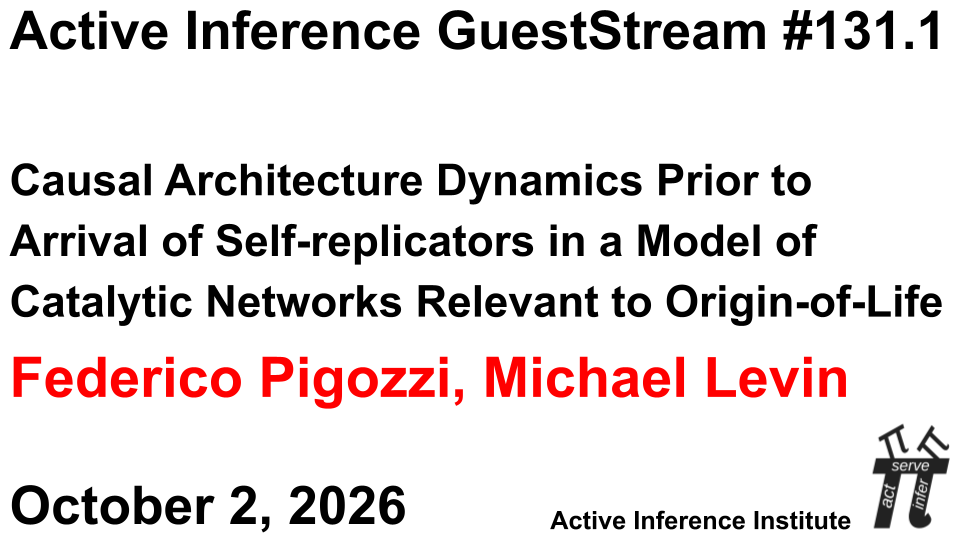
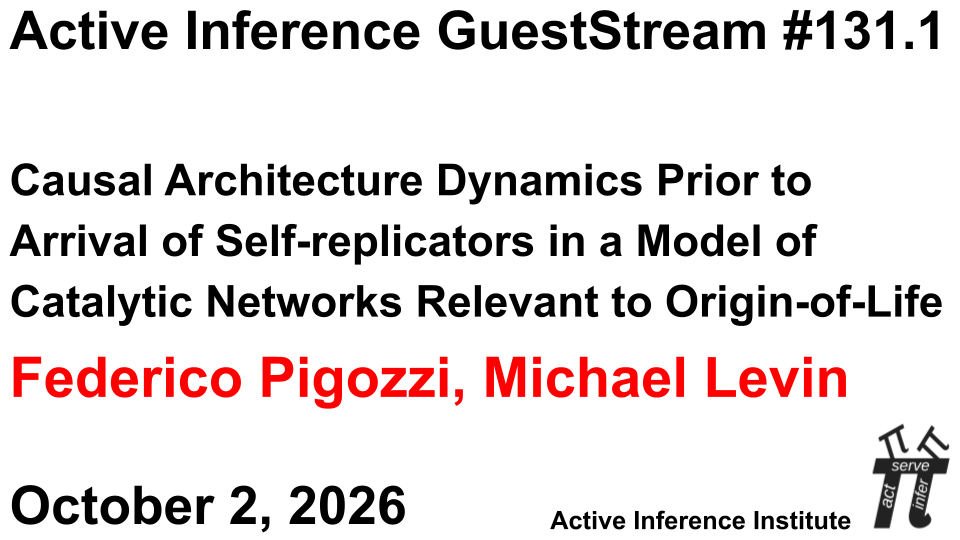
GuestStream #131.1 ~ 10/2/2026 at 14 UTC
Federico Pigozzi, Mike Levin @drmichaellevin
Causal Architecture Dynamics Prior to Arrival of Self-replicators in a Model of Catalytic Networks Relevant to Origin-of-Life
https://t.co/jmKVmCr2md
The Active Inference Institute is currently seeking applicants for the 2027/28 Board of Directors! Our board provides formal governance and oversight for the Institute as a non-profit organization, and in doing so serves the accessibility and applicability of Active Inference. In addition, we are a working board for a (mostly) volunteer organization, and require each board member to serve on a committee dedicated to institute development. If you would like to be considered, please complete this form before November 1st, 2026. Additionally, if you know someone who would be perfect for this role, feel free to pass this opportunity along to them.
More information: https://t.co/4I2qgmSr9R . Application form: https://t.co/sSQHKfh8mi .
Do you have scientific or technical expertise you'd like to contribute to an open research and education community? The Active Inference Institute is accepting applications for its Scientific Advisory Board, a volunteer role that works alongside the Board of Directors and Officers and focuses on scientific direction and rigor. We welcome applicants from across the fields that Active Inference touches.
Details are at https://t.co/XLqUt6ulQK and the application is at https://t.co/9YDv1Htab0
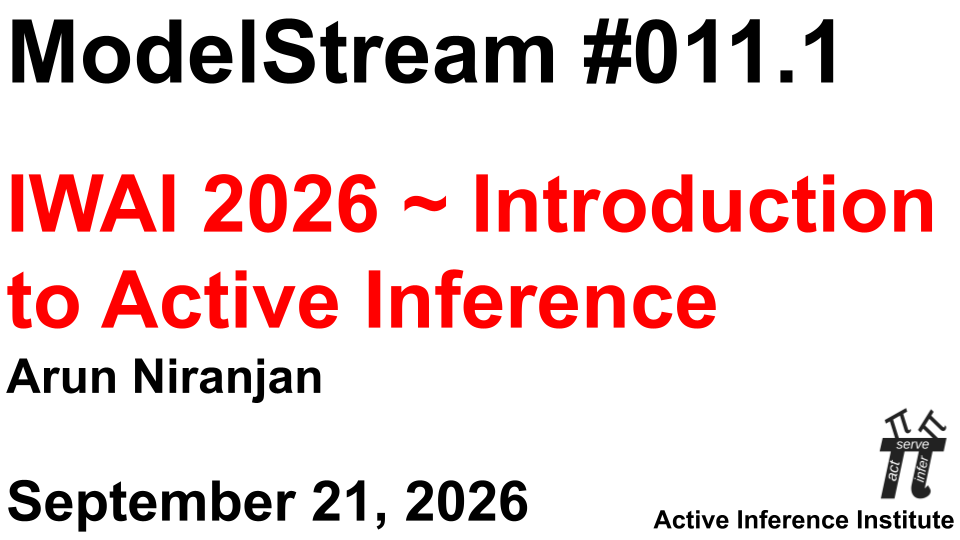
Arun Niranjan is hosting a free online tutorial ahead of IWAI 2026 "Introduction to Active Inference"
Monday 21 September at 14 UTC. Live online session, streamed publicly on YouTube: https://t.co/xwQrglCVuN
Information on IWAI, October 14-16, 2026 https://t.co/lJQDBodY5R
Arun Niranjan is hosting a free online tutorial ahead of IWAI 2026 "Introduction to Active Inference"
Monday 21 September at 14 UTC. Live online session, streamed publicly on YouTube: https://t.co/xwQrglCVuN
Information on IWAI, October 14-16, 2026 https://t.co/lJQDBodY5R
GuestStream #131.1 ~ 10/2/2026 at 14 UTC
Federico Pigozzi and Michael Levin @drmichaellevin
"Causal Architecture Dynamics Prior to Arrival of Self-replicators in a Model of Catalytic Networks Relevant to Origin-of-Life"
https://t.co/jmKVmCr2md
Paper: https://t.co/OcIEdgPqhl
🚀 Excited to share a major update to the Active Inference Journal! We’ve launched a new interactive web portal spanning 573 items and 744 video sessions from the Active Inference Institute library: https://t.co/mHjYez7lZ4
Key features:
• Interactive Video & Transcripts: Click any dialogue cue or timestamp to seek the video to that exact second in real time.
• Chapters & Deep Search: Navigate timestamped discussion topics and search across all titles, speakers, and series in seconds.
• One-Click Transcript Export: Copy clean, speaker-labeled text directly to your clipboard.
Explore the live site at https://t.co/mHjYez7lZ4 and check out the open-source data and pipeline on GitHub at https://t.co/W9U7l9RQQe