🚨 Since 2009, a Bluetooth peer could oops the Linux kernel by asking for a retransmission window of zero frames. The fix became CVE-2026-99807 today, alongside a second remote L2CAP crash, CVE-2026-99806.
Here's how it works:
In L2CAP's Enhanced Retransmission Mode (ERTM), each side tells the other how many unacknowledged frames it may send, the TxWindow. The spec allows 1 to 63. The kernel stored whatever the peer put in its configuration request without checking it.
A TxWindow of zero later reaches l2cap_seq_list_init(), which calls roundup_pow_of_two(0). That result is undefined, and on some architectures the sequence list becomes a ZERO_SIZE_PTR and the kernel oopses, all from the remote side. Values above 63 were accepted too, letting the kernel send more unacknowledged frames than 6-bit sequence numbers can tell apart.
CVE-2026-99806 is the same family. A peer answers the configuration of an already connected channel with a different mode, for example Streaming to ERTM. The kernel switches the channel mode but never allocates the ERTM sequence lists, so the next out-of-sequence I-frame writes through a NULL pointer.
Both are crashes, not code execution, and nothing says they are exploited. The attacker needs a Bluetooth connection in radio range to a channel running ERTM or Streaming mode. Basic-mode channels never reach this code, and the announcement does not say which profiles expose it before pairing. Android uses its own userspace Bluetooth stack, so this is BlueZ Linux: desktops, laptops, Raspberry Pi and embedded boards. Both bugs date to 2.6.32.
Fixed in 5.10.275, 5.15.226, 6.1.193, 6.6.163, 6.12.117, 6.18.63 and 7.3.4. The kernel now rejects a bad TxWindow with UNACCEPT and proposes the default, and refuses mode changes on connected channels. If you can't update yet, the bluetooth.disable_ertm=1 module option stops the kernel offering ERTM and Streaming at all.
https://t.co/uZtmGZ0CgG
🚨 https://t.co/SvsFQQJQV0, the package registry behind Elixir, Erlang and Gleam, was breached on Nov 23 through unauthenticated POST requests that turned its own error reporting into OS command execution.
CVE-2026-129514, CVSS 10.0. The bug had been in the registry code since February 2016. The team blocked the traffic and shipped a fix within 20 minutes, and an outside report of the exact same flaw landed in their inbox 36 minutes after the patched build went live.
Here's how it works:
https://t.co/VbBlBtIpxN accepts request bodies in Erlang term format. That parser ran before routing and authentication, so any POST to any route reached it. It used Plug.Crypto's non_executable_binary_to_term in safe mode, which refuses functions and new atoms but never checked maps.
An Elixir struct is just a map with a __struct__ key naming a module. So the attacker could hand the server fake structs of any loaded module, with every field set to whatever they wanted.
Plug.MethodOverride looked up _method on that struct and raised an error with the fake struct in the stack trace. Sentry and the loggers then call inspect on it, and inspect dispatches on __struct__, so the attacker chose the next code to run: Ecto.Query.DynamicExpr, whose Inspect enumerates a binding field without checking it is a list. In that field sat a https://t.co/N0cqfZAyrf, whose error path runs its :log option. That option was a module, function, args tuple from the request body, and db_connection applied it.
69 requests in 13 minutes ran commands on six web servers, three of them only because a restart brought up fresh nodes still on the old build. Hex found no modified packages and no database writes, but database reads are not logged, so emails, password hashes, API key hashes, 2FA secrets and sessions can't be ruled out. Every credential the attacker could have read has been rotated except the registry signing key and a few low-impact secrets, and the signing key waits on a new system that supports rotation.
Commit 379b0a2 now rejects any term containing a __struct__ key with a 400. Everyone was logged out. Change your https://t.co/VbBlBtIpxN password, set up a new authenticator app to get a fresh 2FA secret, and fetch only from https://t.co/xs3XNxww0O, not mirrors, until the new Hex client ships in the coming days. The same struct trick also worked on Ash keyset pagination cursors, fixed in ash 3.38.0 as CVE-2026-124283.
https://t.co/i1RtUaHMgY
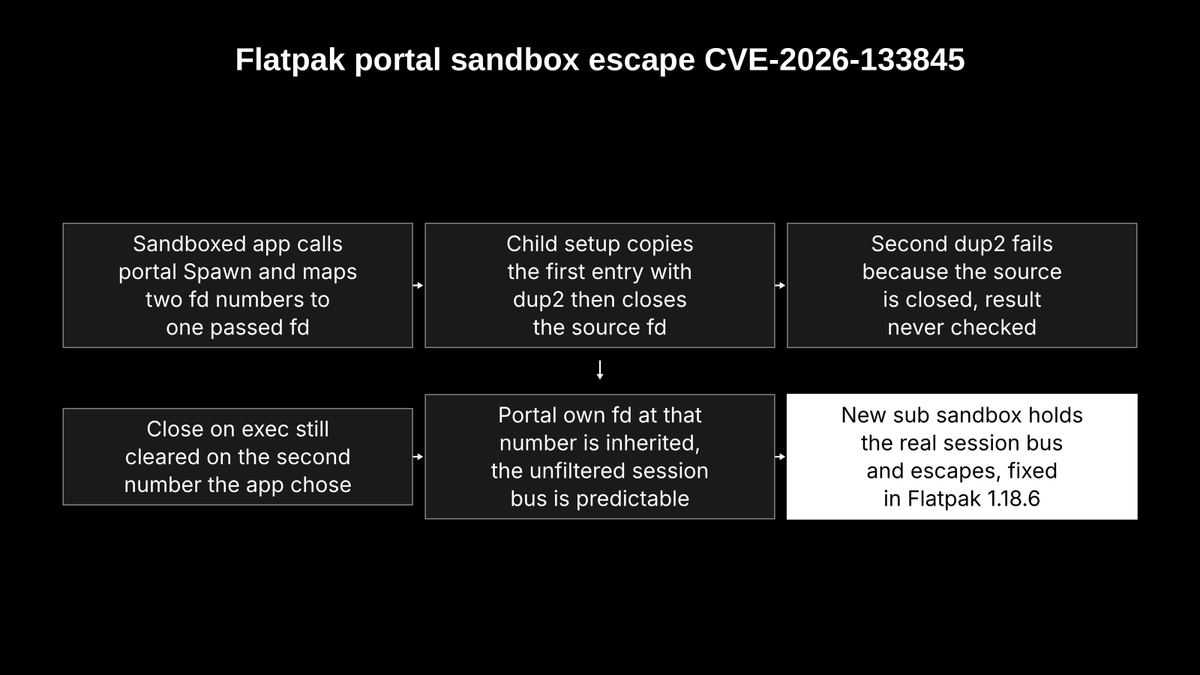
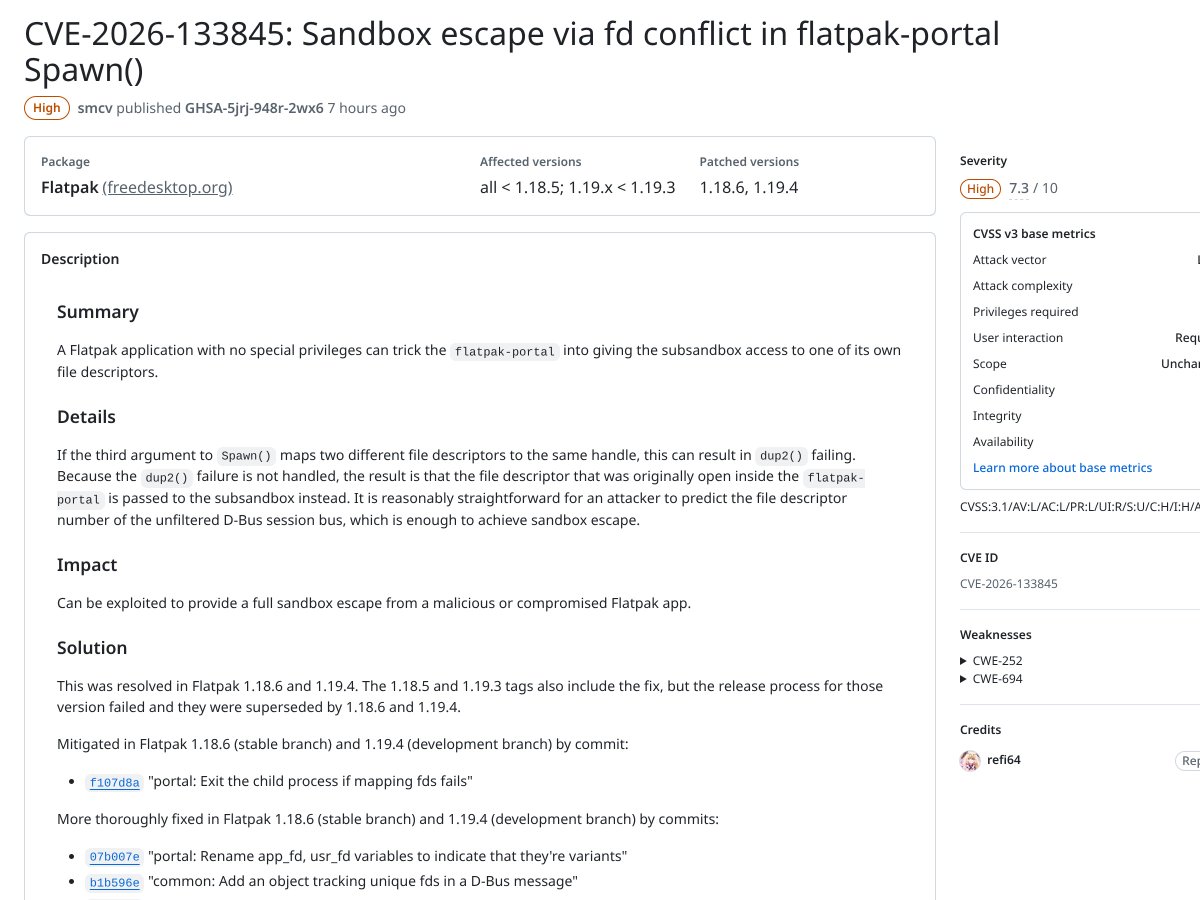
🚨 Any Flatpak app with no special permissions could break out of its sandbox by asking the Flatpak portal to start a helper process with the same file descriptor listed twice.
CVE-2026-133845, CVSS 7.3, fixed today in Flatpak 1.18.6 together with CVE-2026-133842, a separate bug that can leave a setuid root binary under /var/lib/flatpak. The sandbox escape was reported by refi64 on Nov 15, and the advisory says oz9un found it independently before it went public.
Here's how it works:
Sandboxed apps launch sub-sandboxes through flatpak-portal, a service that runs on the host. Its Spawn() call takes a map from fd numbers in the new process to fds the app hands over. Nothing stopped two of those numbers pointing at the same handed-over fd.
In the child setup code, the first entry is copied with dup2() and its source is closed. The second dup2() then fails because that source is already gone, and its return value was never checked. The code still clears close-on-exec on the second number, so whatever the portal itself had open under that number is inherited by the new sandbox.
The app picks that number. The advisory says the fd of the portal's unfiltered D-Bus session bus connection is easy to predict, and that is enough for a full escape, since sandboxed apps normally only reach a filtered proxy of the bus.
This needs a malicious or compromised app already installed and running, so it is a second stage, not a remote bug, and the advisory does not mention exploitation. The setuid bug needs a system-wide install, which by default takes an admin: the app's extra-data script builds a directory tree deep enough that Flatpak's permission cleanup runs out of file descriptors and leaves the setuid bit in place.
Update to 1.18.6, or 1.19.4 on the development branch. The 1.18.5 and 1.19.3 tags carry the fixes but their releases failed. The 1.16 branch only gets backported commits, no release, so Debian 13 and other LTS users should watch for distro updates. The portal now refuses an fd used more than once and kills the child if any mapping fails.
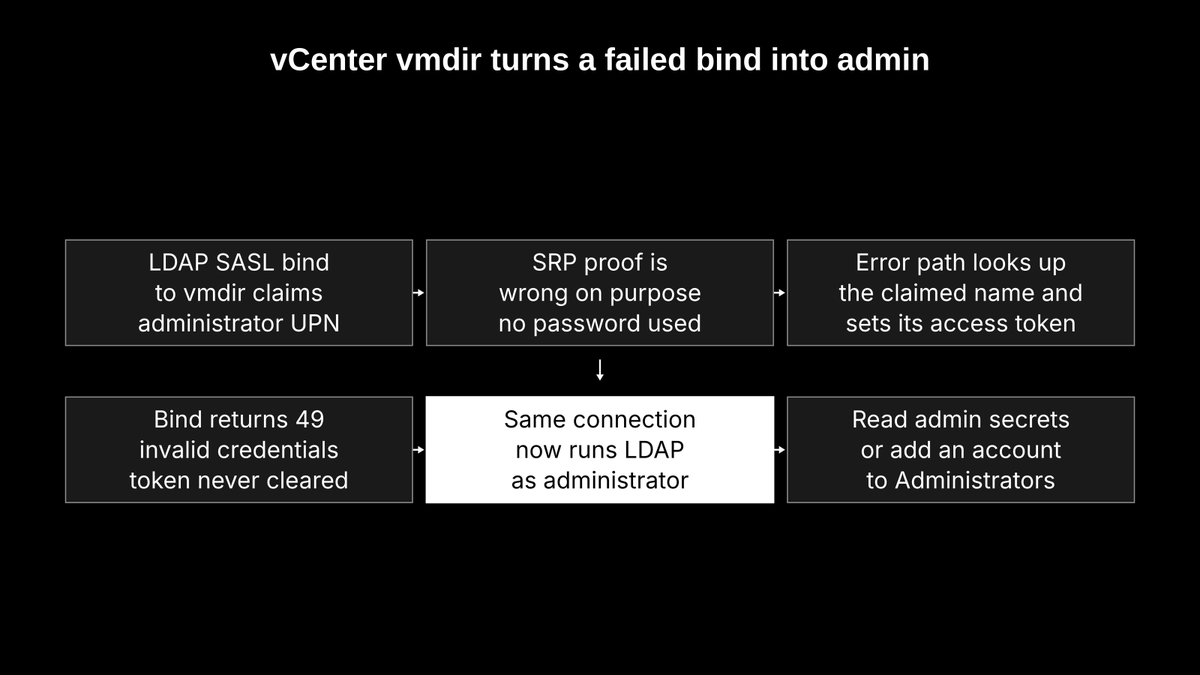
🚨 One deliberately failed login is enough to get an administrator session on VMware vCenter, and a public PoC for it went up within hours of Broadcom's patch.
CVE-2026-123903, CVSS 9.8, fixed today in VMSA-2026-0011. Broadcom credits sglab of QiAnXin, Qi Qin (@LeoQ7_) of depthfirst, and VulTeam and XGTP of ThreatBook, who reported it independently.
Here's how it works:
vmdir, the directory service inside vCenter, accepts LDAP SASL binds over SRP, and the client picks the identity it claims. Per the PoC write-up, when the SRP proof is wrong the error path still resolves that claimed name to its directory entry and copies the entry's access token, SID and DN onto the connection. It then tears down the SASL session without clearing them.
The server answers 49, invalid credentials, but the socket now acts as whoever was claimed. Claim [email protected], send a bad proof, and the next plain LDAP requests on that connection run as admin. The PoC uses this to read admin only attributes such as vmwSRPSecret, or to create an account and add it to cn=Administrators. A failed simple bind clears that state, which is why only the SASL path is hit.
The attacker needs network reach to vmdir's LDAP port on the appliance, 389 or 636 in the PoC. Broadcom has not reported exploitation of this bug and calls it distinct from CVE-2026-123890, the vmdir bypass ARMORY CASTLE used as a zero-day. The PoC was posted by @Dinosn at 12:42 UTC. The mechanism above comes from its write-up, not from Broadcom, and we have not run it.
Broadcom lists no workaround. Fixed builds are vCenter 8.0 U3m, 9.1.2, and the 9.0.2 express patch. If you already moved to 8.0 U3m for the zero-day, Broadcom's Q&A says you need nothing more for vCenter, but 9.1.x still has to go to 9.1.2. Keep vmdir and vCenter management off untrusted networks. The same advisory also patches two critical ESX bugs in the I/O filter service that let a network attacker run code on the host.
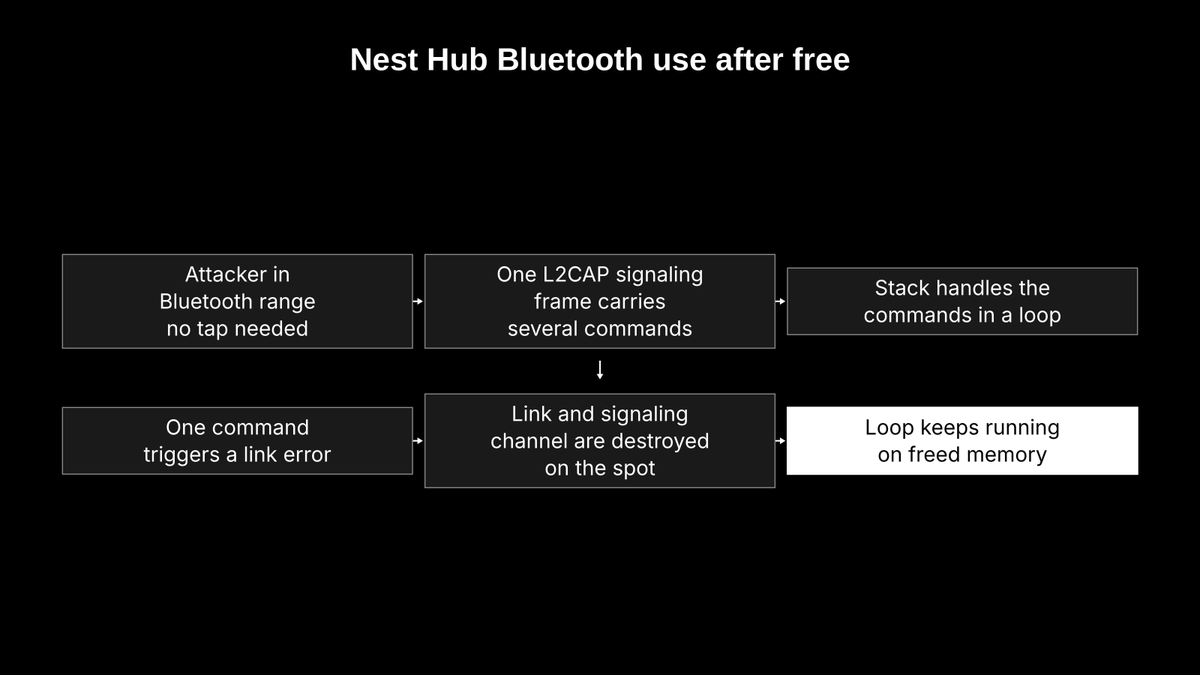
🚨 Google just shipped fixes for 11 Bluetooth bugs in the Nest Hub that it classes as remote code execution from radio range, with no tap or pairing prompt needed.
The November 2026 Nest Security Bulletin, published today, lists 53 CVEs for the Nest Hub (2nd Gen) and Nest Hub Max. 39 are in Bluetooth, and all 11 Bluetooth RCEs are rated High.
Here's how it works:
All 11 are use after free bugs, and most repeat one pattern: a callback destroys an object while the code that called it is still walking through it. The Hub's Bluetooth host stack, Sapphire, is open source in Google's Pigweed repo, so the fixes can be read.
In CVE-2026-95421, a single L2CAP signaling frame can carry several commands, and the stack handles them in a loop. If one command triggers a link error, the link and its signaling channel are destroyed on the spot, and the loop carries on over freed memory. The fix checks that the channel is still alive after every command. CVE-2026-95418, CVE-2026-95451 and CVE-2026-95464 are three more variants in LogicalLink::SignalError, where closing a channel can delete the whole link mid loop.
The pairing bugs are subtler. In passkey entry pairing, each round commits to one passkey bit using both public keys. Sapphire rejected a peer that echoed Sapphire's own public key back, but not one that sent the negated key, which shares the same X coordinate. That let the peer work out the passkey bit by bit (CVE-2026-95460). Other fixes stop a bond being marked authenticated without authenticated pairing (CVE-2026-95420), stop cross transport key derivation from swapping an authenticated LE key for a weaker one (CVE-2026-95427), and stop an unauthenticated nearby device being saved as the audio output (CVE-2026-95458). On the Cast side, two bugs let local code switch off the camera streaming LED (CVE-2026-95432, CVE-2026-95457).
Google has published no exploit, no CVSS scores and no reports of attacks, and each CVE gets a one line description. Nobody has shown publicly that these use after free bugs turn into working code execution on the Hub. An attacker has to be within Bluetooth range, and the passkey bug also needs a pairing in progress and user interaction.
Firmware F32.0.2 fixes all 53 and has been rolling out over the air since November. Hubs update on their own, and the bulletin links steps to check your firmware version. The L2CAP fixes have been public in Pigweed since September 24, so anyone reading the diffs has had two months.
🚨 Bluetooth2Shell is not a real exploit. The "CVE-2026-9001, one pairing prompt to root in under 3 seconds, CVSS 10.0, all platforms" advisory circulating this morning is a parody, and the site says so in its own footer: "This page is satire in the shape of an advisory, written so you will think twice about a pairing prompt."
CVE-2026-9001 does not exist. As of 11:52 AM ET today the https://t.co/nOR88jVsye API returns CVE_RECORD_DNE for it and NVD returns zero results. There is no vendor advisory, no BlueZ, Apple, Microsoft or Android bulletin, and no PoC repository. The "bt-shell v1.3.0" terminal on the page is a scripted animation baked into the page's JavaScript.
The tells are in the text. The claimed chain is pair with PIN 0000, read the SDP record, open the Serial Port Profile over RFCOMM, and the host "binds the channel to a pseudo-terminal" that lands in a root PTY. No mainstream stack attaches a shell to an incoming RFCOMM channel by default, the affected table covers Linux, macOS, Windows, iOS and Android at once with no versions or commits, and the car stereo row says it is "now playing .bash_history".
It is the latest entry in the everything2shell joke-domain run. @aacle_ shared it at 4:56 AM ET and later posted that it was satire, but at least one news aggregator has already republished it as a real CVSS 10.0 disclosure, and small accounts are posting the CVE number with hashtags as if it were live.
Don't add CVE-2026-9001 to scanners, tickets or exec briefings. The site's mitigations, declining pairing prompts you didn't start and disabling unused RFCOMM and SPP services, are ordinary Bluetooth hygiene and not a response to a real bug.
https://t.co/JDDdspIwnh
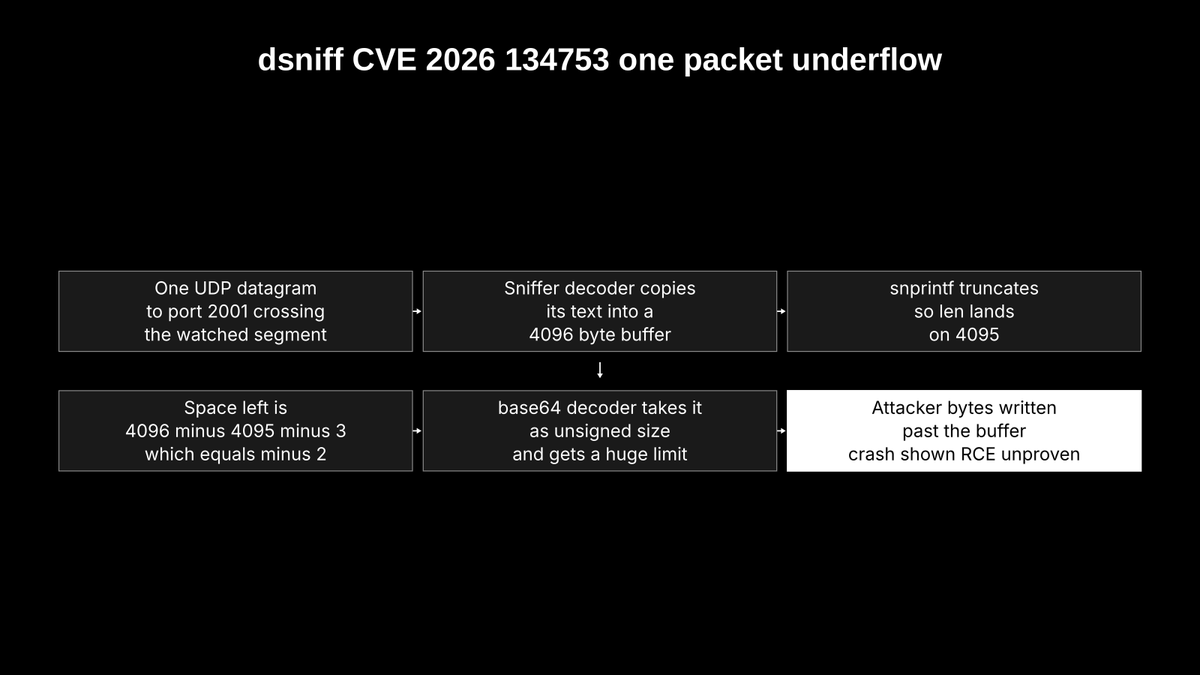
🚨 dsniff, the classic password sniffer still packaged in Kali and Debian, can be knocked over by a single UDP packet that merely crosses the network it is watching, and the same packet writes attacker-chosen bytes past a global buffer.
CVE-2026-134753 (CVSS 4.0 8.3), reported today by Umut Sevinç (VulnSVNC) on the hackerschoice/dsniff tracker and published by VulnCheck.
Here's how it works:
dsniff runs a protocol decoder on every flow it sees. The one for the old Network Associates Sniffer protocol on UDP 2001 prints the packet's text into a 4096-byte output buffer with snprintf, then base64-decodes the same text into the space left, computed as olen - len - 3.
Send a string of 4096+ bytes and snprintf truncates, so len sits at 4095 and the space left comes out as -2. base64_pton takes that as an unsigned size_t, it wraps to nearly SIZE_MAX, and the decoder's own bounds check never trips. Content and length of the overflow are both attacker-controlled.
The packet does not need to be addressed to the sniffing machine. dsniff decodes traffic it only observes, so anyone who can get a datagram onto or across the monitored segment reaches the bug.
What is proven is a reproducible segfault from one datagram against the unmodified binary, built on Ubuntu 24.04 and sniffing loopback. Code execution is not demonstrated. The researcher found obuf sits right before the counters that bound bsearch over the decoder dispatch tables, which hold function pointers, so a hijack is plausible but unproven. The vulnerable lines date to a 2001 revision and are identical in Debian trixie's 2.4b1 package and in 2.5a2, the version now in sid.
No patched release yet; the repo's last commit is from December 2025. The issue proposes clamping the remaining length to zero before the base64 call and flags the same olen - len pattern in decode_oracle.c and decode_tds.c. Until then, treat a running dsniff as an exposed network service and only run it on segments you control.
🚨 The prompt leaks Dragos caught with canary tokens now have provider names attached, and none of the disclosed causes involved breaking a model. One was a loopback trust bug, one was a coding agent committing a token, one was a forwarding rule.
OpenRouter says it has off-boarded three providers, pulled 125 endpoints from Zero Data Retention eligibility and notified affected customers. It links write-ups from Phala, Together AI and Novita, but has not said which three it removed.
Here's how it works:
Phala: an attacker chained a legacy internet-facing service into management interfaces that trusted anything arriving over loopback and never authenticated the caller. That let them create unauthorized confidential VMs and take application credentials, then, on a new GPU server serving production traffic without full hardening, take over the inference VM and read requests while they were processed. Phala says to treat DeepSeek V4 Flash 0731 requests routed by OpenRouter between Oct 21 00:00 and Nov 8 05:35 UTC as exposed.
Together AI: an AI coding agent working on its public xorl repo committed a credential for a private Hugging Face repo of stored prompt samples from MiniMax M3, GLM-5.2 and Kimi K2.6 requests, mostly from June 24, July 4, 8 and 14. Scanning caught it and the commit was reverted, but someone grabbed the token in that window, downloaded the samples and tested credentials found inside. Five of them were Dragos canaries.
Novita: a forwarding path meant for specific customers was applied more broadly, so MiniMax requests from May 28 to Nov 11 could end up at MiniMax's official API, including traffic that came in through OpenRouter. The researcher saw URLs from test prompts being fetched, but none of the planted AWS keys were used.
Canary hits only prove what was sampled. Phala keeps a wider window than the two days its canaries confirm, Together is still reviewing what personal data sat in the samples, and not every affected provider has published anything yet.
If prompts sent through these routes in those windows carried keys, tokens or passwords, rotate them. Pin upstream providers instead of taking the default pool, keep secrets out of agent context, and plant a canary credential in your own pipelines so any use of it pages someone.
🚨 Any Dokploy org member who can create services can get root on the host, and the validator Dokploy added to stop exactly that only checks which characters you type, not which command you run.
A researcher posting as knell disclosed two paths on oss-security today, each self-scored CVSS 9.9 and tested on v0.31.2. No CVE or Dokploy advisory yet.
Here's how it works:
Dokploy builds the deploy script as "docker" followed by the compose service's custom command field, then runs it through /bin/sh or over SSH. The server runs as root and drives the host Docker daemon through /var/run/docker.sock.
After CVE-2026-72884 (shell injection through that same field, fixed in 0.29.13), sanitizeCommand rejects characters like ; | $ and backticks, and every segment after && has to start with "docker compose". The first segment is never checked. So "run --rm -v /:/hostfs alpine ..." passes untouched and becomes docker run with the host's root filesystem mounted read-write.
The second path skips the command field. A raw compose file is only checked for structure and written to docker-compose.yml as is, so privileged: true, a /:/host_root:rw mount and cap_add SYS_ADMIN all reach the daemon. The researcher says the structured editor rejects privileged: true, while the raw path has no such guard.
Both need a logged-in member, not owner or admin, with the create services permission (canCreateServices or a custom role) and access to one compose service. No unauthenticated path is claimed. This matters most on shared instances where teammates, clients or contractors get member accounts.
The latest release, v0.31.4 from Nov 17, and today's canary branch still ship the same sanitizeCommand logic. Until a fix lands, treat create services on a compose service as host root: take it away from anyone you wouldn't give SSH, and audit existing compose services for custom commands that don't start with compose or stack, and raw files with privileged, cap_add or host root mounts.
Good morning, we are releasing Upload2Shell - where you upload a file and get a shell.
We wrote about a single vulnerability that turned file uploads, email attachments, & even print jobs into remote code execution paths across Debian 13, Google, WordPress, Roundcube, etc...
🚨 A file named .png can hand an attacker a shell on servers that only wanted a thumbnail. Upload2Shell is a Ghostscript bug that escapes the -dSAFER sandbox, and https://t.co/ePmT2y4npM ran commands through Debian 13 CUPS, Roundcube, WordPress plugins and MediaWiki, and reached a Google document renderer too.
CVE-2026-125396 (CVSS 4.0 8.5), found by @PaulosYibelo and @pwn_ai, made public today.
Here's how it works:
Most apps never call Ghostscript themselves. Pillow, Imagick and some libvips builds sniff the bytes instead of trusting the name, so PostScript or EPS content uploaded as .png or .pdf goes to gs the moment the app crops, resizes or previews it.
Ghostscript loads parts of its fonts with a hidden PostScript helper, .putgstringcopy, which calls the privileged .forceput operator without checking its inputs. A crafted Type 1 font swaps a string on the stack for an array, so the copy just before .forceput dies with a typecheck. The document's own error handler pops the leftovers, pushes a dictionary, key and value of its choosing, and lets the helper carry on into .forceput.
That write leaves a global dictionary pointing at a local object across save and restore. Restore frees the object, new data lands in the same memory, and the stale reference turns into a read and write window on live interpreter structures. The PoC walks pointers from the current device to the path_control_active flag, writes four zero bytes, and file and command access open up while -dSAFER is still on the command line.
Every route needs software that actually renders untrusted files: an anonymous IPP job to a shared CUPS queue (ran as lp), a Roundcube message view with the ImageMagick delegate (www-data, no click), public upload fields in Forminator or Essential Addons for Elementor, wikis that take anonymous uploads. WordPress core needs Author or upload_files rights. Commands run as the rendering user, product PoCs are not public yet, and AppArmor stopped the shell in https://t.co/ePmT2y4npM's enforced Plesk test. PHP GD, OpenCV, prebuilt Sharp and Java ImageIO never started Ghostscript in their tests.
Ghostscript 10.08.0 (Sept 8) fixes it. Debian 13 has 10.05.1~dfsg-1+deb13u3, Debian 12 got DLA-4914-1 on Nov 17 (10.0.0~dfsg-11+deb12u9), and Ubuntu covered seven releases in USN-8949-1 on Oct 21. As of Nov 12 Amazon Linux was pending and several SUSE branches were still open. Check the gs your containers really ship, block PS, EPS and PDF coders in ImageMagick's policy.xml if you don't need them, and pass an explicit formats list to Pillow's https://t.co/sfrhYWpxGe.
🚨 AMD Zen 1 and Zen+ CPUs have a flaw in the PSP boot ROM, the first code the chip runs, that lets modified firmware skip signature checks. AMD says it will never be fixed because that ROM can't be changed.
CVE-2026-74127 (CVSS 4.0 9.4), found by Matteo Rizzo of Google. AMD's CVE record went live this morning and lists EPYC 7001 and EPYC Embedded 3000 server parts with "No fix planned".
Here's how it works:
The PSP is an Arm Cortex-A5 inside the CPU that starts before the x86 cores and loads its bootloader from the BIOS SPI flash. The boot ROM copies the bootloader header to SRAM address 0x0 and its body to 0x100, then checks the RSA signature.
When that check fails, the ROM leaves the SRAM as it is and falls back to the recovery bootloader. A module's type is recorded only in the flash directory, which is unsigned, so any AMD-signed module can be dropped into the recovery slot.
Google found AMD-signed "donor" modules that have zero signed body bytes and a load address of 0x100. The ROM loads only the donor's header and signature, the signature verifies because it covers just the header, and execution jumps to 0x100, where the tampered bootloader body is still in memory. The PoC then switches off signature checks for every PSP module loaded after it.
This is a variant of Masterkey (CVE-2018-8930), the CTS Labs bug from 2018 that could be fixed with a BIOS update. The new one lives in the ROM.
An attacker has to rewrite the SPI flash. Google says software can do that with no physical access, and AMD says it depends on the platform. The public PoC targets one BIOS version for an MSI X370 board. Google confirmed it on a Ryzen 5 1600X and a Ryzen 7 2700X and has not tested a Zen 1 EPYC. Zen 2 and later are not affected. Once in, the attacker has persistent code on the most privileged core in the machine, with access to all RAM and nothing visible to the OS.
No patch is coming. On Zen 1 and Zen+ systems, restrict who and what can flash firmware, enable any BIOS write protection the board offers, and reflash a suspect box from a known good image with an external SPI programmer. Treat PSP-backed guarantees such as SEV attestation on EPYC 7001 as broken, and move sensitive or confidential workloads to Zen 2 or newer.
https://t.co/fJggLhFdyR
🚨 A ransomware recovery firm whose website told victims "Do not pay the ransom!" allegedly bought decryptors from the gangs and billed victims for "proprietary" cracking. A responder who looked at one of its LockBit cases believes it also used its remote access to wipe the ransom notes.
RansomwareHelp's CTO and co-founder, Juan Ricardo Palacio Escobar, faces three counts of wire fraud in Rhode Island. KrebsOnSecurity named the firm tonight and published its 2024 chat with LockBit.
Here's how it works:
The pitch was brute force. A March 2024 proposal to an accounting firm hit by LockBit quoted $438,880 for "510 preconfigured forensic servers" and named SHA-256 among the encryption types it could break.
Then came a diagnostic fee and a demand for unrestricted AnyDesk access. Paul Ihme of Soteria says the network afterward held a single ransom note, recovered from a backup snapshot. Its ID opened LockBit's chat, where someone had already been bargaining for days and begging LockBit not to tell the victim.
The indictment says a Kansas software company hit in January 2024 paid the firm $720,000, and Palacio sent about $445,000 in bitcoin to the attackers, while the victim got a signed "Recovery Certificate" swearing the firm had never contacted or negotiated with anyone over a ransom.
In June 2026 the FBI ran both ends. Agents invented a Rhode Island victim, encrypted its files themselves and played the gang. Palacio emailed them from Proton Mail quoting the note's victim ID, asked for the lowest possible price, talked 0.2 BTC down to about $6,000 and billed the fake victim $16,010.
All of this is alleged in an indictment, with no conviction. The note-wiping comes from Ihme's review of one 2024 case and is not one of the charges.
If you bring in a recovery or negotiation firm, keep your own copy of the ransom note and victim ID, insist on the full chat transcript, and give remote access only through a session you watch. Working decryptors come from crypto flaws or seized keys, not server farms, so a big "decryption" quote for a current strain usually means someone is paying the gang.
https://t.co/QlDj3dszHI
🚨 A phone call from "IT", a fake SSO page, and the attacker's own MFA device enrolled minutes later. Unit 42 says Com-linked crews are running that loop against healthcare, finance and legal firms, then extorting them without encrypting anything.
New @Unit42_Intel report on Bling Libra (ShinyHunters) and two new clusters, Vortex (CL-CRI-1264) and Cinder (CL-CRI-1274).
Here's how it works:
The caller poses as internal IT fixing a login problem and sends the employee to a subdomain built for that one company, such as company.mfaregister[.]com. The page is an adversary-in-the-middle proxy, an AiTM kit like Doko's Panel, that relays the password and the MFA approval to the operator in real time.
Vortex enrolls its own MFA device within minutes, in several cases the same phone named Pixel 10a across different victims, then scripts bulk pulls of Microsoft 365 mail, OneDrive and SharePoint. Cinder avoids new Duo prompts by replaying a "keep me signed in" session token from proxy servers. The ransom note shows up as Teams messages to staff pointing to a Tor negotiation site.
Another cluster, Helix (CL-CRI-1192), had victims sideload an extension named "Google Chrome" in Developer Mode. It drives the browser through chrome.debugger for hidden screenshots, keystrokes, clipboard and cookie theft, and the name makes Chrome's "Google Chrome started debugging this browser" banner look routine. Kevin Pham first documented it in September, and Unit 42 found a second build talking to the same C2.
Unit 42 names no victims and gives no victim count. The full relay sequence comes from one financial services case and stops at an MFA number-match prompt, which Unit 42 calls a likely session capture. Healthcare overtook finance as the top target in September, and Australia went from under 1% of targeted subdomains to about 13% in October.
FIDO2 keys or passkeys break the relay because the credential only works on the real domain. Tighten help desk identity checks, review every new MFA device registration, allowlist browser extensions, and alert on bulk Graph exports from python-requests or kiota user agents. The report lists 56 lookalike domains to block, such as installpasskey[.]com and ssosettings[.]com.
https://t.co/3V60ZV6OVG