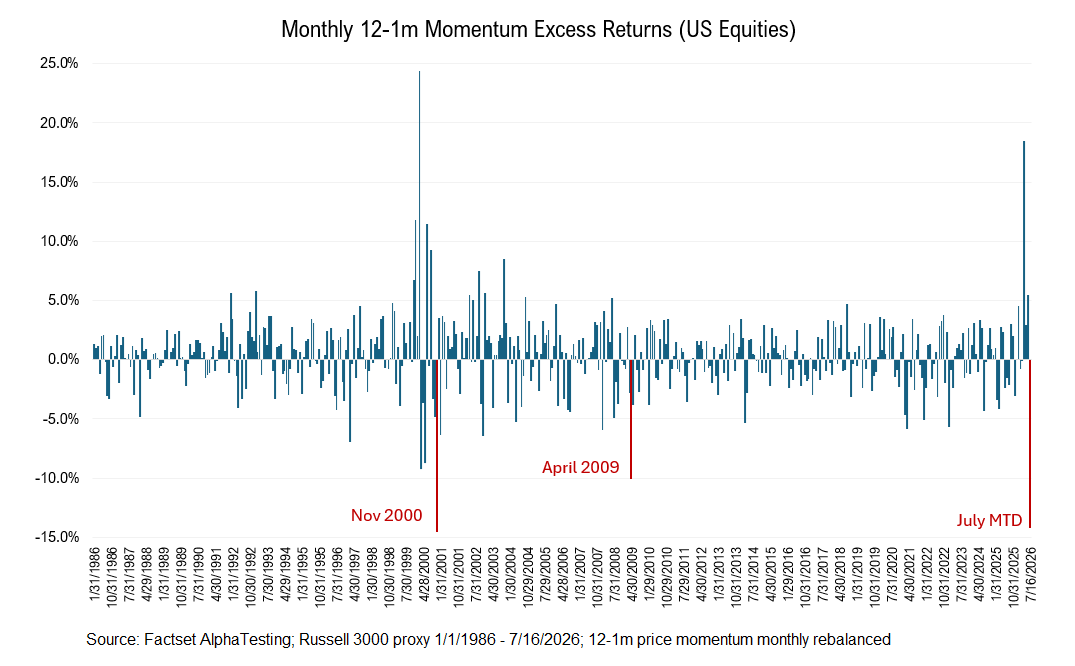
"Momentum tends to be stairsteps up and an elevator down."
So far in July, we're on the elevator. But history suggests these sharp reversals are typically short-lived and have frequently marked attractive entry points for long-term investors.
Yesterday I joined Charles Payne on @FoxBusiness to discuss the status of July's momentum unwind, whether the narrative is changing for AI stocks, and where we're finding new opportunities beyond AI.
Link to the full conversation: https://t.co/AYyXUrXxZI
If July were to end here, this would rank as momentum's worst month since the sharp reversals of 2009 and 2000.
Where do we go from here?
History provides a useful framework for thinking about what has typically followed. Looking at US equities back to 1986 where momentum underperformed by more than 5 percentage points, in the subsequent 1-year periods, momentum outperformed 77% of the time and by an average of more than 4 percentage points. Over the subsequent 3-year periods, momentum outperformed 85% of the time, averaging roughly 30 percentage points of cumulative excess return.
While every market cycle is different, these sharp reversals have often marked periods of opportunity.
https://t.co/bsyw7ZpR12
Humility can be a powerful investment advantage.
Many investment mistakes stem from the belief that success belongs to those who can see further, analyze deeper, and forecast more accurately than the crowd.
Momentum investors take a different approach.
We don't try to predict the future. We don't attempt to call tops or bottoms. We don't claim to know what's next.
Instead, we follow the evidence, adapt as conditions change, and let the market guide us.
When the future is unknowable, discipline beats prediction.
More on what I know, and do not know, here 👉https://t.co/snRUCaaZa0
Trucking stocks have been catching a bid.
Fewer trucks, firmer pricing, and growing demand tied to infrastructure spending have created a strong backdrop for freight.
One thing worth watching: Amazon's ($AMZN) expanding freight business. As Amazon evolves from a major customer into a larger transportation provider, the question becomes: will it be a meaningful disruptor or simply another participant in an increasingly healthy market?
Why does one of investing's most persistent truths remain so controversial?
Across decades of academic research, market cycles, geographies, and asset classes, momentum remains among the most persistent and empirically validated investment factors ever observed.
Yet despite the evidence, it is still frequently viewed with skepticism and discomfort within institutional investment circles.
My thoughts on momentum being one of the great ironies in modern finance: 👉https://t.co/2e4iLYB5Cc
Hotel stocks aren't acting like the economy is slowing.
The story isn't broad consumer strength. It's a resilient affluent traveler, recovering corporate demand, and one of the tightest hotel supply environments in more than a decade.
That combination is creating meaningful pricing power across the industry.
See who is benefitting 👉https://t.co/deI1miYd0F
Momentum doesn't become dangerous simply because it's working. The bigger risk comes when investors assume today's leaders will remain tomorrow's leaders.
I recently spoke with @MarketWatch about the historic run in momentum stocks, what's driving it, and where investors should be paying attention as market leadership evolves.
As trends accelerate, it's increasingly important to distinguish between fundamental business momentum and crowded trades - and to have a process that can adapt when conditions change.
https://t.co/aBJfvEzZie
Can you actually build that?
The next AI bottlenecks are emerging far below the application layer — inside the manufacturing stack required to produce increasingly complex semiconductors.
As AI capex accelerates, demand is cascading downstream into advanced packaging, EUV lithography materials, process chemicals, specialty substrates, and precision assembly equipment.
These are deeply process-qualified technologies with high switching costs, concentrated supplier bases, and growing strategic importance to the entire AI infrastructure buildout.
The market is starting to recognize that scaling AI is no longer just about designing faster chips.
It’s about whether the industry can physically manufacture them at scale.
See where the next supply chain constraints are building 👉https://t.co/Tz6dzjSUj8
Appreciate the opportunity to join Charles Payne on Fox Business Network “Making Money” to discuss some of the emerging themes developing across the AI ecosystem.
As AI capex cascades downstream, we’re seeing new bottlenecks and beneficiaries emerge - from specialty chemicals and materials enabling advanced semiconductor and memory packaging, to edge compute and security companies benefiting from rising AI agent traffic.
At the same time, the growth of agentic and voice AI is increasing the importance of communications and API providers embedded in customer interaction workflows.
One of the most important aspects of this market environment is tying leadership back to improving fundamentals and understanding the rationale behind what’s working.
We look at what’s happening in the market and then seek to understand why.
That ordering matters. Many investors begin with the explanation and then look for prices to confirm it.
Informed Momentum starts with market behavior and then tries to understand the message.
Thank you to @practicalquant for doing an excellent job capturing the philosophy behind our process and why adaptability is so crucial in today’s markets.
Click below for a great recap of our conversation on the Excess Returns podcast.
https://t.co/SQZLsOMIHZ
Call a customer service line today, and it’s increasingly unclear whether you’re speaking to a human or AI.
Behind every AI-driven conversation sits infrastructure that is difficult to replicate.
AI can generate the agent, but not the telecom networks, carrier relationships, phone-number inventory, compliance, or deliverability required to reach customers reliably.
That's where communication platforms sit. And the companies that own the flow of AI communication are seeing real momentum.
More here 👉https://t.co/E8phuDyJFf
Turnover is often thought of as something to minimize in the name of discipline or efficiency.
But what if that framing is wrong?
In markets that evolve as quickly as today’s, low turnover can just as easily signal rigidity as it does conviction.
Turnover isn’t simply a cost to control - it’s how portfolios adapt. How weakening trends are exited. How capital is reallocated toward emerging leaders.
In other words, it’s how investors stay aligned with what’s working now, not what worked before.
A portfolio that rarely changes assumes a level of permanence that markets rarely grant. One that evolves acknowledges reality.
In environments defined by change, the ability to respond deliberately and systematically is essential.
More on this here 👉https://t.co/LWWlYN7amY
Momentum is not anchored in what SHOULD be working - it's flexible to follow strength to what is ACTUALLY working.
For this reason, momentum is a key ingredient in a balanced portfolio. Putting together factor exposures that have shown to outperform at different times in the cycle - like momentum, value and quality - increases the likelihood of success over the long-term.
In this conversation on the Excess Returns podcast, we explore this idea in depth - as well as discuss the structural shifts happening in equity markets today and the implications those have for investors.
Full episode here 📺 https://t.co/C8lEeRbdwD
Lithium’s next leg isn’t about EVs.
Grid storage is emerging as the marginal buyer, driving a tightening market and creating clear winners among producers.
See who’s best positioned to capture the upside 👉https://t.co/fJPZmP5fd1
Absolute pleasure to join @CNBC's The Exchange to discuss what’s behind the extreme divergences in today’s equity markets.
Two structural shifts appear to be underway:
- AI moving from narrative to real-world disruption
- A shift away from globalization toward trade rebalancing and US reshoring
From our perspective, these forces aren’t operating in isolation – they are reinforcing one another, with meaningful implications for market leadership.
We’re seeing a broadening beyond technology into industrials, energy, utilities, financials, and materials, alongside significant dispersion between winners and losers. Notably, these trends have largely remained intact despite March volatility.
From a momentum perspective, success depends on identifying these shifts early—and adapting as they evolve.
If you missed it, here’s the full segment → https://t.co/6omZ6YlhyQ
How important is price level in momentum investing?
Our latest factor research paper explores a simple but powerful idea: where a stock trades relative to its 52-week high.
Across global equity markets, we evaluated different measures of a stock’s proximity to its 52-week high to test whether this measure:
- Stands on its own as a predictor of returns
- Captures a substantial portion of the momentum effect
- Enhances outcomes when combined with traditional price momentum
The results suggest price level matters more than many assume.
Full paper available here👉https://t.co/lNBW7SulRv