@northernassist can you give an update on when a train can be expected from St Annes on the sea https://t.co/4ZzZfnwO00 Preston? Also the announcements on the tannoy are inaudible. Thank you
🤩 The Mystery of Uranus: The Upside-Down Planet 🛰
In 1986, Voyager 2 captured Uranus, the planet with the strangest seasons in the Solar System. Due to its axial tilt of nearly 98°, the poles are plunged into darkness for 42 years, followed by 42 years of daylight. Imagine a polar night lasting decades!
Although an unusual Peter Brook subject, ‘Heading for the Humber’ has many of the hallmarks often associated with his Pennine winter landscapes, the painting dominated by an expanse of sea and sky, empty save for a single ship and overwhelming the tiny figures of Peter and Shep.
Jupiter’s Polar Aurora, Captured by Hubble This breathtaking image from NASA’s Hubble Space Telescope reveals a dazzling aurora blazing across Jupiter’s north pole — a cosmic light show of almost unimaginable scale.Jupiter’s auroras are up to 1,000 times more powerful than those on Earth. While our Northern Lights are beautiful, Jupiter’s version is a violent, high-energy spectacle driven by the planet’s colossal magnetic field (20,000 times stronger than Earth’s) and its rapid 10-hour rotation. High-energy particles slam into the upper atmosphere, creating glowing rings larger than our entire planet.
Unlike Earth’s auroras, which are mostly triggered by solar wind, Jupiter’s are also fueled by its volcanic moon Io, which pumps charged particles into the giant planet’s magnetosphere.Hubble’s ultraviolet observations peel back the layers to show these ethereal blue-white curtains of light in stunning detail — a reminder of just how wild and energetic our Solar System really is.
The Sun Has Just 22 Laps Left in Its Epic Galactic Journey
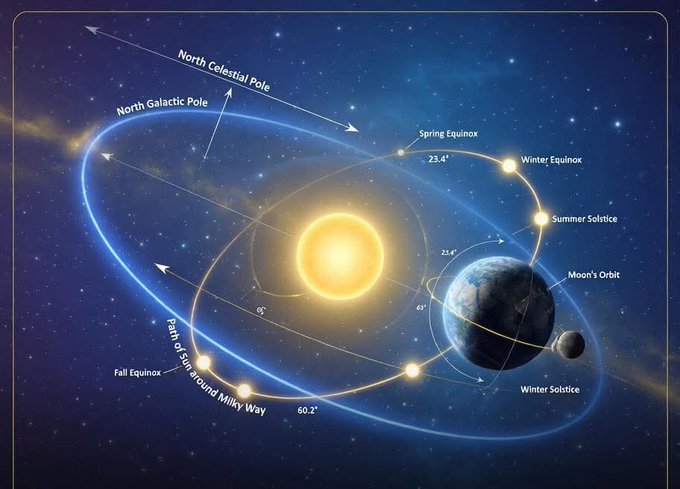
While we measure our lives in birthdays and calendar years, our entire Solar System is on a far grander voyage — one that makes Earth’s history feel like the blink of an eye.Our Sun is hurtling through space at 514,000 miles per hour (828,000 km/h), circling the center of the Milky Way once every 230 million years — a period known as a “cosmic year.” At that breathtaking speed, it takes roughly 230 million years to complete a single lap around the galaxy.The Sun formed 4.6 billion years ago and has so far completed only about 20 of these vast orbits. The last time our star was exactly where it is right now, the very first dinosaurs were just beginning to appear on Earth.Scientific models show the Sun is now middle-aged. With about 5 billion years of hydrogen fuel remaining in its core, it has roughly 22 galactic laps left before it swells into a red giant and eventually fades away. That gives our star a total lifetime of roughly 10 billion years.Think about that for a moment: all of human civilization — from the first cave paintings to space stations — has unfolded in just a tiny fraction of a single galactic orbit. While we obsess over decades and centuries, the Sun is silently carving a path tens of thousands of light-years long, weaving through spiral arms, star clusters, and interstellar clouds on a journey older than the dinosaurs and longer than anything our species will ever witness.We are passengers on a 10-billion-year odyssey that’s only halfway done.
Source: NASA . Our Galactic Home. NASA Solar System Exploration.
@TNLUK was there an issue with your app last night ( Tuesday 28 April 2026)? As I was unable to access from 7pm to buy a ticket for the Euro draw. Thanks