Really enjoyed talking robotics and where AI goes next with the @BBC AI Decoded team.
A wide ranging discussion from the World Humanoid Robot Games to world models, robot manipulation, uncertainty, data, deployment, and quite a bit in between.
And still so much more to say.
@oxdev_ox@AnsonISL@bschoelkopf@a2i_oxford@oxengsci@MPI_IS That's a fair distinction. But the paper's claim isn't about the substrate, it's about internal organisation. A model can be fluent in language w/o its internal repr. being structured around reusable, composable mechanisms. And language evolves. Often in ways we don't expect.
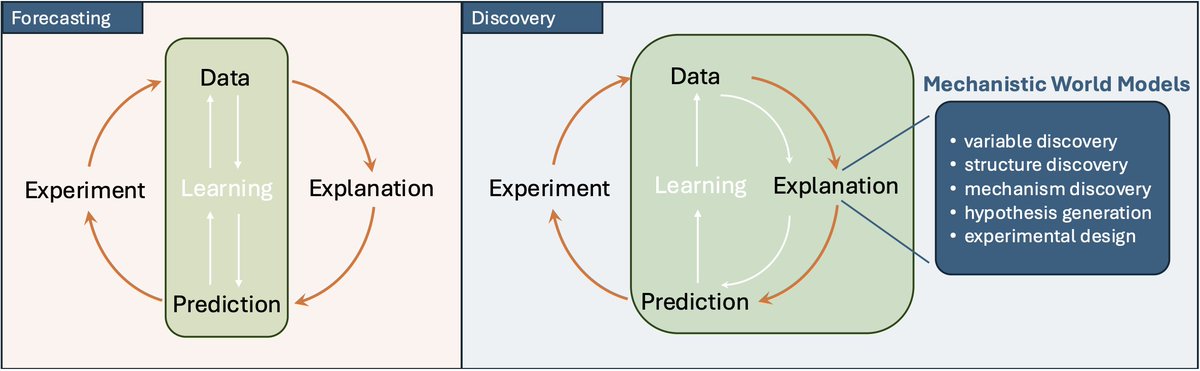
Introducing: Mechanistic World Models.
Scientific discovery is not just prediction. It requires uncovering the mechanisms generating what we observe. A capability current ML lacks.
With @AnsonISL and @bschoelkopf.
@a2i_oxford, @oxengsci and @MPI_IS.
https://t.co/YeTdE9crc9
@SarthakPar16@AnsonISL@bschoelkopf@a2i_oxford@oxengsci@MPI_IS Yes it does. Robotics is fundamentally about closed-loop interaction: acting, observing consequences, refining, which is exactly the 'active inquiry' side of discovery (experimental design), not just prediction. That framing carries over directly to MWMs.
@Melletenmoon@AnsonISL@bschoelkopf@a2i_oxford@oxengsci@MPI_IS We take discovery to mean uncovering a new causal structural regularity that was not already known with as broad an explanatory scope as possible. In that sense a mechanism generalises e.g. a physical law.
@Tsing967 @AnsonISL@bschoelkopf@a2i_oxford@oxengsci@MPI_IS Good question. Short version: a mechanism is a typed variable signature + transformation (or a function) reused across systems via bindings. Full formalisation (incl. the MWM tuple) is in Section 4.2. Eq. 4-8 has the details!
Delighted to be back at the @royalsociety#SummerScience Exhibition with a team of humans and robots, showcasing research from our @EPSRC Programme Grant on Embodied Intelligence and across the wider @OxfordRobotics Institute.
If you're in London this week, come and say hello!
Are world models the missing piece for truly dexterous tactile robots? 🤖
Great to join the @ARIA_research programme meeting on robot dexterity to discuss how predictive models perform in contact-rich settings.
#WorldModels#Robotics#ARIA@a2i_oxford@oxfordrobots
@ahmedkar_ Thanks! And I agree. Pixel-level prediction has been incredibly useful, but it’s often a poor proxy for relevance. What we’re really after is structure that reflects influence on behaviour, not fidelity of reconstruction.
A recurring theme in our recent work (e.g. SPARTAN): predictive world models become more interpretable when they help identify which parts of the input stream actually influence behaviour.
Learning what matters, not just what happens, is central.
https://t.co/TNzBoJ1URM
Very excited to share our new work - SPARTAN: A Sparse Transformer Learning Local Causation.
We develop a Transformer world model that learns local causal dependencies between entities, leading to improved adaptation efficiency and robustness with accurate prediction.
🧵
On my way to the 7th UK Manipulation W/s - a great way to start 2026! Over the years it’s become a premier UK meeting place for exchanging ideas across planning, control, and learning in robot manipulation.
If you’re attending, do come say hello.
https://t.co/eGQZYIUB55
Always look forward to CoRL - for the people, papers & workshops. Sadly have to miss it this year.
Delighted that @junjungoal & Alex Mitchell are there representing A2I - and @JankowskiJulius is presenting new work from our Amazon team! 🎉
See you next year!
NVIDIA’s £2bn pledge to UK AI startups is recognition that we don’t just use AI: we invent it, shape it & apply it.
As @UniofOxford researcher & co-founder of a successful AI startup, I was proud to be in the room. #AI#UKTech
🎓 Multiple faculty positions @oxengsci ! 🎓
We welcome applications from outstanding candidates in robotics, and especially if you are working in areas such as human-robot interaction, mechanical design, novel robotic sensor design and/or field robotics. Closing soon...🚀
Multiple faculty positions at University of Oxford in @oxengsci - Join Us!
Robotics - Computer Vision - Machine Learning
Faculty positions in Oxford are typically linked to a college.
Please repost!
Amongst my favourite research directions this year: understanding model complexity and its link to generalization and intelligence. Progress here could mean leaner models, versatile representations, and less reliance on data/energy. Excited that we’re off to the races on this!
I’m pleased to announce our work which studies complexity phase transitions in neural networks! We track the Kolmogorov complexity of networks as they “grok”, and find a characteristic rise and fall of complexity, corresponding to memorization followed by generalization.
🧵