Yoongi really went from “there’s no way they’re playing Hip Hop Phile” to absolutely vibing his heart out seconds later 😭
denial → realization → pure happiness 😂
The Recording Academy has once again started what looks like a desperate attempt at media play to save face.
First, they announced that they were reconsidering and revamping the Asian Pop category after BTS opted out. Then? Nothing. No actual changes, no concrete announcement, no explanation of what this “revamp” was supposed to look like. Submissions have now closed, and yet the category was allowed to move forward without the supposed changes we were told were coming. At this point, it is becoming increasingly obvious that the Academy wants to control the narrative more than it wants to address the actual criticism.
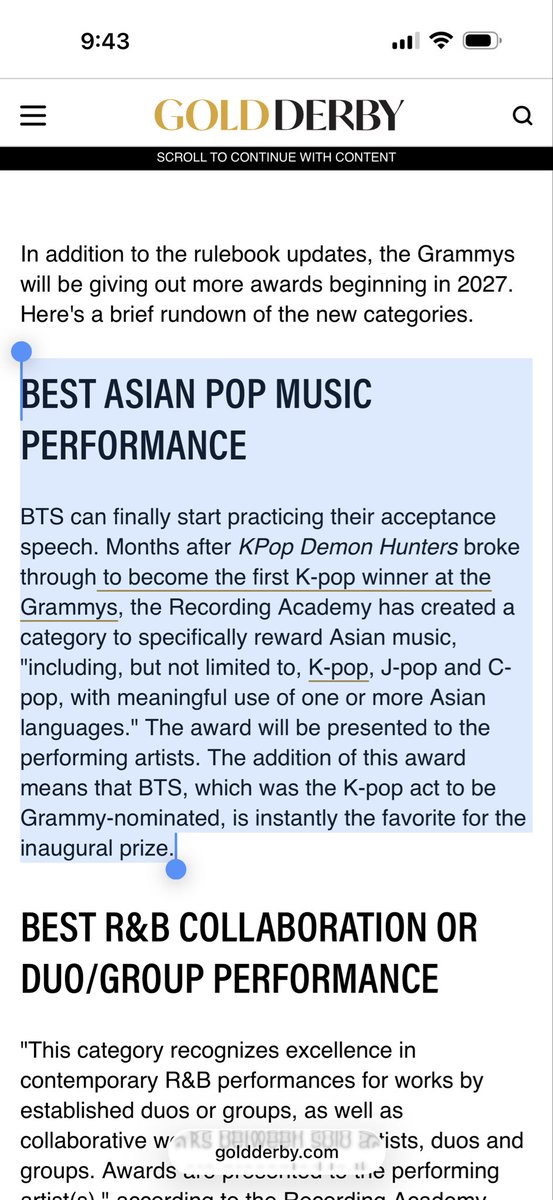
And now comes the media rehabilitation. Gold Derby published an article claiming that “K-pop fans in particular” saw the Asian Pop Performance category as a “consolation prize.” No. K-pop fans did not. ARMY did. And there is a very important distinction there. ARMY are the BTS fandom, and we have spent YEARS having to understand how the music industry works because we have had to deal with its categories, eligibility rules, language requirements, voting structures and everything else that surrounds BTS’s relationship with the Recording Academy or the industry in general. We know what we are looking at. We know why this category was created, how it was structured and why it was completely reasonable to question whether this was genuine representation or simply a way of placing Asian artists into a separate box.
What makes this article even more infuriating is the language used to describe BTS. It calls them the “prohibitive favorite” for this new category; understandable BUT then says that BTS “sided with aggrieved fans” and chose to boycott the Grammys altogether. Read that framing carefully. BTS are not being presented as artists who rejected being separated by geography and language. They are being presented as artists who listened to angry fans and walked away from an award they were supposedly guaranteed to win. That is an incredibly convenient way to rewrite what actually happened. It turns a legitimate institutional criticism into a story about supposedly unreasonable fans being upset because their favorite artists were not getting enough recognition. And I am sorry, but that is not neutral reporting. That is narrative management.
#ArtHasNoAliens
https://t.co/kTzI2xk1Qs
According to CBC Globe, cultural philosopher Prof. Lee Ji-young calls BTS’s Grammys move a “postcolonial act”, BTS didn’t just reject an award; they questioned the entire Western gatekeeping system: “Who gave you the authority to evaluate us?” The “Asian fence” just got hit hard.
Forbes article 👀👀👀 calling out Grammys bs category 😒again must read 👀
So when the Recording Academy created a new category for Best Asian Pop Music Performance this June, and BTS answered by declining to submit any music for the 2027 awards, the institution lost the artist its new category seemed built to honor.🙄😒
The skeptical reading of BTS's refusal deserves to be taken seriously. The group's biggest single from ARIRANG, "SWIM," was recorded entirely in English and would not even qualify for the new category. BTS has spent a decade building a global brand that treats K-pop as an origin rather than a boundary, and saying no to the Grammys may cost the group very little while strengthening BTS's own brand considerably.👀👀
The skeptics are right about the price and wrong about the meaning. Walking away rarely creates leverage. What it does, reliably, is reveal how much leverage someone accumulated before entering the room. BTS remains fully visible after saying no; most artists could not make the same choice without disappearing, which is why almost no one else can afford the gesture. Refusal, it turns out, is an audit. It exposes how unequally artists depend on the institution being refused.
What BTS holds instead of a trophy is an audience, and that audience is more than evidence of popularity. It is an independent constituency. The Recording Academy can decide whether BTS receives an award but it cannot withdraw the attention, amplification, revenue and cultural standing that millions of people provide entirely outside the Academy's control.
The group represented South Korea as cultural envoys, named its comeback album after a traditional Korean folk song, and posted the refusal itself in Korean; the members declined the category in the language. The dispute is about authorship, not identity. BTS naming an album ARIRANG is self-definition. An American institution sorting pop by market geography and language is institutional classification. From the outside, both point at the same identity. The power relationship inside them is not the same.
BTS did not become powerful by refusing the Grammys. The group could refuse because it had spent years building relationships and cultural meaning that the Grammys could not award and therefore could not take back. That is the practical question this story offers anyone working inside an institution: if your title, access and internal endorsement disappeared tomorrow, what would still move with you?
None of this means walking away is always wise. Refusal can be theatrical, self-serving or strategically useful, and BTS's decision may be all three. The point is that only some people can make the gesture without becoming invisible, and that difference is what refusal exposes.
At the Met five years ago, RM spoke about artists the world had not discovered. Today BTS is powerful enough to decline discovery on someone else's terms. 🔥🔥🔥👏Recognition measures the institution's judgment. What you can afford to refuse measures how much of your authority belongs to you
https://t.co/WuBB7MYsK5
FYI….👀👀👀 worth a read
It is time to break free from the Billboard and Grammy Awards, the two symbols of the American music industry that we have revered like sacred relics. Of course, reaching high chart positions and winning a Grammy is a gratifying experience, but is there really a need to obsess over them? Nor does the Grammy necessarily equate to honor and pride. For a long time, while the authority of the Grammys has been acknowledged, there has been strong public criticism regarding its awarding practices, which have been seen as leaning toward authoritarianism.
First of all, the awards have been stained by discrimination and exclusion. While favoring the songwriting style of Tin Pan Alley Pop established in the 1940s and 1950s, it has ignored new youth music like rock 'n' roll and hip-hop, as well as indie music. Elvis Presley, the King of Rock 'n' Roll whom they themselves worship as a national hero, was nominated 14 times during his prime in the 1950s and 1960s but never once lifted a trophy for music in that genre. It was not until 1968 that he received an award in the religious music category, which is practically considered a periphery. The Beatles were also underdogs of the Grammy Awards, and Elton John, like Elvis, only became a Grammy laureate belatedly in the 1990s . Legends such as Jimi Hendrix, Led Zeppelin, Queen, and David Bowie were rarely even nominated for a Grammy, receiving only "Lifetime Achievement Awards" after their disbandment or posthumously. Hip-hop artists and female singers also protested against the practice of being excluded from the main awards.
All that matters is music that is diligently crafted to enhance quality and that the artists enjoy. Isn't it enough if the music is truthful enough for people to see themselves in it and communicates with the times? Only by breaking away from the US and the Grammys will BTS be able to pursue music imbued with individuality and authenticity. Restoring their sense of self is the key. Music must come first as music for oneself, not for others.
https://t.co/KMsXM8miOJ
Atp even Inkigayo feels more honest than these so called big western award shows. At least there, we have a scoreboard. Here, it's just vibes, sponsors, hidden rules and "trust us".
The bar is not on the floor anymore. It's underground.
#ArtHasNoAliens@RecordingAcad
.@vmas, I’d genuinely love to know what the criteria are for Artist of the Year nominations, because how are artists who underperformed this year or simply just released an album getting nominated, while BTS, who literally had the biggest album of 2026 and one of the biggest songs gets overlooked? Make it make sense. Who is paying you? 😭
😂😂😂😂💀Gold Derby did a whole 180 💀💀 Went from “BTS can start practicing their acceptance speech” to “maybe the Grammys can kick the can on the Asian category, admit they messed up and hope BTS and the fans come back” 💀💀😂😂 my goated legends BTS only you could do this to Grammys🔥🔥🔥💜
From the article 😂😂👀
The simplest short-term solution to the Best Asian Pop Music Performance category controversy would be to say "Never mind!" Walk back the announcement, fall on the sword, and hope that a swift-ish response😒💀 to backlash is enough to bring some fans (and a certain group named BTS) back into the fold.🙄
At the moment, the Recording Academy has on their hands a new awards category that's been essentially invalidated by its top contender. The situation doesn't just hurt the Grammys, but also the potential victors. 😂😂😂😂If the Academy follows through with handing out Best Asian Pop Music Performance, the winner could be perceived as having an asterisk next to their win😂😂😂😂💀(they’ve been lurking on armytwt😂💀). Perhaps the most likely outcome for the category is a big pause button and a vague promise to fix it in the future... once the stakeholders are consulted
https://t.co/DPKP7IoftK
The @RecordingAcad issuing a statement so close to the deadline was nothing but damage control - a tactic to give media/artists the impression that they were genuinely deliberating, when they were just delaying
Scrap the category
Review all submissions as pop
#ArtHasNoAliens
No, se están yendo las que los idealizaron y llevaron al extremo su relación parasocial, las moralistas selectivas
Nos quedamos las que entendemos, las que nos estamos moviendo por ellos, las que vimos más allá de un error
@Catty_luv20 this is actually fake ragebait activism , its very much is an issue created out of non issue … week of bs and its stops by itself…i would say as an army since 2015 : 2016 was very hard because a lot of mayor stuff happened and we as fandom where small 2018 big and 2024 massive
@snowlovesjinrix@Catty_luv20 (2) 2016 blue house petitions ,calls into mma, black ocean , middle finggers project which trented and boys deffinetly seen , break wings project there is probably more … we truly felt we where drowning as fandom but learned to be organised due to all of it…
@snowlovesjinrix@Catty_luv20 (1)yeah but with that we got white paper project and clocked their asses, i feel like 2024 was worse life or death kind of situations ,but we organised done projects. Personally 2016 i feel was very f up year because we as fandom was still small and hate was bigger-
The Grammys' decision to scrap the proposed "Asian Pop" category immediately after BTS withdrew their submissions is a blatant admission of what critics have been saying for years: The Recording Academy does not care about celebrating Asian artists; they just want a "BTS Tax" to boost their tanking television ratings.
By folding the entire category the moment the biggest group in the world opted out, Harvey Mason Jr. and the Grammys exposed the entire initiative as a hollow, tokenizing stunt rather than a genuine attempt at inclusivity.
The Category Was Always a Ghettoization Strategy
Let’s call this what it actually was: an attempt to gatekeep the major categories. For years, the Grammys have faced intense backlash for shutting out non-Western global powerhouses from the "Big Four" categories (Album, Record, and Song of the Year, plus Best New Artist)
Creating an "Asian Pop" category was a transparent tactical move to herd BTS and other massive Asian acts into a separate, marginalized corner. It was designed to satisfy the demand for representation on paper while ensuring these artists would never compete for or win the prestigious main-stage awards
No BTS, No Clout, No Category
The fact that the category was discarded the second BTS pulled their submissions proves that the Recording Academy never actually cared about the incredibly diverse, booming Asian pop music landscape.
If this category was genuinely built to honor the rich, diverse world of J-pop, C-pop, and K-pop, the absence of one group shouldn't throw the entire Board of Trustees into a panic. By completely rethinking the category right before the August 21 submission deadline, By killing the category Mr Harvey Mason Jr. essentially admitted: "We only built this stage so BTS would show up, perform, and bring millions of viewers with them. If we can't exploit their fandom for ratings, the rest of the genre isn't worth our time."
BTS Called Their Bluff As They Should
BTS and their team made the ultimate power move by withdrawing. They refused to let themselves be used as token playthings for an institution that has historically weaponized nominations to milk K-pop fans for social media engagement, only to snub the artists during the actual broadcast.
By stepping away, BTS forced the Grammys to show their true colors. The immediate collapse of the "Asian Pop" category is embarrassing proof that the Recording Academy’s commitment to diversity is completely performative. It’s not about the music; it’s about the metrics.
The Grammys thought they could pacify Asian artists with a separate-but-equal category. BTS looked them dead in the eye, rejected the crumbs, and left them standing with an empty, embarrassing stage. It’s a legendary moment in music history and proof that BTS doesn't need the Grammys; the Grammys need BTS.
Major media outlets are seeing right through the Grammys’ attempt to save face 🤣🤣🤡🙄 by pointing out that the RA CEO defended the category just two weeks back, only to now backtrack 🤡😒
When BTS announced their decision to not submit their latest album, ARIRANG, for consideration for the 2027 Grammy Awards, Recording Academy CEO Harvey Mason jr. defended the creation of the awards show’s new Best Asian Pop Music Performance category. 😒The new award “was created to celebrate the depth, diversity and extraordinary growth of pop artistry coming out of Asia,” he said last month. Now, it seems the Recording Academy will actually be taking criticism of the category into deeper consideration ahead of the 2027 Grammys.😒😒
https://t.co/iBgL99cWZk