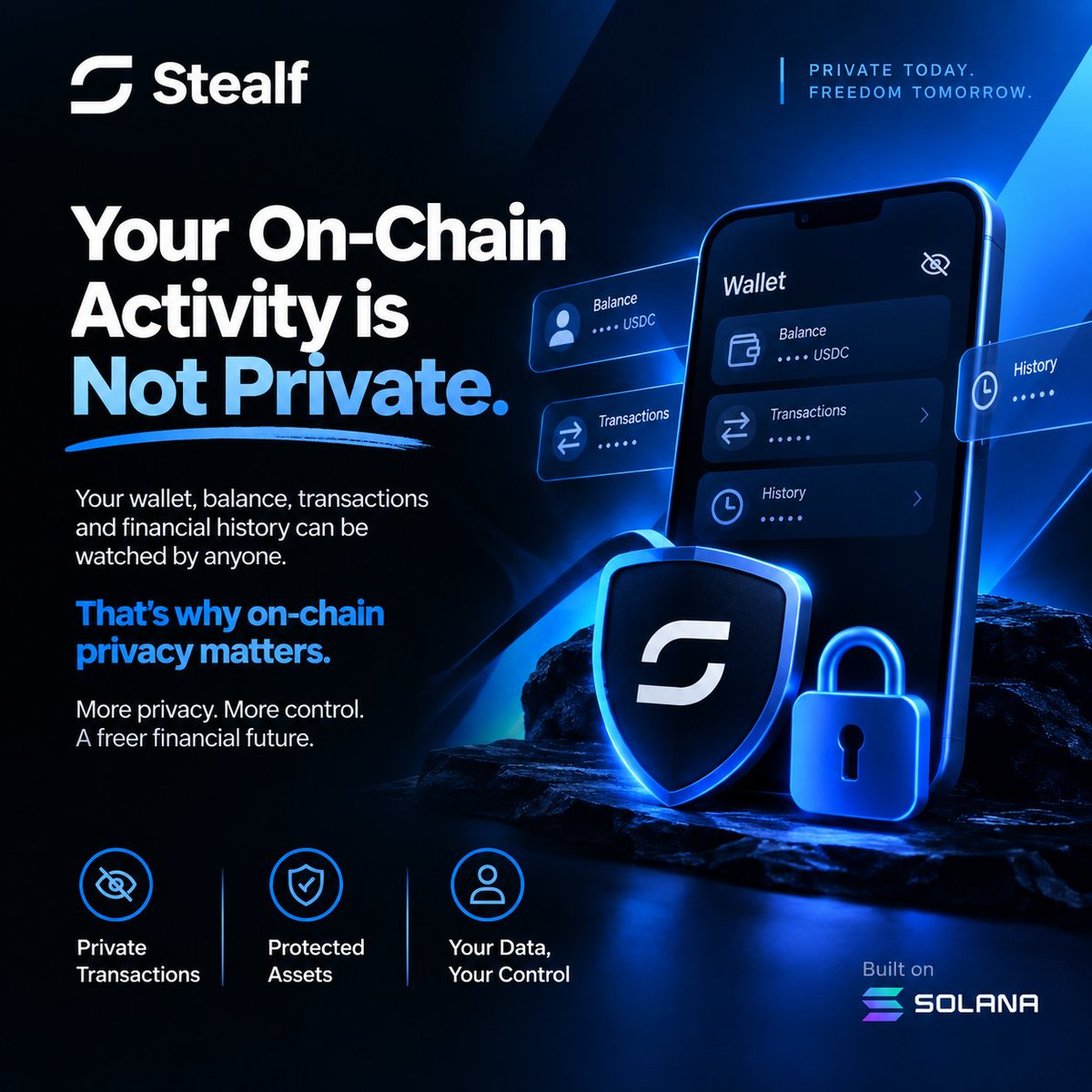
Your wallet is public🥺🙄.
Every balance💰,
transaction♻️,
token transfer📈,
and interaction with a smart contract can be traced on-chain. While transparency is one of blockchain’s greatest strengths, it also means your financial activity can be monitored, analyzed, and linked to your identity.
Privacy isn’t about hiding wrongdoing. It’s about having control over who can access your financial information, how that information is used, and whether your entire financial history becomes permanently searchable. 🔐
That’s why on-chain privacy matters—and why @STEALFxyz , powered by @Arcium , is working toward a more private financial future on Solana.
Arcium’s technology is designed to support confidential computation, allowing data to be processed while keeping sensitive information protected. For applications like Stealf, this could help create a stronger privacy layer for on-chain activity without giving up the speed, composability, and accessibility that make Solana powerful.
The broader vision is important: privacy-preserving infrastructure can make DeFi, payments, trading, and digital ownership safer for everyday users, businesses, and institutions. Instead of exposing every transaction to the entire world, users should have more choice over what they reveal and to whom.
Public blockchains gave us verifiability. Privacy-focused protocols can help give users back financial autonomy.
The future of crypto shouldn’t require choosing between transparency and privacy. With projects like @STEALFxyz and infrastructure from @Arcium , Solana is moving closer to making confidential, user-controlled finance a practical reality.
#Stealf #Arcium #Privacy #Solana #DeFi #Web3
What if every disagreement forced you to buy the most expensive version of justice first?
That is basically how disputes have always felt to me.
The average court case takes 344 days.
But the numbers in this clip from @GenLayer suggest a very different model:
First verdict: about 5 minutes, currently less than $1.
First appeal window: around 30 minutes.
Full appeal path: around 3 hours and roughly $100.
What interests me isn't only that those numbers are smaller.
It's that you don't have to pay the full price of disagreement upfront.
Imagine two agents disagree over a $20 task.
Starting with a sub-$1 verdict makes sense.
Spending roughly $100 to push that same dispute through the full appeal path probably doesn't.
Now change the disputed job to $10,000.
The first step can still be cheap, but suddenly spending more time and money for additional scrutiny can become rational.
That makes the appeal ladder feel less like one court getting progressively slower and more like a way to buy more scrutiny only when the value of the disagreement justifies it.
Small dispute, small first step.
Important dispute, keep climbing if the first answer isn't convincing enough.
That is the number I find most interesting here.
Not 344 days versus 5 minutes by itself.
It's less than $1 versus roughly $100, with a choice in between.
If you lost a $20 dispute on the first verdict, would you spend roughly $100 to keep appealing it?
Reply YES or NO, then tell me what would make you change your answer.
ngl, what caught my attention about $PLAY is how easy it is to understand where the yield starts.
there are real claw machines generating revenue from actual plays.
@DualMintRWA takes that physical activity and connects it to an onchain structure, instead of relying on token emissions to create the yield.
that's what makes the idea interesting to me.
the machine has to actually run, people have to actually use it, and the revenue comes from that activity.
$PLAY is targeting 12–15% annually with monthly distributions, but the target obviously isn't a guarantee.
pre-deposits open september 22.
if you're curious about the campaign too, uptime is where to follow along. also keeping @DualMintRWA and @stardotfun on my radar.